
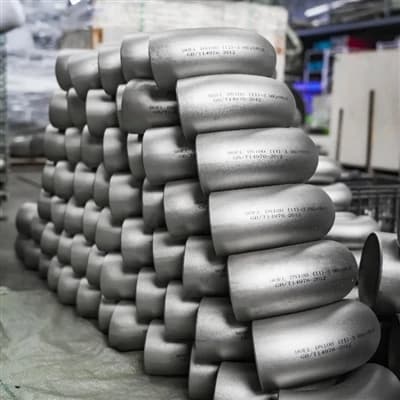
A stainless pipe fitting is fully defined by five fields: type, nominal size, wall schedule, material grade and the governing standard. ASME B16.9 sets the dimensions for factory-made wrought butt-welding fittings, and the material is normally ordered to ASTM A403 for wrought austenitic stainless. Leaving any of the five out is what produces fittings that arrive the right shape and the wrong wall.
Fitting Types and What Each Does
- Elbows change direction. The common angles are 45 degrees, 90 degrees and 180 degrees, in long radius (1.5 x nominal diameter centre-to-face) or short radius (1.0 x nominal diameter). A 316L butt-weld elbow is the usual choice for corrosion service; a 317L elbow is used where higher molybdenum is needed.
- Tees create a branch, either equal or reducing.
- Reducers change diameter. Concentric reducers keep both centre lines on one axis; eccentric reducers keep one side flat so a horizontal line does not trap a pocket. A carbon steel concentric reducer is the same geometry in a different material group.
- Caps and plugs close an end or an opening. A 316L pipe cap to ASME B16.9 is the standard way to terminate a line.
- Couplings and unions join two ends, with unions allowing later disassembly.
- Nipples are short threaded lengths used to connect fittings or extend a run.
- Cross fittings split flow four ways, typically in manifolds and spray systems.
- Stub ends are used with lap joint flanges so a welded line can still be broken at the flange.
Connection Methods Compared
| Connection | How it joins | Where it is usually chosen |
|---|---|---|
| Threaded (NPT / BSP) | Screwed connection | Small diameters, low to medium pressure, disassembly without cutting |
| Socket weld | Pipe inserted in a socket and fillet welded | Small diameters at higher pressure, where a full penetration weld is not required |
| Butt weld | Bevelled ends welded to the pipe | All sizes, critical and high-temperature service, smooth bore |
| Flanged | Bolted flange pair | Larger diameters and lines that must be opened for maintenance |
| Compression / press | Mechanical press fit | Fast installation in water and HVAC systems, subject to the system approval |
Stainless Grades Used for Fittings
| Grade | Key alloying | Where it is selected |
|---|---|---|
| 304 / 304L | 18% Cr, 8% Ni | Food, dairy, general industrial and architectural service |
| 316 / 316L | 16% Cr, 10% Ni, 2-3% Mo | Marine, chemical and pharmaceutical service with chlorides |
| 317L | Higher molybdenum, roughly 3-4% | Acidic service where 316L is not enough |
| 321 | Titanium stabilised | High-temperature service where intergranular corrosion after welding matters |
| 2205 duplex | 22% Cr, 5% Ni, 3% Mo | Higher strength plus chloride stress corrosion cracking resistance |
| 2507 super duplex | 25% Cr, 7% Ni, 4% Mo | Offshore and aggressive chloride service |
Molybdenum is what separates 316L from 304L in chloride service, and it is the usual reason 304L fittings fail early on a coastal or chemical line. Where both strength and chloride resistance are required, S31803 duplex butt-weld fittings are the step up from 316L. Nickel alloys such as Inconel and Hastelloy are separate material families with their own specifications and are not stainless grades.
Weldability is a selection input as much as corrosion is. Low-carbon grades such as 304L and 316L are preferred where the fitting is welded, because they reduce the risk of carbide precipitation in the heat-affected zone.
Standards That Apply
| Standard | Scope |
|---|---|
| ASME B16.9 | Factory-made wrought butt-welding fittings - elbows, tees, reducers, caps |
| ASME B16.11 | Forged fittings, socket weld and threaded, with pressure classes |
| ASTM A403 | Wrought austenitic stainless steel piping fittings |
| ASTM A182 | Forged or rolled alloy and stainless flanges, and forged fittings |
| MSS SP-43 | Wrought stainless steel butt-weld fittings, light wall |
| ISO 4144 | Stainless steel fittings threaded to BSP |
| DIN 2605 / 2615 / 2616 | Wrought steel butt-weld fittings to German practice |
| JIS B2311 / B2312 | Steel butt-weld pipe fittings to Japanese practice |
Dimensions and pressure classes are not the same thing. A class designation such as Class 3000 in ASME B16.11 identifies a pressure class, and the allowable pressure for a fitting comes from the pressure-temperature tables for that material group, not from the class number. Always read the rating against temperature and material group.
Bends Compared with Elbows
| Feature | Pipe bend | Elbow |
|---|---|---|
| How it is made | Formed from a continuous length of pipe | Manufactured as a separate fitting |
| Radius | Custom, commonly 3D, 5D or 10D | Standardised: long radius 1.5D, short radius 1.0D |
| Wall thickness | The outer wall thins during bending | Uniform wall as manufactured |
| Flow | Smoother flow and lower pressure drop on long radii | Higher pressure drop at the sharper turn |
| Typical use | Coils, long-radius runs, pigged lines | General piping where a standard fitting is specified |
The outer wall thinning on a bend is a design input. Where the line is pigged, or where the bend is on a high-pressure or erosive service, the minimum wall after bending has to be stated.
How to Specify a Fitting
- Name the type and the angle or configuration: 90 degree long radius elbow, equal tee, concentric reducer.
- Give the size as NPS and DN, and the schedule or wall thickness - for example NPS 2 Sch 40S.
- Name the grade and the material specification, for example ASTM A403 WP316L.
- Name the dimensional standard, for example ASME B16.9, and the end preparation: bevelled, plain or threaded.
- State any supplementary testing, heat treatment, solution annealing, pickling or passivation required.
- State the certificate scope: material test report, heat number traceability, NDT.
The wider picture - which fitting families each ASME and MSS document covers, and where threaded, socket weld and butt weld families stop - is set out in our guide to pipe fitting types and ASME coverage.
Matching the fitting schedule to the pipe schedule avoids a weld mismatch and a stress step at the joint. Where a full set is being bought together, stainless steel butt-weld fittings and NPS 2 / DN 50 stainless steel pipe fittings are normally ordered as one line against one standard so the dimensions come from the same table.
What to Confirm with Your Inquiry
Send these fields so the quotation covers the fittings you actually need:
- Fitting type, size as NPS and DN, and schedule or wall thickness.
- Material grade and specification, for example ASTM A403 WP316L or WP317L.
- Dimensional standard and pressure class where applicable, with the design temperature.
- End preparation and any bevel angle required by the welding procedure.
- Manufacturing route - seamless or welded - where the service requires one.
- Surface condition: as-formed, pickled, passivated, or mechanically polished.
- Testing and certification: MTR, heat traceability, NDT scope, third-party inspection.
- Quantity per size and type, plus the delivery term.



