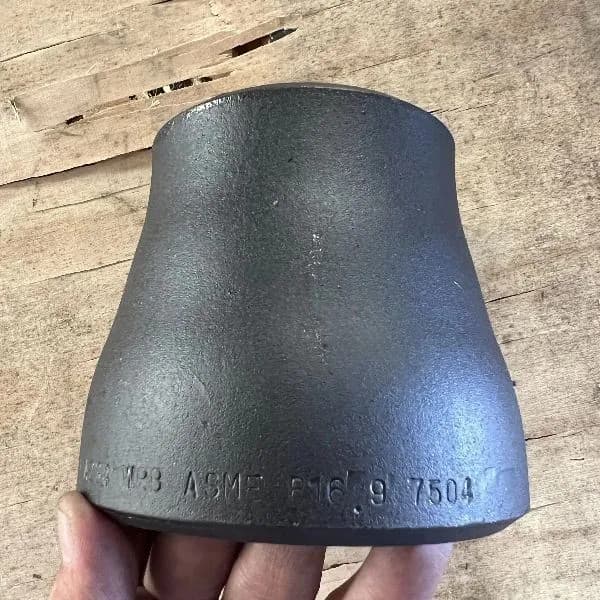
Carbon Steel Concentric Reducer for Butt-Welded Size Transitions
A carbon steel concentric reducer joins two butt-welded pipe runs of different diameters while keeping both centrelines on the same axis. The fitting is symmetric about its axis, so the flow area changes gradually from the large end to the small end instead of stepping. This page covers wrought carbon steel reducers made to ASME B16.9 from ASTM A234/A234M Grade WPB, supplied in seamless or welded construction with beveled ends ready for butt welding.
Reducers are ordered by their two end sizes written large end first, for example 6 x 4 in. (DN150 x DN100). Wall thickness is not an independent fitting property: each end is ordered to the schedule of the pipe it will be welded to, and the finished wall may not fall below 87.5% of that nominal wall at any point.
Concentric or Eccentric: Confirm the Shape Before You Order
Both types are ASME B16.9 reducers, they share the same material specifications and the same end-to-end lengths, and they are easy to confuse on a purchase order. The difference is geometry, and it decides whether a horizontal line drains or vents correctly.
| Factor | Concentric reducer (this page) | Eccentric reducer |
|---|---|---|
| Shape | Symmetric cone, tapered evenly all round | Tapered on one side, flat on the other |
| Centerlines | Large and small ends share one axis | Offset; one edge stays aligned |
| Typical service | Vertical runs, gas and vapour lines, vertical pump discharge, nozzle-to-pipe connections that must stay centered | Horizontal liquid lines, horizontal pump suction (flat side up), pipe racks that need a constant bottom-of-pipe elevation |
| Risk it avoids | Uneven flow distribution at the size change | Air pockets at the top or liquid pooling at the bottom of a horizontal run |
A concentric reducer is the default choice for vertical piping, gas and vapour service and any connection where the two centrelines must stay aligned. If your line is horizontal liquid service, the fitting you need is usually the eccentric type, which is a different product; say so on the enquiry rather than assuming the supplier will substitute. S1 (a UK distributor) markets the same WPB butt-weld package under BS 1640, which is a reminder that the dimensional standard is an order decision: state ASME B16.9 on the enquiry if that is what the piping class calls up.
Chemical Composition and Mechanical Properties of ASTM A234 WPB
The values below are the ASTM A234/A234M requirements for Grade WPB, given as reference limits for the material certificate rather than as a guarantee for any individual fitting; the edition of A234/A234M adopted by the purchase order governs.
| Element | Requirement, % |
|---|---|
| Carbon (C) | 0.30 max |
| Manganese (Mn) | 0.29 - 1.06 |
| Phosphorus (P) | 0.050 max |
| Sulfur (S) | 0.058 max |
| Silicon (Si) | 0.10 min |
| Chromium (Cr) | 0.40 max |
| Molybdenum (Mo) | 0.15 max |
| Nickel (Ni) | 0.40 max |
| Copper (Cu) | 0.40 max |
| Vanadium (V) | 0.08 max |
Standard footnotes that matter when reading a mill certificate: fittings made from bar or plate may carry 0.35% max carbon, and fittings made from forgings may carry 0.35% max carbon and 0.35% max silicon with no minimum; the sum of copper, nickel, chromium and molybdenum shall not exceed 1.00%; and the carbon equivalent, calculated as C + Mn/6 + (Cr + Mo + V)/5 + (Ni + Cu)/15, shall not exceed 0.50 on heat analysis and is reported on the test report.
The mechanical requirements below are the minimum values A234/A234M imposes on WPB fittings in the delivery condition.
| Property | Requirement |
|---|---|
| Tensile strength, min | 415 MPa (60 ksi) |
| Yield strength, min | 240 MPa (35 ksi) |
| Elongation, longitudinal / transverse (standard round specimen) | 22% / 14% min |
| Elongation, longitudinal / transverse (rectangular specimen, wall 7.94 mm and over) | 30% / 20% min |
| Hardness, max | 197 HBW |
WPB is generally applied between -29 °C and 427 °C (-20 °F to 800 °F). Below -29 °C the fitting grade normally changes to ASTM A420 WPL6, which is impact tested at -46 °C, and the piping code together with the design conditions decides what is acceptable; do not treat the temperature span as a fitting rating.
Schedules, Wall Thickness and the Pressure Rating Question
A butt-weld reducer carries no pressure class of its own, and this is the most common ordering mistake on this product family. ASME B16.9 rates the fitting as straight seamless pipe of the equivalent material in the same schedule, and the allowable pressure of the line is then calculated under the applicable ASME B31 piping code. The Class 150 to Class 2500 designations belong to flanges under ASME B16.5, and the Class 3000, 6000 and 9000 designations belong to forged socket-weld and threaded fittings under ASME B16.11; neither set is a reducer rating.
Order the fitting by schedule instead. Carbon steel schedules follow ASME B36.10M (STD, XS, Sch 10, 20, 40, 60, 80, 120, 160, XXS), and each end of a reducer follows the schedule wall of the pipe size it matches, so a 20 x 10 in. STD reducer does not have one uniform wall: the large and small ends take their own schedule wall. The stainless schedule series of ASME B36.19M uses S-suffixed numbers (Sch 10S, 40S, 80S) with different wall thicknesses at the same number, so a schedule written without its suffix is ambiguous on paper even though the carbon steel reading is the usual one.
Heat Treatment and What the Certificate Should Show
A234 does not impose one blanket heat treatment on WPB; the requirement follows the final forming temperature, and this ladder is worth checking against the certificate on critical work.
| Condition at final forming | Heat treatment required |
|---|---|
| Hot formed, finished at 620 - 980 °C (1150 - 1800 °F), cooled in still air | None required |
| Hot formed, finished above 980 °C (1800 °F) | Annealed, normalised, or normalised and tempered |
| Cold formed (final forming below 620 °C / 1150 °F) | Normalised, or stress relieved at 595 - 690 °C (1100 - 1275 °F) |
| Fusion-welded construction, wall 19 mm (3/4 in.) and over at the weld | Post-weld heat treated at 595 - 675 °C (1100 - 1250 °F) |
Start material is killed steel in the form of forgings, bars, plates, sheet or seamless or fusion-welded tubular products, formed by hammering, pressing, piercing, extruding, upsetting, rolling, bending, fusion welding or machining, singly or in combination.
End Preparation, Marking and Receiving Checks
Unless the order says otherwise, butt-weld ends are prepared to ASME B16.25: a 37.5° ± 2.5° bevel with a 1.6 mm (1/16 in.) root face. Each fitting is permanently marked with the manufacturer's name or trademark, the material identification, the schedule number or nominal wall thickness, the NPS size of each end and the standard compliance mark, and a heat number is added for traceability. On receipt, those marks should read back against the purchase order line, because the size and schedule on the fitting are what the welder and the inspector will work to.
Protective finishes such as black primer, rust-inhibiting oil or varnish, or hot-dip galvanising are order options; carbon steel is not a corrosion-resistant material, so the coating belongs to the specification rather than to the fitting itself.
Ordering Information
To price and supply a concentric reducer without back-and-forth, send the following with the enquiry:
- Both end sizes, large end first, in NPS and/or DN (for example 6 x 4 in. / DN150 x DN100)
- Schedule or nominal wall thickness for each end, per ASME B36.10M
- Material grade (ASTM A234 WPB for general service; A420 WPL6 below -29 °C; WP11, WP22 or WP91 for elevated-temperature alloy service)
- Seamless or welded construction
- Dimensional standard and edition (ASME B16.9 unless the piping class calls up another standard)
- End preparation, coating and any special tolerances
- Quantity, delivery condition and certificate requirements (for example EN 10204 3.1), plus any third-party inspection scope
For related ranges, see the carbon steel pipe fittings category, the ASTM A53 90° long radius elbow for direction changes, API 5L grade pipe fittings for line-pipe systems, forged pipe fittings for the socket-weld and threaded route, and carbon steel line pipe when the pipe itself is still to be ordered.
Common Questions about Carbon Steel Concentric Reducers
Can I order a Class 150 or Class 900 concentric reducer?
No. A Class number is not a rating that an ASME B16.9 butt-weld fitting carries. Classes 150 to 2500 belong to flanges under ASME B16.5 and Classes 3000, 6000 and 9000 to forged socket-weld and threaded fittings under ASME B16.11. A B16.9 reducer is rated as straight seamless pipe of the same material and schedule, so the schedule - not a class - is what you order, and the line's allowable pressure is calculated under the applicable ASME B31 code.
What is the difference between a concentric and an eccentric reducer?
Both are B16.9 reducers with the same material specification and the same end-to-end lengths. A concentric reducer tapers evenly and keeps both pipe centrelines on one axis, which suits vertical runs, gas and vapour service and centered nozzle connections. An eccentric reducer has one flat side, which is what a horizontal liquid line usually needs: flat side down to stop liquid pooling, flat side up on a pump suction to stop vapour collecting at the inlet. They are different fittings, so name the type on the enquiry.
Why does the order say ASTM A234 WPB instead of ASTM A105?
A105 is a forging specification used for flanges under ASME B16.5 and for forged socket-weld and threaded fittings under ASME B16.11. It is not one of the material specifications that ASME B16.9 lists for butt-weld fittings; the carbon steel grade for this product is ASTM A234 Grade WPB. Earlier versions of this page listed A105 alongside WPB, which mixed the flange and fitting material routes, and the listing has been corrected.
How do I write the size on an enquiry?
Large end first, then the small end, with the schedule for each end: for example "concentric reducer 6 x 4 in., Sch 40, ASTM A234 WPB, ASME B16.9". Reducer end-to-end length depends only on the large end, so a 6 x 4 in. and a 6 x 3 in. reducer share the same overall length of 140 mm (5.5 in.).
What length is a standard B16.9 reducer?
The end-to-end length is tabulated in B16.9 by large end: 38 mm (1.5 in.) for a 3/4 in. large end, 76 mm (3 in.) at 2 in., 140 mm (5.5 in.) at 6 in., 152 mm (6 in.) at 8 in., 203 mm (8 in.) at 12 in. and 508 mm (20 in.) at 20 in. and 24 in. These are the ASME B16.9 table values. The edition named on the order is the contract figure.
Does every fitting need heat treatment?
Not necessarily. Hot-formed WPB finished between 620 °C and 980 °C (1150 - 1800 °F) and cooled in still air needs no heat treatment; finish above 980 °C and the fitting must be annealed, normalised or normalised and tempered; cold-formed fittings are normalised or stress relieved; and fusion-welded fittings with 19 mm (3/4 in.) wall and over at the weld are post-weld heat treated. Check the ladder against the certificate when the order is critical.