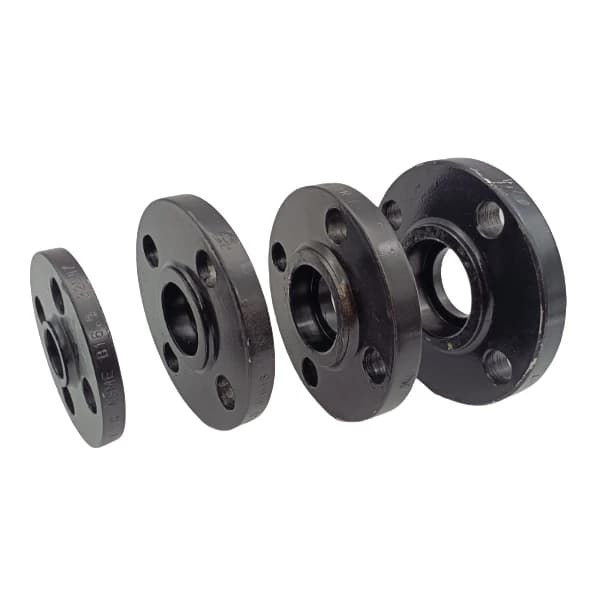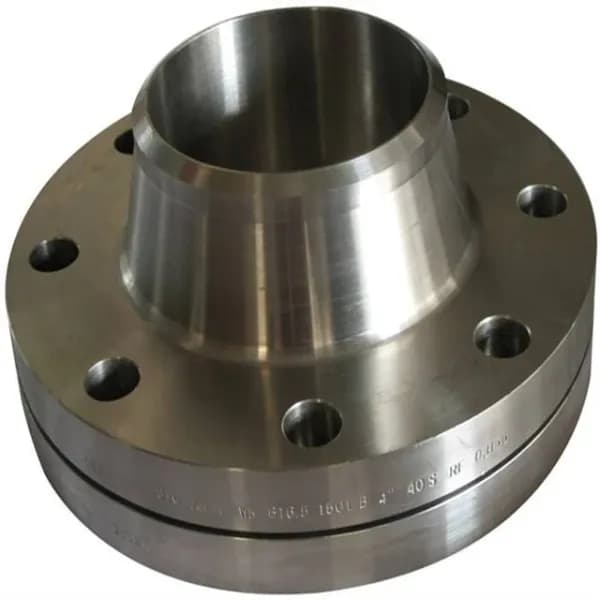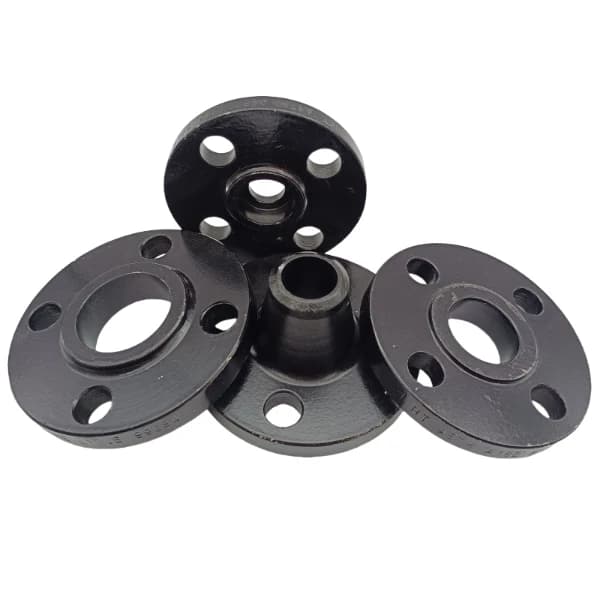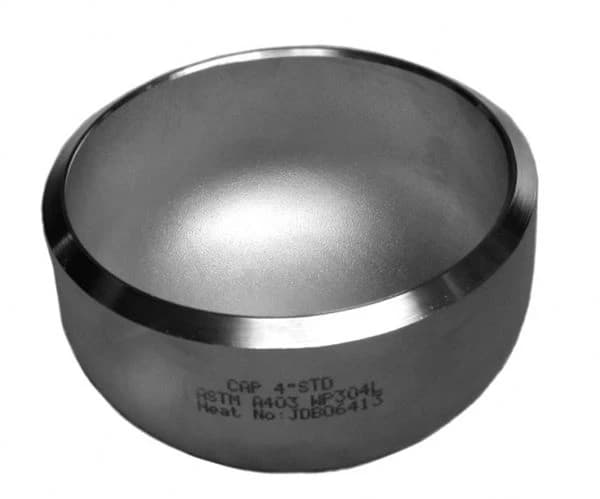
316L stainless steel pipe caps are ellipsoidal closure fittings welded onto the open end of a pipe to terminate a line. This page covers butt-weld (BW) caps in grade 316L / UNS S31603: dimensions and tolerances to ASME B16.9, material to ASTM A403 WP316L, with the wall thickness matched to the connecting pipe. Forged threaded and socket-weld caps (ASME B16.11 / ASTM A182 F316L) look similar and are often mixed up with butt-weld caps in enquiries, so this page also sets out where the two families differ and how to order each one.
Because 316L carries a controlled carbon content of 0.030% maximum and 2.00–3.00% molybdenum, a welded 316L cap keeps its corrosion resistance in the as-welded condition without post-weld heat treatment, and resists chloride pitting and crevice attack clearly better than 304L. That combination is why 316L caps are standard closing fittings in chemical, petrochemical, marine, pharmaceutical and water-treatment piping.
Butt-Weld Cap, Forged Cap, Plug or Blind Flange?
Before fixing dimensions, confirm which closure family the enquiry actually needs — the four parts below are frequently interchanged, but they attach to the piping in different ways and are governed by different standards.
| Component | How it attaches | Governing standard | Typical use |
|---|---|---|---|
| Butt-weld cap | Welded to the pipe end (bevel per ASME B16.25) | ASME B16.9; material ASTM A403 | Permanent closure of pipe ends, NPS 1/2–48 |
| Forged cap (SW / threaded) | Socket weld or NPT thread onto small-bore pipe | ASME B16.11; material ASTM A182 | Small-bore closures, NPS 1/8–4, Class 3000/6000 (SW also 9000) |
| Pipe plug | Threads into the bore of a fitting or pipe | ASME B16.11 / B16.14 | Closing female-threaded openings |
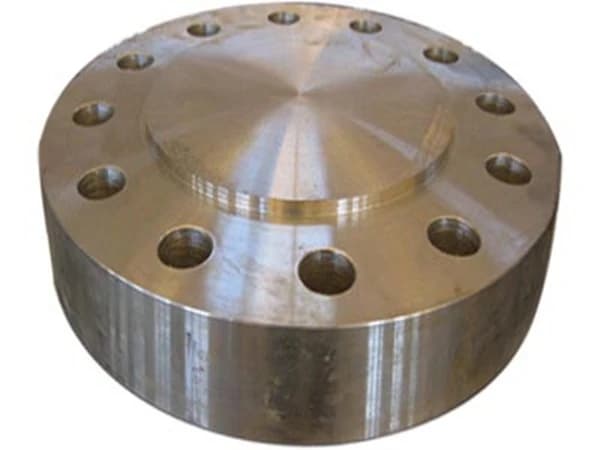
| Blind flange | Bolted to a flanged face with a gasket | ASME B16.5 | Demountable closure where future re-access is planned |
A cap slips over the outside of the pipe end, a plug goes inside the bore, and a blind flange is the bolted alternative used wherever the line will be opened again. If the closure must be removable, specify a blind flange; a welded cap is the compact, gasket-free choice for permanent dead ends. NPT threads on forged caps are cut to ASME B1.20.1.
ASME B16.9 Cap Dimensions and Tolerances
The table below reproduces the ASME B16.9 cap dimensions for the most commonly ordered sizes; the cap shape is ellipsoidal and shall conform to the shape requirements of the ASME Boiler and Pressure Vessel Code.
| NPS | OD at bevel D (mm) | Length E (mm) | Limiting wall for E (mm) | Length E1 (mm) |
|---|---|---|---|---|
| 1/2 | 21.3 | 25 | 4.57 | 25 |
| 3/4 | 26.7 | 25 | 3.81 | 25 |
| 1 | 33.4 | 38 | 4.57 | 38 |
| 1 1/2 | 48.3 | 38 | 5.08 | 38 |
| 2 | 60.3 | 38 | 5.59 | 44 |
| 3 | 88.9 | 51 | 7.62 | 64 |
| 4 | 114.3 | 64 | 8.64 | 76 |
| 6 | 168.3 | 89 | 10.92 | 102 |
| 8 | 219.1 | 102 | 12.70 | 127 |
| 12 | 323.8 | 152 | 12.70 | 178 |
| 16 | 406.4 | 178 | 12.70 | 203 |
| 24 | 610 | 267 | 12.70 | 305 |
| 36 | 914 | 267 | – | by agreement |
| 48 | 1219 | 343 | – | by agreement |
Length E applies when the wall thickness does not exceed the limiting value listed for the size; heavier-wall caps take length E1 (for NPS 24 and smaller). For NPS 26 and larger, length E1 is a matter of agreement between manufacturer and purchaser. Key tolerances: outside diameter at the bevel +1.6/−0.8 mm for NPS 1/2–2 1/2, ±1.6 mm for NPS 3–3 1/2, +4/−3.2 mm for NPS 10–18 and +6.4/−4.8 mm for NPS 20–30; inside diameter at end ±0.8 to ±4.8 mm by size; overall length ±3 mm (NPS 1/2–4), ±6 mm (NPS 10–24) and ±10 mm (NPS 26–30); and the wall at the bevel may not be thinner than 87.5% of the nominal wall. ASME B16.9 does not require hydrostatic testing of individual fittings, but every fitting must be capable of withstanding the hydrostatic test pressure that the applicable piping code would apply to equivalent seamless pipe of the marked size and wall.
Chemical Composition and Mechanical Properties of WP316L
The composition and strength values below are the specified limits for the two 316L fitting materials — A403 WP316L for butt-weld fittings and A182 F316L for forged fittings — and both are acceptance minima, not typical test results.
| Element (wt%) | ASTM A403 WP316L | ASTM A182 F316L |
|---|---|---|
| Carbon, C | 0.030 max | 0.030 max |
| Manganese, Mn | 2.00 max | 2.00 max |
| Phosphorus, P | 0.045 max | 0.045 max |
| Sulfur, S | 0.030 max | 0.030 max |
| Silicon, Si | 1.00 max | 1.00 max |
| Chromium, Cr | 16.0–18.0 | 16.0–18.0 |
| Nickel, Ni | 10.0–14.0 | 10.0–14.0 |
| Molybdenum, Mo | 2.00–3.00 | 2.00–3.00 |
| Nitrogen, N | 0.10 max | 0.10 max |
| Property (room temperature, min) | ASTM A403 WP316L | ASTM A182 F316L |
|---|---|---|
| Tensile strength | 485 MPa (70 ksi) | 485 MPa (70 ksi); 450 MPa (65 ksi) for sections over 5 in. [130 mm] |
| Yield strength (0.2% offset) | 170 MPa (25 ksi) | 170 MPa (25 ksi) |
| Elongation | 28% longitudinal / 20% transverse (4D) | 30% in 2 in. [50 mm] or 4D |
| Delivery condition | Solution annealed, rapid cool | Solution annealed (1040 °C min), rapid cool |
Neither ASTM A403 nor ASTM A182 sets a hardness band for the austenitic fitting grades, so hardness is reported on the mill certificate rather than accepted against a limit. The 1040–1150 °C range with rapid cooling is mill practice for solution annealing, not the standard minimum. The delivery-condition minimum on this page remains 1040 °C. Treat the certificate and the governing specification revision as the acceptance basis, not any single published furnace number. The equivalent designations for the grade are UNS S31603, W.Nr. 1.4404 / X2CrNiMo17-12-2, JIS SUS316L and GB 022Cr17Ni12Mo2; note that the EN 10088-1 chemistry variant (Ni 10.0–13.0, Mo 2.0–2.5%) differs from the ASTM ranges and the two are not interchangeable on paper.
WP316L vs CR316L: the Rating Depends on the Dimensional Standard
A “316L cap” can be bought against two different delivery systems, and confusing them is the single most common specification error on this product family.
| Feature | WP316L (pressure fittings) | CR316L (light-wall fittings) |
|---|---|---|
| Dimensional standard | ASME B16.9 | MSS SP-43 |
| Wall / schedule | Any producible wall, matched to pipe (Sch 5S–XXS) | Schedule 5S and 10S only |
| Size range | NPS 1/2–48 | NPS 1/2–24 |
| Pressure basis | Rated as the matching seamless pipe per the ASME B31 code | Only 30% of the allowable pressure of comparable straight seamless pipe |
| NDE classes | WP-S / WP-W / WP-WX / WP-WU radiography or UT classes | No NDE classes |
| Marking | Grade + class + schedule + size per MSS SP-25 | “CR” + material symbol + schedule + size |
ASME B16.9 deliberately excludes low-pressure corrosion-resistant butt-welding fittings from its scope and points them to MSS SP-43. A CR316L cap made to SP-43 is a genuine product for utility and low-pressure lines in Sch 5S/10S pipe, but it is not an equivalent substitute for a Sch 40S pressure cap — its pressure capability is defined at 30% of the matching pipe. When the line is a pressure system, order the WP316L cap with the schedule stated on the purchase order, and where radiography of welds matters, name the A403 class (WP-S seamless, WP-W welded with examined starting-material welds, WP-WX/WU fully examined) explicitly.
Size Range, Wall Thickness and How to Order
Order a butt-weld cap with four data items: NPS, wall (schedule or nominal wall), material grade with the A403 class, and end preparation. A complete line reads, for example: Cap NPS 6, Sch 40S, ASTM A403 WP316L-WX, bevel per ASME B16.25. Because B16.9 fittings have no pressure class of their own, the schedule is what fixes the rating — a cap ordered without wall thickness cannot be quoted correctly.
Two corrections to information circulating on supplier listings: first, ASME B16.9 covers caps from NPS 1/2 through NPS 48 (DN 15–1200); listings advertising “1/2 in.–60 in.” standard caps exceed the standard’s scope, and caps above NPS 48 (such as 60 in.) are non-standard items made to drawing by agreement. Second, older references to ASME B16.28 are outdated — that standard was withdrawn and its short-radius elbows and returns were absorbed into B16.9, so B16.9 is now the single dimensional standard for this family. The wall thickness of the cap is matched to the connecting pipe; schedules from 5S through XXS are produced, but the schedule belongs to the pipe specification, not to the cap as an independent pressure rating. For European orders, the corresponding delivery standard is EN 10253-4:2025 (Type A fittings with a reduced pressure factor versus Type B fittings usable at full service pressure), and Chinese-standard orders follow GB/T 12459 / GB/T 13401 for the same DN 15–1200 span.
Corrosion Performance and Temperature Limits
The 2.00–3.00% molybdenum addition is what separates 316L from 304L in service: it raises the pitting-resistance equivalent — PREN = %Cr + 3.3 × %Mo + 16 × %N — to 22.6–29.5, calculated from the chromium, molybdenum and nitrogen limits in the table above with nitrogen at its 0.10 maximum, against the high teens for a molybdenum-free grade. PREN is a comparison index only, not an acceptance criterion, and no absolute corrosion rate or service life is published here; resistance must be judged against the actual medium, chloride level and temperature. The 0.030% carbon ceiling is the welding-side advantage: a welded 316L cap does not sensitize in normal shop fabrication, so no post-weld heat treatment is needed to restore intergranular corrosion resistance (where a project requires it, intergranular testing is performed to ASTM A262 at the practice stated on the order).
On temperature: ASME BPVC Section II-D tabulates allowable stresses for S31603 up to 816 °C (1500 °F), but the allowable value falls steeply as temperature rises, and the cap’s pressure design must follow the allowable stress of the matching pipe through the governing ASME B31 code at the design temperature. Do not treat any single published temperature figure as a service guarantee for the closure; 316L is selected for weldability and corrosion performance rather than for creep strength, and sustained high-temperature design values should be taken from the current ASME II-D tables for the specific design conditions.
Common Questions about 316L Stainless Steel Pipe Caps
Is this cap butt-weld or threaded?
This page covers butt-weld (BW) caps to ASME B16.9 in NPS 1/2–48. Forged caps with female NPT threads or socket-weld ends are a different family: ASME B16.11 dimensions, ASTM A182 F316L material, Class 3000/6000 for threaded caps and up to Class 9000 for socket-weld caps, in NPS 1/8–4 only. State the connection type explicitly on the purchase order — both products appear under the same “316L cap” name in the market.
Why do some listings advertise 1/2–60 in. caps?
ASME B16.9 covers caps through NPS 48 only. Sizes above NPS 48, including 60 in., fall outside the standard; they are fabricated to drawing by agreement rather than supplied as standard B16.9 caps, so a 60 in. closure needs a fabricated-cap enquiry with a drawing, not a catalogue order.
What schedule should I order for the cap?
The cap takes the wall of the connecting pipe. Order NPS + schedule (or nominal wall) + grade; a B16.9 cap has no pressure class of its own. The minimum wall at the bevel is 87.5% of nominal, and heavier-wall caps may take a longer body (length E1) than the standard-length dimension.
What is the difference between WP316L and CR316L caps?
WP316L is the pressure-fitting grade to ASME B16.9; CR316L is the light-wall corrosion-resistant grade to MSS SP-43, made for Sch 5S/10S pipe only, in NPS 1/2–24, with a pressure capability of 30% of the comparable pipe and no NDE classes. A CR-marked cap is not a substitute for a Sch 40S pressure cap.
Do 316L caps need heat treatment or post-weld treatment?
ASTM A403 WP fittings are furnished in the solution-annealed condition with rapid cooling. In fabrication, the 0.030% carbon limit means an as-welded 316L cap normally needs no post-weld heat treatment to retain its corrosion resistance.
Cap, plug or blind flange — which one closes my line?
A cap welds or threads over the outside of the pipe end; a plug screws into the bore of a fitting; a blind flange bolts to a flange when the closure must be opened again. Use a blind flange where future access matters, and a welded cap for permanent terminations.
Related 316L and Stainless Steel Products
For the mating line components, see our 316L stainless steel welded and seamless elbows and the family overview of stainless steel butt-weld fittings. The material itself is covered on the 316L stainless steel pipe page (matching A312 TP316L pipe), and small-bore assembly options are compared on the 2 inch stainless steel pipe fittings page. The full fittings range is listed under stainless steel pipe fittings.