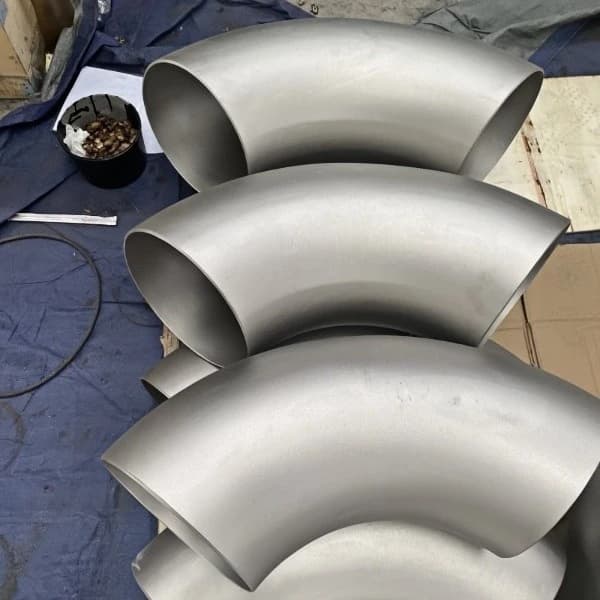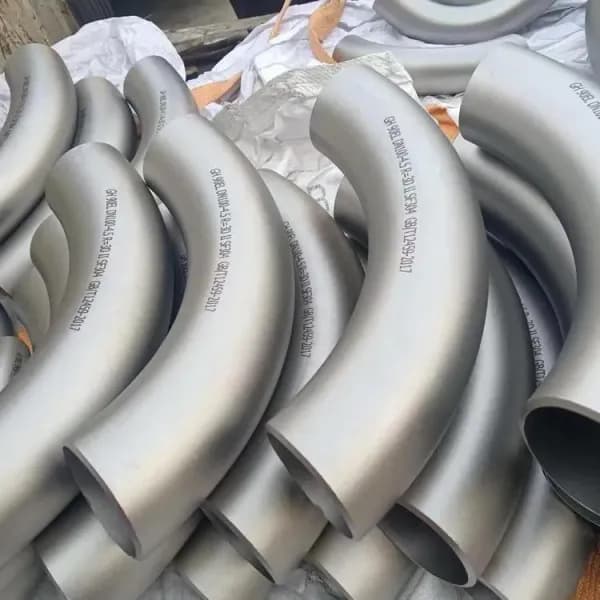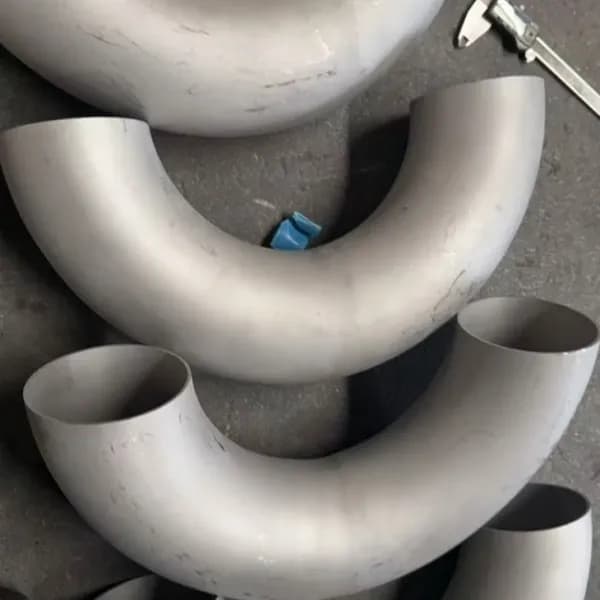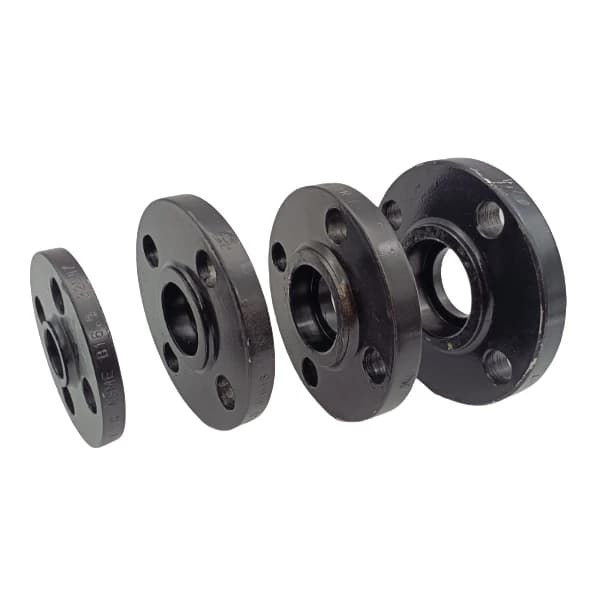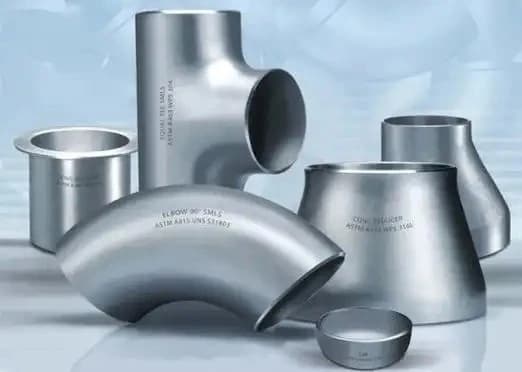
Stainless steel butt-weld fittings join pipe with a full-penetration weld at a beveled end, so the fitting becomes part of the pressure boundary rather than a mechanical joint. This range covers the shapes used to turn, branch, reduce and close a stainless line: 45° and 90° elbows, 180° returns, equal and reducing tees, concentric and eccentric reducers, caps and lap-joint stub ends, in the austenitic grades from 304/304L through to 347H.
Two documents decide what is actually delivered, and they do different jobs. The dimensional standard fixes centre-to-end, outside diameter, wall and end preparation. The material standard fixes the grade, the heat treatment and the examinations. A purchase line that names only one of them leaves the other to the supplier, which is how a light-wall fitting ends up on a standard-wall line. The sections below keep the two apart; the Stainless Steel Pipe Fittings range lists the fitting types supplied alongside this page.
Fitting Types and the Standard That Governs Them
The table below lists the shapes in this range and which dimensional standard tabulates each one. Sizes and wall thickness are confirmed per order against the standard you name, because the same shape can be made to either standard with a different wall.
| Fitting | Configuration | ASME B16.9 (standard wall) | MSS SP-43 (light wall) |
|---|---|---|---|
| 90° elbow | Long radius, R = 1.5 D | Yes | Yes |
| 45° elbow | Long radius | Yes | Yes |
| 180° return | Long radius | Yes | Yes |
| 90° elbow | Short radius, R = 1.0 D | Yes — moved into B16.9 from the withdrawn B16.28 | Not tabulated |
| 180° return | Short radius | Yes — moved into B16.9 from the withdrawn B16.28 | Not tabulated |
| Tee | Equal / straight | Yes | Yes |
| Tee | Reducing (run × outlet) | Yes | Yes |
| Reducer | Concentric | Yes | Yes |
| Reducer | Eccentric | Yes | Yes |
| Cap | — | Yes | Yes |
| Lap-joint stub end | Long pattern | Yes | Yes (Schedule 5S / 10S) |
| Lap-joint stub end | Short pattern | Yes | Yes (Schedule 40S only) |
| Cross, lateral, wye | — | Not tabulated — quoted to drawing | Not tabulated |
Both standards cover the same long-radius geometry, and both are dimensional and rating documents: neither names a grade. Radius convention is fixed industry-wide — long radius is 1.5 times the nominal pipe size, short radius is 1.0 times. A cross, a lateral or a wye is outside the tabulated type list of both standards, so quote those from a drawing rather than from a size table.
Stainless Steel Grades and Material Standards
The table below routes each alloy family and product form to the material standard that governs it, and gives the designations you should expect to see on the mill certificate. The chemistry and mechanical limits of a specific grade stay in the named standard and on its certificate; they are not reproduced here.
| Product form | Material standard | Designations in common use | What decides the choice |
|---|---|---|---|
| Austenitic stainless, seamless or welded | ASTM A403 / A403M (ASME SA403) | WP304, WP304L, WP304H, WP304N, WP316, WP316L, WP316H, WP317L, WP321, WP321H, WP347, WP347H, WP310S, WP904L | Default family for process, power and utility piping; highest choice of grades and classes |
| Austenitic stainless, light wall to MSS SP-43 | ASTM A403 / A403M, CR grades | CR304, CR304L, CR316, CR316L, CR317L, CR321, CR347 | Low-pressure, corrosion-resistant lines where Schedule 5S or 10S wall is sufficient; no NDE class applies |
| Austenitic stainless, as-welded light wall | ASTM A774 / A774M | Five grades, outside diameter 3–48 in. (75–1225 mm), wall 0.062–0.500 in. (1.6–12.7 mm) | Low-pressure service at low to moderate temperature; supplied as welded, not solution annealed after forming |
| Duplex and super duplex | ASTM A815 / A815M | WP S31803, WP S32205, WP S32750, WP S32760 | Higher strength and chloride resistance — see the S31803 duplex pipe fittings page |
| Nickel alloy | ASTM B366 | Direct UNS designations, for example N10276 or N06625 | Corrosive service beyond stainless; a separate material family, not an extension of this grade list |
| Cast austenitic | ASTM A351 / A351M | — | A403 and A774 do not cover cast fittings, so a cast part cannot be certified against either |
MSS SP-75 does not belong on this page. It is a high-strength butt-welding fittings standard for carbon and low-alloy steel (A860 WPHY grades) in high-pressure oil and gas transmission lines, and it references ASME B16.9 dimensions only up to NPS 14. On a stainless butt-weld fitting the MSS designation that applies is SP-43. A774 is also worth separating from A403 at the quotation stage: a fitting supplied as-welded to A774 has not had the post-forming solution anneal of an A403 fitting, and the standard itself directs buyers who need heat treatment or a full pressure rating to A403/A403M.
Fabrication Classes and Non-Destructive Examination
For the A403 austenitic grades, the class letter is what tells you whether the fitting is seamless and how its welds were examined. The table below sets out the class system as it is written into the standard; the class must be stated on the order, because the same grade is supplied in all four of the WP classes.
| Class | Construction | Non-destructive examination | Marking example |
|---|---|---|---|
| S | Seamless | None | WP316L-S |
| W | Welded | Radiography or ultrasonic examination of welds made with filler metal | WP316L-W |
| WX | Welded | Radiography of all welds, with or without filler metal | WP316L-WX |
| WU | Welded | Ultrasonic examination of all welds, with or without filler metal | WP316L-WU |
| CR | Welded or fabricated, light wall | Not required (MSS SP-43) | CR316L |
Two marking rules follow from this and are worth checking on the delivered goods. Marking must carry the manufacturer, the grade and class index, and the heat number, so a certificate without the class letter is incomplete. Multi-grade marking is permitted where both grades' requirements are met, which is why dual-certified WP304/304L and WP316/316L fittings are normal rather than a compromise. Grades 321, 321H, 347, 347H and 348 may in addition be given a stabilisation treatment (815–870 °C) after the high-temperature solution anneal when the order asks for it — a point that matters where intergranular corrosion resistance is the selection driver.
Standard Wall (ASME B16.9) or Light Wall (MSS SP-43)
This is the decision that catches the most purchase orders, because the two standards share their geometry but not their wall. The table below compares them on the points that change the quotation.
| Parameter | ASME B16.9 | MSS SP-43 |
|---|---|---|
| Size range | NPS 1/2 through NPS 48 (DN 15–1200) | NPS 1/2 through NPS 24 (DN 15–600) |
| Wall | Any producible wall thickness, matched to the ordered pipe schedule | Schedule 5S and Schedule 10S; Schedule 40S only for short-pattern stub ends |
| Fitting types | All the tabulated types, including short-radius elbows and returns | Long radius only; short-radius elbows and returns are not tabulated |
| Material standards | Wrought materials generally, including A403, A815, A234 and A860 | Corrosion-resistant materials: A403, A815 and B366 |
| Pressure basis | Rated with the matching pipe schedule under the governing piping code | No published pressure-temperature rating of its own; the matching pipe and the piping code govern the allowable pressure |
| Usual service | Process, power and petrochemical piping at normal design pressure | Low-pressure corrosion-resistant lines: food, dairy, pharmaceutical, clean utilities, water treatment |
Identical centre-to-end dimensions do not make the two interchangeable. An SP-43 fitting has the thinner Schedule 5S or 10S wall, so applying an ASME B16.9 pressure rating to it because the geometry matches would overstate the line. ASME B16.9 states the same boundary from its side by excluding low-pressure corrosion-resistant butt-welding fittings from its scope and pointing them to MSS SP-43.
Ends, Welding and Code Basis
Butt-weld end preparation follows ASME B16.25, and the geometry is set by wall thickness. A square end or slightly chamfered end is used up to 3 mm wall; above 3 mm and up to 22 mm a single bevel of 37.5° ±2.5° with a 1.6 mm root face is standard; above 22 mm the end is given a compound bevel so that the groove does not become too wide. Where the fitting wall and the pipe wall differ, the joint needs a tapered transition — the internal offset is tapered at 1:4 or flatter and the external at 1:3 or steeper, which is why the mating pipe schedule and inside diameter belong on the purchase line even when the size is already fixed. Tolerances and the tables themselves sit in the standard, so the edition that applies is confirmed when the order is placed.
Fillet-welded joints are a different product family, and the piping code treats them differently. Socket-weld and threaded fittings to ASME B16.11, and outlet-weld or weld-to-thread adapters, are selected on the joint rather than on the wall and are listed separately under forged pipe fittings: ASME B31.3 advises against socket-welded joints where crevice corrosion or severe erosion may occur, and does not permit socket welds larger than DN 50 (NPS 2) under severe cyclic conditions. A butt weld is a full-penetration joint that can be radiographed or ultrasonically examined; a fillet weld cannot be radiographed. That difference, rather than price, is normally what decides the joint type on a stainless line.
Allowable pressure and temperature are design results, not catalogue figures. They come from the wall thickness, the allowable stress of the grade at the design temperature and the weld joint quality factor defined in the governing code — ASME B31.3 for process piping, ASME B31.1 for power piping, or the equivalent national code. This page therefore publishes no working-pressure table; the design pressure, design temperature and code section are confirmed against the order.
Metric and Other Regional Standards
Butt-weld fittings are also specified to metric and regional standards, and the current editions are not the ones most often quoted. The table below lists the equivalents that come up in enquiries, with the edition that applies today.
| Region | Standard | Points to confirm on the order |
|---|---|---|
| Europe | EN 10253-3 and EN 10253-4 | Part 4 adds specific inspection requirements; Type A has a reduced pressure factor and Type B is for full service pressure. EN 10253-4:2025 is the current edition |
| Germany | DIN 2605, 2615, 2616, 2617 | These former national fitting standards have been replaced by the EN 10253 series, so a drawing that still cites them needs a stated replacement |
| Japan | JIS B 2311, B 2312, B 2313 | B 2312 is the steel butt-welding fitting standard and B 2313 the plate-made version; stainless grades are SUS304L, SUS316L, SUS321, SUS347 and similar. JIS and ASTM specifications are not identical, so name the governing standard rather than swapping one for the other |
| China | GB/T 12459-2025 with GB/T 13401-2025 | The 2025 editions replaced the 2017 editions with effect from 1 May 2026 — types and parameters in one document, technical specification in the other. Scope runs DN 8 to DN 3400 |
| International | ISO 5251 (stainless), ISO 3419 (non-alloy and alloy steel) | JIS B 2312 is aligned with both as a modified (MOD) correspondence, which is why the grade tables cross-reference but do not match line for line |
Applications
These fittings appear wherever a stainless line has to change direction or branch under process conditions, including:
- Chemical and petrochemical process piping carrying acids, solvents and other corrosive fluids at moderate pressure.
- Oil and gas gathering, produced water and utility lines in stainless construction.
- Power generation auxiliary systems: cooling water, condensate and demineralised water.
- Food, dairy and beverage lines where light-wall Schedule 5S or 10S fittings are accepted by the governing code.
- Pharmaceutical clean utilities: purified water, water for injection and clean steam.
- Desalination and water treatment plants, where chloride-bearing water drives the grade choice.
- Pulp and paper process lines.
Grade and wall selection stay with the owner's engineering decision. The list above shows where these fittings are normally used; it is not a statement that any particular grade is suitable for a particular service, and corrosive conditions can restrict the use of a grade even inside its own standard.
Ordering Information
Include the following on the enquiry or purchase order so that the quotation can be built on the correct standard:
- Fitting type and configuration, for example 90° long-radius elbow or eccentric reducer.
- Nominal size (NPS or DN) and quantity.
- Wall: the mating pipe schedule, or outside diameter and wall thickness in millimetres.
- Dimensional standard and edition: ASME B16.9-2024 or MSS SP-43, or the EN, JIS or GB equivalent.
- Grade and fabrication class, for example WP316L-S, so that the seamless or welded construction and the examination level are fixed before manufacture.
- Heat treatment requirement, including stabilisation for 321, 347 and 348 grades where intergranular corrosion resistance matters.
- End preparation, plus the mating pipe inside diameter or wall where the two differ and a transition is needed.
- Inspection and documentation: mill test certificate to EN 10204 3.1, radiographic or ultrasonic examination, positive material identification, intergranular corrosion test or third-party inspection, as required.
- Marking, packing and any restriction on the length of the fabricated assemblies.
Where a standard or grade is not yet fixed, say which piping code governs the line and what the design pressure and temperature are; the quotation will then be built against the standard that fits the service rather than against a wall thickness alone. More stainless shapes are listed on the Stainless Steel Pipe Fittings page, within the wider Pipe Fittings range, with grade-specific pages for 316L elbows, 317L elbows and 316L caps.
Common Questions about Stainless Steel Butt-Weld Fittings
These are the questions that decide whether a quotation matches the line. The answers follow the standards named above.
How should I specify a stainless steel butt-weld fitting on a purchase order?
Name five things: the fitting type and radius, the nominal size, the wall, the dimensional standard, and the grade with its class. An order that reads "90° elbow, 6 in., 316L" is incomplete in three places — the wall, the standard and the class. Written fully it becomes, for example, "90° long-radius elbow, NPS 6, Schedule 40S, ASTM A403 WP316L Class S, end preparation to ASME B16.25". Add the examination and documentation requirements after that, and the quotation is comparable between suppliers.
What is the difference between ASME B16.9 and MSS SP-43 fittings?
Wall, size range and pressure basis. ASME B16.9 runs from NPS 1/2 to NPS 48 in any producible wall and includes short-radius elbows and returns; MSS SP-43 is the light-wall standard for Schedule 5S and 10S fittings from NPS 1/2 to NPS 24, long radius only, for low-pressure corrosion-resistant service. The centre-to-end dimensions are the same, which is exactly why the two are confused: an SP-43 fitting on a line rated to a B16.9 fitting of the same size will be the thinner part.
Is ASME B16.28 still current?
No. ASME B16.28-1994 covered short-radius elbows and returns, and that content was folded into ASME B16.9, whose current edition is B16.9-2024. A quotation or certificate that names B16.28 as the governing standard is citing a document that is no longer the reference. Ask for the short-radius item to be certified to ASME B16.9 instead.
Which grade and fabrication class should I order?
For most process and utility service, dual-certified 316/316L covers a wider range of media than 304/304L, and the low-carbon side of the pair is what holds up after welding. Stabilised grades such as 321 and 347H are chosen where service temperature makes intergranular corrosion the main concern. On class, seamless (S) removes the longitudinal weld entirely; welded W, WX and WU are acceptable where the specification allows them and the required examination is defined. If light-wall SP-43 fittings are used, the CR designation applies and no NDE class is claimed.
What end preparation is supplied, and will it match my pipe?
Ends follow ASME B16.25: square cut up to 3 mm wall, a 37.5° ±2.5° single bevel with a 1.6 mm root face from above 3 mm to 22 mm, and a compound bevel above 22 mm. A butt weld needs the bevel, the root face and the inside diameter to line up with the mating pipe, so give the pipe schedule as well as the size. Where the fitting wall and the pipe wall differ, the transition is tapered rather than left as a step.
The earlier specification sheet listed 1/2 in. to 60 in. Does that apply to these fittings?
Not to a stainless butt-weld fitting made to ASME B16.9 or MSS SP-43. ASME B16.9 stops at NPS 48 and MSS SP-43 at NPS 24, so the first specification line on this page has been corrected to those ranges: NPS 1/2–48 for B16.9 and NPS 1/2–24 for light wall. A 60 in. upper limit belongs to specifications written for other products, such as carbon and low-alloy high-strength pipeline fittings or the metric national standards. Sizes above NPS 48 are outside B16.9; if you need one, send the drawing, the grade and the wall and it will be quoted as a fabricated fitting rather than as a catalogue item.