
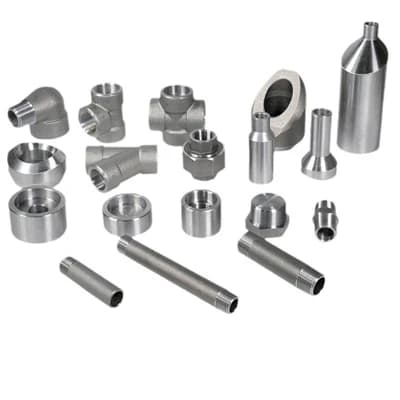
A pipe fitting connects pipe, changes direction, branches a line, reduces a size, or closes an end. The end, not the shape name, decides the standard. ASME B16.9 covers factory-made wrought buttwelding fittings in NPS 1/2 through NPS 48, in producible wall thicknesses. ASME B16.11 covers forged socket-welding and threaded fittings. Threaded fittings are listed in Classes 2000, 3000, and 6000. Socket-weld fittings are listed in Classes 3000, 6000, and 9000. Those class numbers are not schedules, and an elbow, tee, reducer, or cap can use more than one end.
Choose the connection before the shape
An elbow, tee, reducer, or cap can be made with more than one end. The end, not the shape name, selects the standard and the matching pipe.
| End | Standard and published coverage | Do not treat it as |
|---|---|---|
| Butt weld | ASME B16.9, NPS 1/2 through NPS 48, any producible wall | A socket-weld or threaded fitting |
| Socket weld | ASME B16.11, Classes 3000, 6000, and 9000 | Class 2000, or a butt-weld schedule |
| Threaded | ASME B16.11, Classes 2000, 3000, and 6000 | Class 9000, or a welded joint |
ASME B16.9 also includes short-radius elbows and returns that were previously in ASME B16.28-1994. It does not cover low-pressure corrosion-resistant buttwelding fittings; ASME points that use to MSS SP-43. The current ASME catalog editions are B16.9-2024 and B16.11-2021. Confirm the edition named in the project specification.
The B16.9 size range is the standard's coverage, not a statement that every size and wall is stocked. The B16.11 classes are fitting ratings. They are not the same as pipe schedule numbers, and this article does not convert them into a schedule.
Butt-weld, socket-weld, and threaded ends
A butt-weld fitting is joined to a prepared pipe end. The weld joint has to follow the specified end preparation and welding procedure. ASME B16.25 covers buttwelding-end preparation; it does not turn a socket or thread into a butt weld. See stainless steel butt-weld fittings and the 316L ASME B16.9 pipe cap for that end type.
A socket-weld fitting receives the pipe in a socket and uses a fillet weld. A threaded fitting joins a threaded pipe end without that weld. Both are forged-fitting types under ASME B16.11, but the class list differs: threaded fittings include Class 2000 and exclude Class 9000, while socket-weld fittings do the reverse. Forged pipe fittings on this site have to be ordered with the end and class, not by the product name alone.
A small size does not automatically call for a socket or thread, and a large size does not automatically call for butt welding. Use the joint type the design specifies. Threaded ends are a poor match where the design expects a welded joint that can be examined.
Shape names still need a size convention
The function names are elbow, tee, reducer, coupling, cap, and similar parts. A 90-degree elbow can be long radius or short radius. ASME B16.9 includes both in its current scope, but the center-to-end dimension has to be taken from the current standard or a dimensioned drawing. Do not calculate a project dimension from a rule of thumb when the drawing already states it.
A tee or reducer needs every opening identified. A single NPS describes only a straight-size fitting. A reducing fitting needs the run and the branch, or the large end and the small end. The ASTM A234 WPB 90-degree long-radius elbow is one example of a shape tied to a material specification and a matching pipe, not a generic elbow.
Material standards are separate from B16.9 and B16.11
The B16 standards cited here set fitting type, rating or size coverage, dimensions, tolerances, and marking requirements as stated in their scope. The material grade comes from the material specification.
- ASTM A234 covers wrought carbon-steel and alloy-steel fittings of seamless and welded construction for moderate and elevated temperatures.
- ASTM A403 covers wrought austenitic stainless-steel fittings for pressure piping.
- ASTM A182 covers forged or rolled alloy and stainless-steel flanges, forged fittings, valves, and parts for high-temperature service.
- ASTM A815 is a separate duplex-fitting specification. It is not established by ordering a B16.9 shape.
Matching a fitting to the pipe means matching the specified grade and weldability, not merely matching a color or a generic stainless label. A 316L butt-weld elbow does not substitute for a carbon-steel WPB fitting, and a duplex fitting is a different material decision.
What the marking can confirm
Use the marking, the material test report, and the dimensions together. A fitting stamp may show manufacturer, material grade, size, and heat or lot identification, but the required mark depends on the standard and edition. Do not treat one sample stamp as the marking rule for every standard.
Confirm these points on the document, not from the fitting shape:
- Standard and edition: ASME B16.9 or ASME B16.11, not a general ASME fitting note.
- End and class or wall: butt-weld wall, or the B16.11 class allowed for that end.
- Material specification and grade, including a distinction between 304 and 316L or between WPB and an alloy grade.
- Every opening size, radius for an elbow, and end preparation.
- Required examination or test documents. A catalog page does not supply those results.
EN 10253, JIS, and GB fitting standards are different documents. They are not shown to be equivalent here. For pipe-standard comparisons, use the ASTM, EN, JIS, and GB pipe-standard comparison, then check the fitting standard separately.
What to send for a fitting inquiry
A usable inquiry names one fitting, not a family:
- Shape, NPS of each end, and butt-weld, socket-weld, or threaded end.
- ASME B16.9 or B16.11, the edition, and the wall or permitted class.
- Material specification and grade, plus the pipe standard it must join.
- Quantity, end preparation, and any impact, sour-service, or examination requirement.
- Whether a material test report and the specified inspection documents are required.
This page does not rate a fitting by a pressure chart and does not state stock, price, or a manufacturing range beyond the standards quoted above.



