
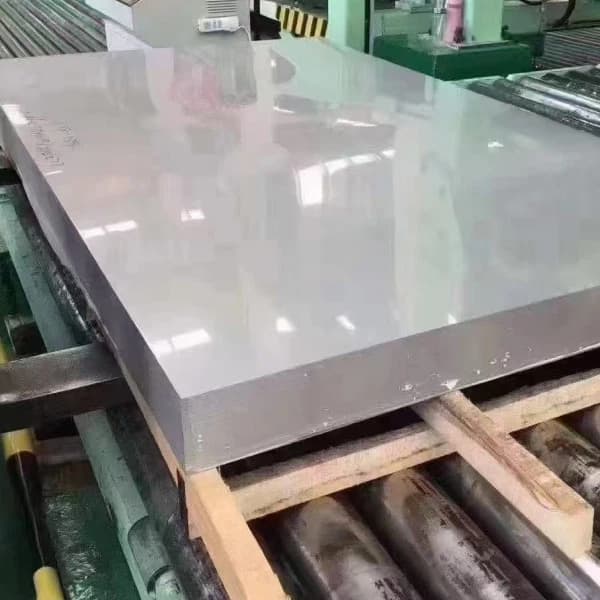
Plate selection starts with the duty, not the grade name. A structural grade, a pressure-vessel grade, a wear grade and a corrosion-resistant grade answer different questions, and the order has to carry the standard edition, thickness range, heat treatment condition and any impact test requirement. Chemistry alone will not tell you which one you need.
What Counts as Steel Plate
Plate is flat-rolled product produced by hot rolling slab and cutting to length. A thickness of about 3 mm is a common boundary between sheet and plate, but the boundary is set by the standard or the mill practice in question, so confirm it rather than assuming it. Thickness bands used in practice are roughly 3-20 mm for medium plate, 20-60 mm for thick plate and above 60 mm for extra-thick plate, with the maximum available depending on the mill.
Condition matters as much as grade. As-rolled, normalised, and quenched and tempered plate of the same grade do not have the same properties, and the condition is a line item on the order.
Carbon Steel Plate Grades
Carbon steel plate carries the largest share of structural and vessel work. The values below are typical minimum mechanical properties quoted against the standard; confirm the edition and the thickness range that applies, because minimum yield usually steps down as thickness increases.
| Grade | Min yield (MPa) | Tensile (MPa) | Typical duty |
|---|---|---|---|
| ASTM A36 | 250 | 400-550 | General structural work, base plates, frames |
| ASTM A516 Gr.70 | 260 | 485-620 | Pressure vessels and boilers, moderate temperature |
| ASTM A572 Gr.50 | 345 | 450-600 | High-strength structural members, bridges |
| EN S355J2 | 355 | 470-630 | Structural work with -20 degrees C impact requirement |
A36 remains the general structural default where no impact or through-thickness requirement exists. A572 Gr.50 raises minimum yield from 250 MPa to 345 MPa, which is what allows lighter sections. A516 is a different category: it is specified for pressure-containing parts, and it is normally ordered with a stated heat treatment and, where the design requires it, impact testing at a stated temperature. Low-temperature toughness is a supplementary requirement to be named on the order - it is not implied by the grade number. The grades and conditions to ask for are set out on the ASTM A516 carbon steel plate page.
For non-critical fabrication and general engineering, low carbon steel plate and Q235 carbon steel plate to GB/T 700 are the common commercial options, and the choice between them is usually governed by which standard the drawing calls up. Where a drawing names an EN or GB grade and the mill offers an ASTM equivalent, the same comparison rules apply as for pipe, which are set out in comparing steel grades across standards.
Stainless and Duplex Plate Grades
| Grade | Min yield (MPa) | Key alloying | Typical duty |
|---|---|---|---|
| 304 / 304L | 205 | 18% Cr, 8% Ni | Food, architectural, general chemical |
| 316 / 316L | 205 | 16% Cr, 10% Ni, 2% Mo | Marine, pharmaceutical, chloride service |
| 2205 duplex | 450 | 22% Cr, 5% Ni, 3% Mo | Chemical and offshore, higher strength |
| 2507 super duplex | 550 | 25% Cr, 7% Ni, 4% Mo | Aggressive chloride and high-pressure service |
Molybdenum is the reason 316 is chosen over 304 in chloride service, and the duplex grades roughly double the yield strength of 304 while improving resistance to chloride stress corrosion cracking. Higher strength comes with tighter welding controls: duplex plate needs a qualified procedure and controlled heat input, so the fabrication route should be settled before the grade is fixed.
Each of these is ordered against its own ASTM specification, and the finish and condition belong on the enquiry: 304 stainless steel plate, duplex stainless plate and sheet and 2507 super duplex plate.
Alloy and Heat-Resistant Plate
Cr-Mo plate such as ASTM A387 Grade 11 is specified for elevated-temperature and hydrogen service, and is usually ordered in the normalised and tempered condition with class stated. Grades such as 310S are chosen for oxidation resistance at high temperature; the temperature a grade can tolerate in air is not the same as its allowable design stress at that temperature, so the design code governs the number that goes on the drawing.
What to Confirm with Your Inquiry
Plate enquiries come back faster and more accurately when these fields are complete:
- Grade and governing standard with edition, for example ASTM A516 Gr.70 or EN 10028-2 P265GH.
- Thickness, width and length, and whether those are nominal or minimum.
- Heat treatment or delivery condition: as-rolled, normalised, quenched and tempered, solution annealed.
- Impact test temperature and absorbed energy, and whether through-thickness (Z-direction) testing is required.
- Non-destructive testing scope, for example ultrasonic testing to a stated acceptance level.
- Surface condition, edge preparation, and any cutting, bevelling or priming required.
- Quantity in tonnes or pieces, plus the delivery term and destination.
Standards define what a grade must achieve; they do not define what any supplier can offer on a given order. Availability, thickness range, cutting capability and certificate scope all have to be confirmed per order.



