
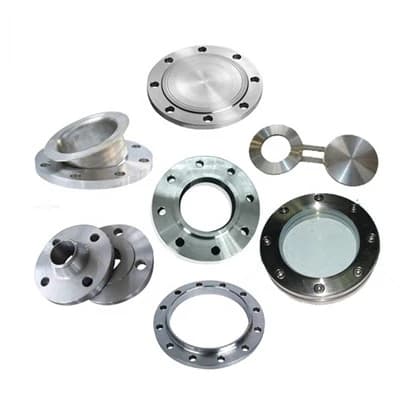
A flange class is not a working pressure. In ASME B16.5 each class has a pressure-temperature table, the allowable pressure falls as temperature rises, and carbon steel, alloy steel and stainless steel do not share the same numbers. Read the table for the material group at the design temperature. The class number alone does not tell you what the joint can hold.
What the Class Number Actually Fixes
The class fixes the flange geometry: thickness, bolt-circle diameter, bolt count and bolt diameter. A higher class is thicker and uses more, or larger, bolts. That geometry is why the flange can be rated higher. It is not itself the rating.
The rating is the maximum allowable working pressure for one material group at one temperature. ASTM A105 carbon steel, ASTM A182 F304 or F316 stainless, and ASTM A182 F11 or F22 alloy steel sit in different groups and have different curves inside the same class. Select the group first, then read the column for the design temperature.
The ASME B16.5 Classes
ASME B16.5 defines Classes 150, 300, 400, 600, 900, 1500 and 2500 for the sizes it covers. The table says what each class is commonly chosen for. It deliberately has no pressure column. Ambient values for one carbon-steel group are sometimes quoted as if they were the class rating. They are one cell of one table, and they overstate the joint as soon as the temperature rises or the material changes.
| Class | Common duty | Facing often specified |
|---|---|---|
| 150 | Utility water, air and low-pressure steam | Raised face |
| 300 | General process piping | Raised face |
| 400 | Less common, between 300 and 600 | Raised face |
| 600 | Higher-pressure process and hydrocarbons | Raised face or ring joint |
| 900 | High-pressure refinery and petrochemical | Ring joint is common |
| 1500 | Feedwater, injection and high-pressure gas | Ring joint is common |
| 2500 | The highest standard class, extreme pressure | Ring joint, weld neck |
Class 150 and Class 300
Class 150 is the lightest standard class and the usual choice for utility lines. Its allowable pressure drops quickly once the temperature is well above ambient, which is why a Class 150 flange that is fine on cold water can be the wrong flange on hot steam. Check the table before treating it as a general-purpose flange.
Class 300 is the step up for ordinary process piping. Raised face is the normal facing. It is not "twice Class 150" in any reliable sense, and the ratio changes with temperature.
Class 600 and Class 900
Class 600 is widely used in hydrocarbon service. The flange is heavier, the bolts are larger, and a ring-type joint becomes common, though raised face is still used. Assembly loads are high enough that the bolting procedure matters as much as the class.
Class 900 is a high-pressure refinery and petrochemical class. Weld-neck bodies and ring-joint facings are the usual combination, with bolting such as ASTM A193 B7. A high-class body in an alloy, such as the ASME B16.5 UNS N08020 long weld neck flange for Class 900 to 2500, still has to be read against the pressure-temperature table for its own material group. The class range in the product name is not the allowable pressure.
Class 1500 and Class 2500
Class 1500 is specified for severe pressure, including boiler feedwater and injection. Bolt loads usually need hydraulic tools, and the material is often an alloy or stainless grade because carbon steel has already been down-rated by the temperature. The ASTM A182 F22 alloy steel flanges are chosen in that situation for the grade, and the class is then confirmed from the F22 group tables.
Class 2500 is the highest class in ASME B16.5. Expect a weld-neck flange, a ring-joint facing, qualified welding, post-weld heat treatment where the material requires it, and nondestructive examination written into the order. It is a special item, not a heavier version of a stock Class 300 flange.
EN PN Ratings Are a Different System
EN 1092-1 uses PN numbers. A PN number is a designation, and the allowable pressure still depends on the material and the temperature. People treat PN 20 as roughly Class 150, PN 50 as roughly Class 300 and PN 100 as roughly Class 600. Those are orientation points only. The bolt circles, thicknesses and facing details differ, so the flanges do not bolt together, and the pressure-temperature curves diverge as temperature rises. Do not substitute one for the other from a conversion table.
How to Select the Class
Take the design pressure and the design temperature, including any condition that is more severe than normal operation, such as a steam-out or a hydrotest if the specification says the flange must contain it. Choose the material group. Read the ASME B16.5 table for that group, at that temperature, and pick the lowest class whose allowable pressure covers the design case. Then check the next temperature step above the design temperature, so a small process change does not put the joint over the line.
What to Confirm with Your Inquiry
State the design pressure, the design temperature, the material grade, and the flange type, size and facing. Name ASME B16.5 or EN 1092-1, and the edition if the project specifies one. The class is the output of that check. It should not be the only number on the inquiry.



