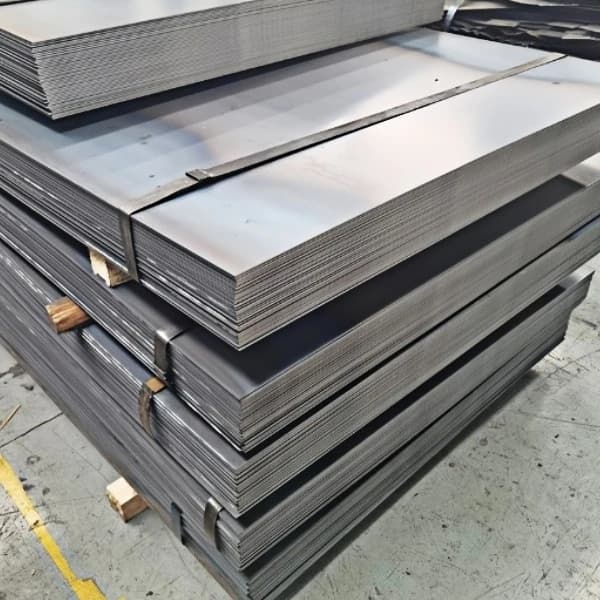
Product Description
ASTM A516 carbon steel plate is a pressure vessel quality plate supplied to ASTM A516/A516M, the specification for carbon steel plates intended for service in welded pressure vessels where improved notch toughness is important. It covers four strength levels — Grade 55, Grade 60, Grade 65 and Grade 70, named for their minimum tensile strength of 55, 60, 65 and 70 ksi (380, 415, 450 and 485 MPa) — and the steel is fully killed with a fine austenitic grain size, which is one of the differences between a pressure vessel plate and a general structural plate.
The differences that decide an A516 order are not only the grade. Normalizing, impact testing and ultrasonic examination are chosen by the purchaser and by the pressure vessel code, so the same grade can be supplied as-rolled with no toughness test or normalized with Charpy V-notch results at a stated temperature. The tables below list the specification requirements for each grade; the grade, condition and test results for your order are confirmed against the purchase specification before supply.
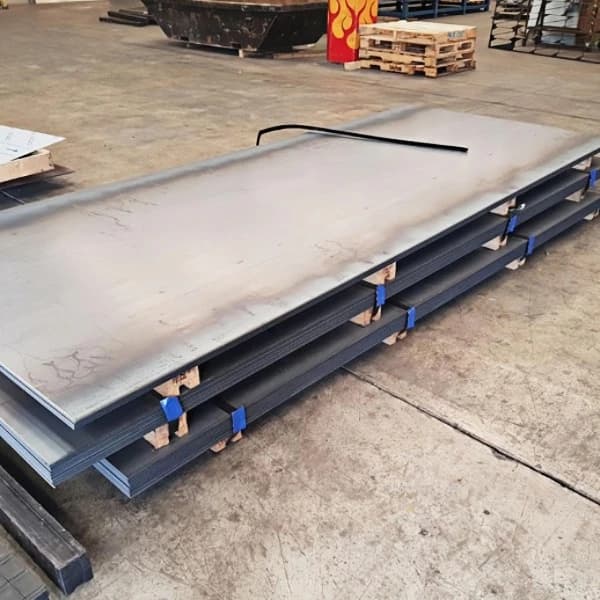
Plate is supplied cut to size, with flame or plasma profiling and edge preparation to drawing. Where the application is structural rather than pressure retaining, compare this material with ASTM A36 carbon steel plate: A36 is not a pressure vessel material and is not interchangeable with A516. Other carbon steel plate grades, including Q235 carbon steel plate, are listed in the carbon steel plate range.
Specifications
Standard, grade and supply details — grade and delivery condition are confirmed for each order:
| Item | Reference |
|---|---|
| Standard | ASTM A516/A516M; ASME SA516/SA516M equivalent designation |
| Grades | Grade 55 [380], Grade 60 [415], Grade 65 [450], Grade 70 [485] |
| Product form | Hot-rolled plate; cut-to-size plate and profiled parts on request |
| Steelmaking practice | Fully killed steel with fine austenitic grain size (ASTM A516/A516M; A20/A20M) |
| Delivery condition | As-rolled for 40 mm (1.5 in.) and under; normalizing required over 40 mm and where notch toughness testing is specified |
| Thickness | 0.45-100 mm. Sizes outside this range are made to the ordered dimensions. |
| Width | Standard widths 1000 mm and 1219 mm; other widths up to 1500 mm. Sizes outside this range are made to the ordered dimensions. |
| Length | Standard lengths 3 m and 6 m; other lengths up to 12 m. Sizes outside this range are made to the ordered dimensions. |
| Impact testing | Supplementary Requirement S5 (Charpy V-notch) — applies when stated in the purchase order, with temperature and energy given by the purchaser |
| Surface | As-rolled; blast-cleaned and primed on request |
| Density | 7.85 g/cm³ |
| Inspection documents | State the required mill test report, certificate type (e.g. EN 10204 3.1 / 3.2) or third-party inspection |
Chemical Requirements
ASTM A516/A516M Table 1 limits, shown for reference. Carbon is capped by thickness band, manganese by grade and thickness; phosphorus and sulfur are held to 0.025% maximum on both heat and product analysis. For each 0.01 percentage point the carbon maximum is reduced, the manganese maximum may be increased by 0.06 percentage point, up to 1.50% by heat analysis and 1.60% by product analysis.
| Element | Grade 55 | Grade 60 | Grade 65 | Grade 70 |
|---|---|---|---|---|
| Carbon (C), max — 12.5 mm and under | 0.18% | 0.21% | 0.24% | 0.27% |
| Carbon (C), max — over 12.5 to 50 mm | 0.20% | 0.23% | 0.26% | 0.28% |
| Carbon (C), max — over 50 to 100 mm | 0.22% | 0.25% | 0.28% | 0.30% |
| Carbon (C), max — over 100 to 200 mm | 0.24% | 0.27% | 0.29% | 0.31% |
| Carbon (C), max — over 200 mm | 0.26% | 0.27% | 0.29% | 0.31% |
| Manganese (Mn), heat analysis | 0.60–0.90% (12.5 mm and under) 0.60–1.20% (over 12.5 mm) | 0.60–0.90% (12.5 mm and under) 0.85–1.20% (over 12.5 mm) | 0.85–1.20% | 0.85–1.20% |
| Phosphorus (P), max | 0.025% | 0.025% | 0.025% | 0.025% |
| Sulfur (S), max | 0.025% | 0.025% | 0.025% | 0.025% |
| Silicon (Si), heat analysis | 0.15–0.40% | 0.15–0.40% | 0.15–0.40% | 0.15–0.40% |
Mechanical Properties by Grade
ASTM A516/A516M Table 2 requirements. Tensile strength is a range and yield strength a minimum, measured by the 0.2% offset or the 0.5% extension-under-load method; elongation adjustment for heavy plate is taken from A20/A20M. The two elongation rows are the two gauge lengths of the tension test, not thickness bands.
| Property | Grade 55 | Grade 60 | Grade 65 | Grade 70 |
|---|---|---|---|---|
| Tensile strength | 380–515 MPa (55–75 ksi) | 415–550 MPa (60–80 ksi) | 450–585 MPa (65–85 ksi) | 485–620 MPa (70–90 ksi) |
| Yield strength, min | 205 MPa (30 ksi) | 220 MPa (32 ksi) | 240 MPa (35 ksi) | 260 MPa (38 ksi) |
| Elongation, min — 2 in. [50 mm] gauge | 27% | 25% | 23% | 21% |
| Elongation, min — 8 in. [200 mm] gauge | 23% | 21% | 19% | 17% |
| Maximum thickness | Up to 305 mm (12 in.) | Up to 205 mm (8 in.) | Up to 205 mm (8 in.) | Up to 205 mm (8 in.) |
Material Characteristics
A516 is a carbon-manganese pressure vessel steel. Its properties come from the grade, from the melting practice and from the heat treatment: the steel is fully killed and grain refined, which is what delivers consistent notch toughness instead of the erratic toughness of a rimmed or semi-killed plate. Strength is controlled mainly by the carbon and manganese content within the limits above — carbon is deliberately capped, so the plate is welded in the normal way rather than relying on high carbon for strength.
Heat treatment is the second decision on an A516 order. Plate 40 mm (1.5 in.) and under is normally supplied as-rolled and can also be ordered normalized or stress relieved; plate over 40 mm is normalized. When notch toughness testing is required on plate 40 mm and under, the plate is normalized unless the purchaser states otherwise. Normalized supply is often ordered as A516 Grade 70N, and stress relief after welding is governed by the pressure vessel code rather than by this specification.
Points that decide suitability for a project:
- Grade is a strength choice, not a quality level. Grade 70 is the highest strength of the four and allows a thinner plate for the same design pressure; the lower grades are specified where the design or the welding procedure calls for them. Never let the grade be assumed from the description alone.
- Toughness is a purchase-order decision. Charpy V-notch testing is Supplementary Requirement S5 of A20/A20M and applies only when it is stated. The test temperature, the energy level and the specimen orientation must come from the project, and they should match the minimum design metal temperature.
- Tolerances come from the general requirements. Thickness, width, length, flatness and camber tolerances are those of ASTM A20/A20M for the grade and size ordered; state any project tolerance that is tighter than the standard.
- Plate and coil are not the same supply. A516/A516M is a plate specification. Where plate is produced from coil and supplied without heat treatment, or with stress relief only, the additional requirements and reporting of A20/A20M apply — state this on the enquiry if the material is to be coil produced, whether the inquiry is for carbon steel coil or for plate.
- Killed and grain-refined steel is a requirement. A516 cannot be met by a commercial quality structural plate: the specification requires killed steel and fine austenitic grain size, and the mill test report is checked against it.
Commonly cited approximate nearest grades in other standards are EN 10028-2 P355GH, GB/T 713 Q345R and JIS G3115 SBV2 for Grade 70, depending on the grade selected. These are comparisons of strength level and application, not one-to-one equivalents: residual element limits, impact test temperatures and heat treatment rules differ between standards, and any change of specification must be approved against the design code the equipment is built to.
Applications
ASTM A516 plate is selected where a carbon steel plate has to retain toughness in pressure service at moderate and lower temperatures. Typical applications include:
- Pressure vessels and pressure-containing parts built to ASME BPVC Section VIII (or an equivalent code)
- Boilers and boiler components, including steam drums
- Storage tanks and spheres for liquefied petroleum gas, ammonia and industrial gases
- Heat exchanger shells and channels, columns, reactors and drums in refinery, petrochemical and gas plants
- Deaerators, feedwater heaters and other power plant pressure parts
- Other welded pressure equipment where notch toughness at a stated design temperature has to be demonstrated
A516 is not a structural steel grade and is not selected on cost for general fabrication. Where toughness testing, ultrasonic examination or post-weld heat treatment is called for by the code, it should be stated in the enquiry together with the design temperature — those requirements, and not only the plate dimensions, decide what is supplied.
Ordering Information
Send the following with your enquiry so that the plate, the heat treatment and the documentation can be confirmed against your specification:
- Quantity, by weight or by number of plates
- Grade (55, 60, 65 or 70) and the applicable standard and edition (for example ASTM A516/A516M), with the ASME SA516 designation if dual certification is required
- Plate thickness, width and length, with tolerances where they are critical, and whether the plate is to be cut to size or profiled
- Delivery condition: as-rolled, normalized, normalized and stress relieved, and whether the plate is produced from coil
- Impact test requirements: required or not, test temperature, minimum energy and specimen orientation
- Supplementary requirements to be applied, for example simulated post-weld heat treatment of test coupons, product analysis, ultrasonic examination or vacuum carbon-deoxidised steel
- Inspection and documentation: mill test report, certificate type (EN 10204 3.1 / 3.2), third party or customer inspection, and a certificate of origin where needed for customs
- Design and service conditions — design pressure, minimum design metal temperature and any corrosion allowance — and the destination port
Thickness, width, length, heat treatment, testing, documentation and delivery terms are confirmed against the enquiry. The tables above state the requirements of ASTM A516/A516M for each grade; they are not a statement of stocked sizes or of a guaranteed figure for every thickness.