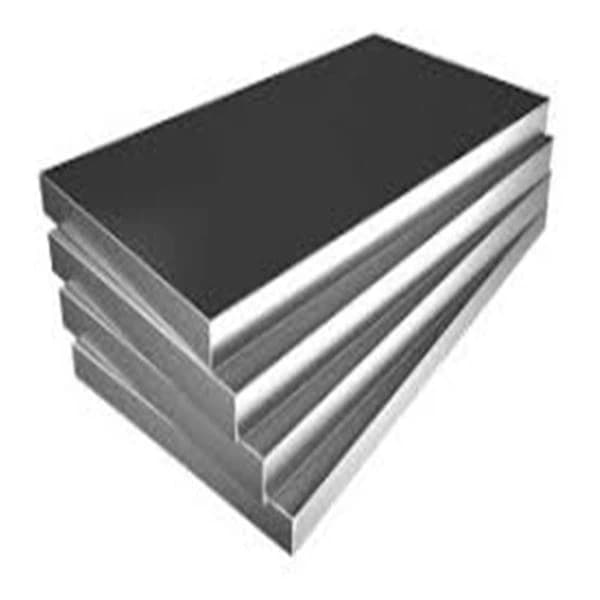
Product Description
Duplex stainless steel plate and sheet in UNS S31803 / S32205 (EN 1.4462), commercially known as duplex 2205, supplied to ASTM A240 / ASME SA240. The dual-phase microstructure of approximately 50% austenite and 50% ferrite gives this grade roughly twice the yield strength of standard austenitic stainless steels such as 304 or 316L, together with good resistance to chloride pitting and stress corrosion cracking.
The balanced chemistry of about 22% chromium, 3% molybdenum and controlled nitrogen additions produces a Pitting Resistance Equivalent Number (PREN) of typically 34–35, calculated as %Cr + 3.3 × %Mo + 16 × %N. Actual performance in a given medium depends on chloride concentration, temperature and other service conditions and should be confirmed for each application.
Because of the higher strength, fabrications in duplex 2205 can often use thinner sections than equivalent austenitic designs, reducing weight and material cost. Compared with super duplex grades, duplex 2205 provides an economical level of corrosion protection for moderately aggressive chloride environments; for direct seawater service, super duplex is normally required.
Specifications
Grade, dimensions and supply details:
| Item | Reference |
|---|---|
| Material | Duplex stainless steel (austenitic-ferritic), UNS S31803 / S32205, EN 1.4462 (duplex 2205) |
| Applicable standards | ASTM A240 / ASME SA240; EN 10088 |
| Product form | Plate and sheet |
| Thickness | 0.45–100 mm |
| Width | Standard widths 1000 mm and 1219 mm; other widths on request, up to 1500 mm |
| Length | Standard lengths 3 m and 6 m; other lengths on request, up to 12 m |
| Surface finish | No.1, 2B, BA, hairline, mirror, brushed |
| Production process | Hot rolled, cold rolled, annealed, pickled |
| Edge | Mill edge or slit edge |
| Certification | Per order requirement (e.g. EN 10204 3.1) |
Chemical composition — reference limits per ASTM A240 (% by weight); confirm the applicable edition at order stage:
| Element | UNS S31803 | UNS S32205 |
|---|---|---|
| Carbon (C) | 0.030 max | 0.030 max |
| Manganese (Mn) | 2.00 max | 2.00 max |
| Silicon (Si) | 1.00 max | 1.00 max |
| Phosphorus (P) | 0.030 max | 0.030 max |
| Sulfur (S) | 0.020 max | 0.020 max |
| Chromium (Cr) | 21.0–23.0 | 22.0–23.0 |
| Nickel (Ni) | 4.50–6.50 | 4.50–6.50 |
| Molybdenum (Mo) | 2.50–3.50 | 3.00–3.50 |
| Nitrogen (N) | 0.08–0.20 | 0.14–0.20 |
Mechanical properties — minimum requirements per ASTM A240, reference values to be confirmed against the applicable edition and product form:
| Property | UNS S31803 | UNS S32205 |
|---|---|---|
| Yield strength, 0.2% proof (min) | 450 MPa | 450 MPa |
| Tensile strength (min) | 620 MPa | 655 MPa |
| Elongation (min) | 25% | 25% |
| Hardness (max) | 290 HBW | 290 HBW |
Material Characteristics
The balanced austenitic-ferritic structure gives duplex 2205 a combination not found in single-phase grades: yield strength around twice that of 304 or 316L, good low-temperature toughness, and clearly better resistance to stress corrosion cracking and chloride pitting. Measured by PREN, duplex 2205 (34–35) compares with 18 for type 304 and 24 for type 316; PREN is a predictive index based on composition, not a guarantee for a specific environment.
Duplex 2205 is not strengthened by heat treatment in the way martensitic grades are; strength can be increased by cold working (strain hardening). It is partially magnetic because of its ferrite phase.
The grade is weldable with procedures qualified for duplex steels and controlled heat input, which preserves the austenite-ferrite balance in the heat-affected zone. Its lower thermal expansion compared with austenitic grades reduces distortion and residual stress after welding, and it can be welded to carbon, low-alloy and austenitic steels using filler metals of suitable composition.
For elevated-temperature service or environments with very high chloride levels, suitability should be confirmed for the specific conditions before specification.
Applications
Duplex stainless steel plate and sheet is widely used where higher strength than austenitic grades and better chloride resistance than 304 / 316L are required, including:
- Chemical processing equipment and process plant
- Oil and gas installations and oilfield fabrications
- Offshore and marine structures and components
- Water treatment, wastewater and desalination plant
- Pressure vessels and storage tanks
- Heat exchangers and condensers
- Pulp and paper industry equipment
- Structural applications such as bridges and load-bearing fabrications
Ordering Information
To receive an accurate quotation, please specify: the required UNS grade (S31803 or S32205 — S32205 carries the tighter composition limits and is generally preferred for new specifications), product form (plate or sheet), thickness, width and length, quantity, applicable standard and edition, surface finish, delivery condition and any certification requirements (e.g. EN 10204 type). Details of the service environment — medium, chloride level and temperature — help confirm grade suitability.
Compare this item with the Stainless Steel Plate category before fixing size, grade and quantity. For direct seawater and other highly aggressive chloride service, see the Super Duplex Stainless Steel Plate S32750 range.