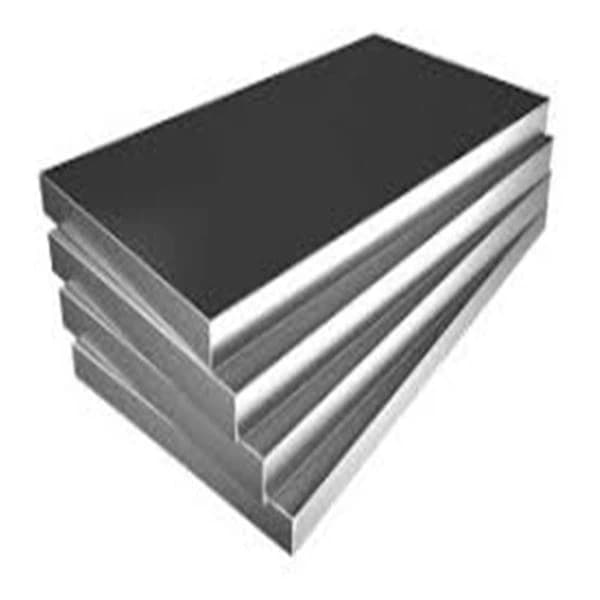
Product Description
ASTM A387 Grade 11 is a chromium-molybdenum alloy steel plate with a nominal 1.25% chromium and 0.50% molybdenum content (UNS K11789), covered by ASTM A387/A387M and ASME SA-387/SA-387M. The specification is written for welded boilers and pressure vessels designed for elevated-temperature service, where carbon steel plate no longer holds enough strength. Chromium carries the oxidation resistance in hot steam and process gas, while molybdenum raises the recrystallisation temperature so the plate keeps its strength under sustained load at temperature.
Grade 11 is supplied in two strength classes that share the same chemical composition. Class 1 is furnished annealed or normalised with a minimum yield strength of 240 MPa; Class 2 is normalised and tempered (minimum tempering temperature 620 °C) with a minimum yield strength of 310 MPa, and is normally chosen where the design pressure calls for a thinner wall. Both classes are killed steel, and both are quoted against the ordered class and heat treatment rather than against the grade name alone.
Specifications
Reference supply data for A387 Grade 11 plate. Final values are confirmed against the ordered thickness, the class and the applicable edition of the standard.
| Item | Reference value |
|---|---|
| Material | ASTM A387 Grade 11 chromium-molybdenum alloy steel plate, nominal 1.25Cr-0.5Mo, UNS K11789 |
| Standard | ASTM A387/A387M; ASME SA-387/SA-387M; general requirements for pressure vessel plates per ASTM A20/A20M |
| Class | Class 1 (minimum yield 240 MPa) or Class 2 (minimum yield 310 MPa); both classes share the same chemical composition |
| Delivery condition | Class 1: annealed or normalised. Class 2: normalised and tempered, minimum tempering temperature 620 °C [1150 °F]. Quenched and tempered by purchaser agreement. |
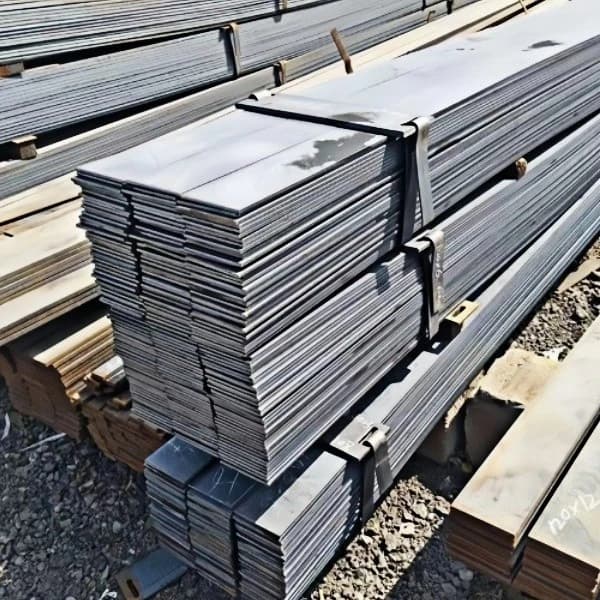
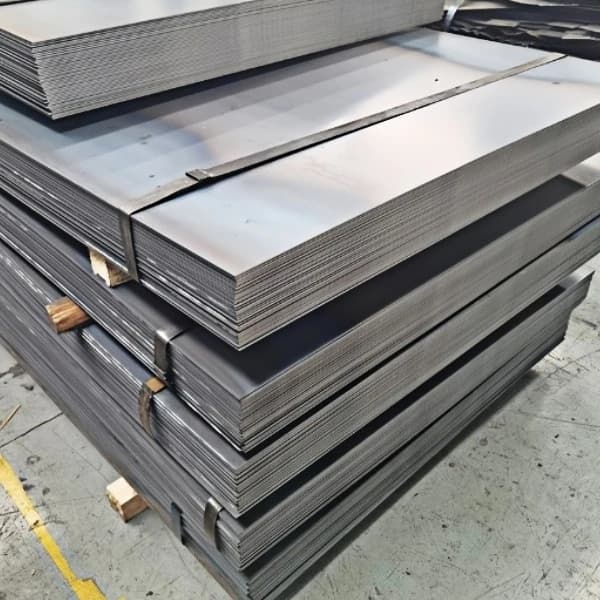
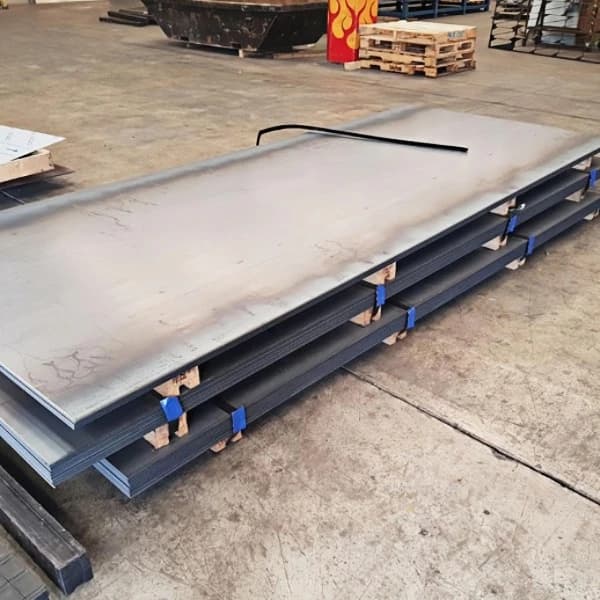
| Product form | Plate. Cut-to-size plate, flame-cut or plasma-cut shapes and machined blanks are separate options - send the drawing with the enquiry. |
| Thickness | 0.45-100 mm. Sizes outside this range are made to the ordered dimensions. |
| Width | Standard widths 1000 mm and 1219 mm; other widths up to 1500 mm. Sizes outside this range are made to the ordered dimensions. |
| Length | Standard lengths 3 m and 6 m; other lengths up to 12 m. Sizes outside this range are made to the ordered dimensions. |
| Surface | Hot rolled and descaled; shot blasting, priming or coating on request |
| Tolerance | Thickness and width tolerances to be agreed, commonly per ASTM A20/A20M |
| Testing and documentation | Mill test certificate to EN 10204 3.1; product analysis, Charpy V-notch impact testing, ultrasonic examination and third-party inspection on request |
| Approximate equivalents | BS 1501 621B; EN 10028-2 13CrMo4-5 (1.7335); DIN 17155 13CrMo44. These are near-equivalents, not direct substitutes - verify composition, heat treatment and mechanical properties against the governing design code. |
| Service temperature | Selected for elevated-temperature service. The allowable stress falls as temperature rises, so the design limits must be read from the applicable construction code at the design metal temperature, not from the grade name. |
Chemical Composition of ASTM A387 Grade 11
Heat analysis limits per ASTM A387/A387M Grade 11.
| Element | C | Mn | P | S | Si | Cr | Mo |
|---|---|---|---|---|---|---|---|
| Content, % | 0.05 - 0.17 | 0.40 - 0.65 | 0.030 max | 0.030 max | 0.50 - 0.80 | 1.00 - 1.50 | 0.45 - 0.65 |
Phosphorus and sulfur are 0.030% maximum on heat analysis, as shown in the table. Product analysis tolerances apply to check analysis on the finished plate. A tighter residual limit, where the order requires one, is stated on the order.
Mechanical Properties and Class Selection
ASTM A387/A387M reference values. Acceptance is based on the class, the heat treatment and the test results reported in the mill certificate.
| Class | Tensile strength | Yield strength, min | Elongation, min (50 mm) | Elongation, min (200 mm) | Delivery condition |
|---|---|---|---|---|---|
| Class 1 | 415 - 585 MPa | 240 MPa | 22% | 19% | Annealed or normalised |
| Class 2 | 515 - 690 MPa | 310 MPa | 22% | 18% | Normalised and tempered |
Class 1 may be supplied in any of the acceptable heat treatments; Class 2 must be furnished in a heat treatment other than annealing. Where the plate will be formed and welded, it is worth agreeing at order whether the tested properties have to represent the simulated post-weld heat treated condition.
Material Characteristics
A387 Grade 11 is a low-alloy Cr-Mo steel, not a stainless steel. Chromium forms a protective oxide layer that slows scaling in hot steam and flue gas, and molybdenum slows the loss of strength as temperature rises, which is what separates this grade from carbon steel plate in boiler and vessel service. The microstructure in the normalised and tempered condition is ferrite and bainite, and the strength that the specification guarantees is a function of the heat treatment as much as of the chemistry.
Fabrication is conventional for a low-alloy plate: hot forming, cold forming, machining, gas cutting and welding are all used. Welding normally uses matching low-hydrogen Cr-Mo (B2-type) consumables with preheat and post-weld heat treatment, and the procedure, including any impact requirement, should be qualified to ASME BPVC Section IX - the grade is assigned to P-No. 4 in that code. The 1.25Cr-0.5Mo family is temper-embrittlement sensitive, which is why phosphorus, sulfur and residual elements are controlled and why impact testing, step cooling or simulated post-weld heat treatment is sometimes specified alongside the tensile test.
Applications
A387 Grade 11 plate is used for welded equipment in elevated-temperature service: pressure vessels and reactors in refineries, petrochemical and chemical plants; hydrotreating and hydrocracking and other hydrogen-service vessels; distillation and fractionation columns; heat exchangers, process heaters and steam condensers; boiler drums, steam headers and superheater and reheater components; power plant piping and steam systems; hot-service separators, storage tanks and gas processing equipment. Suitability for a particular item depends on the design code, the design metal temperature, the medium (including hydrogen partial pressure where relevant) and the corrosion allowance, so the grade should be confirmed against the design data before the plate is ordered.
Ordering Information
Plate is quoted against the specific requirements of the item, so an enquiry is answered faster when it states:
- Class 1 or Class 2, and the standard designation required (ASTM A387/A387M or ASME SA-387/SA-387M)
- Thickness, width and length, and the piece quantity - or a drawing where plates are cut to shape
- Delivery condition and any heat treatment instruction
- Testing and documentation: mill test certificate, product analysis, Charpy impact temperature and energy, ultrasonic examination, third-party inspection, simulated post-weld heat treatment
- Design metal temperature, medium and any code stamping requirement where the class or grade still has to be confirmed
- Delivery terms and destination
Sizes outside the range in the table are made to the ordered dimensions.
Frequently Asked Questions
What is the difference between A387 Grade 11 Class 1 and Class 2?
The chemistry is identical; the class fixes the tensile level. Class 1 is annealed or normalised with a minimum yield strength of 240 MPa and a tensile range of 415-585 MPa. Class 2 is normalised and tempered, with a minimum yield strength of 310 MPa and a tensile range of 515-690 MPa, and it may not be supplied in the annealed condition. Class 2 is the usual choice where the design pressure would otherwise need a heavier wall; Class 1 suits less demanding service. State the class on the enquiry, because the two are not interchangeable on a design calculation.
Is ASTM A387 Grade 11 the same as ASME SA-387 Grade 11?
The technical requirements are the same; the difference is the designation. ASTM A387/A387M is the ASTM specification, and ASME SA-387/SA-387M is the ASME Boiler and Pressure Vessel Code version used for code-stamped equipment. Quote the designation that your design drawing, data sheet and quality plan call for. Approximate European and British near-equivalents are BS 1501 621B, EN 10028-2 13CrMo4-5 (1.7335) and DIN 17155 13CrMo44, but these are not direct substitutes and need to be checked against the governing design code.
Which sizes of A387 Grade 11 plate can be supplied?
Thickness is 0.45-100 mm. Standard widths are 1000 mm and 1219 mm, and other widths are supplied up to 1500 mm. Standard lengths are 3 m and 6 m, and other lengths are supplied up to 12 m. Sizes outside this range are made to the ordered dimensions. Heat treatment and mechanical properties still follow the ordered thickness and class.
How is A387 Grade 11 welded and heat treated?
Welding uses matching low-hydrogen Cr-Mo (B2-type) consumables with preheat and post-weld heat treatment, and the welding procedure - including any impact or hardness requirement - should be qualified to ASME BPVC Section IX, where the grade is assigned to P-No. 4 (confirm the assignment in the edition your code work is based on). The plate is supplied in the heat-treated condition; where the fabrication route includes post-weld heat treatment, simulated post-weld heat treatment testing can be specified at order so that the mechanical test results represent the finished condition.
What information is needed for a quotation?
Give the class, the standard designation, the thickness, width, length and quantity, the delivery condition, the testing and documentation you require, the design metal temperature and medium, and the delivery terms. With those details the plate can be quoted against the exact class and test regime instead of a generic size, which avoids later re-qualification.
Compare this item with the Carbon Steel Plate range before fixing size, grade and quantity in non-elevated-temperature service.