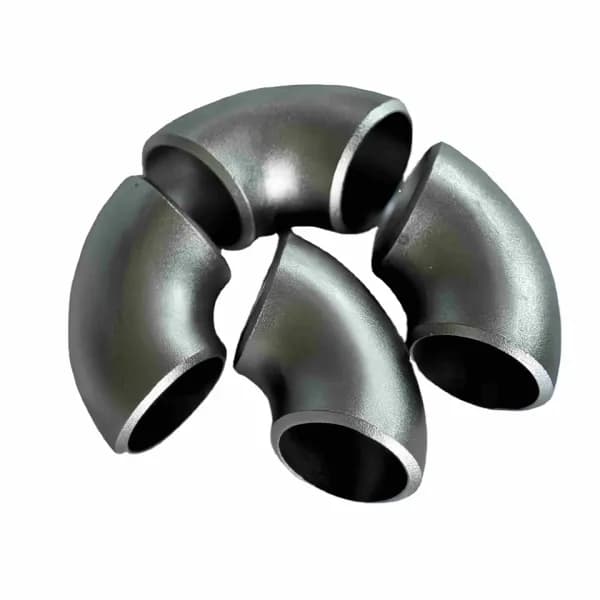
ASTM A53 Pipe, A234 WPB Elbow: Which Standard Applies
ASTM A53/A53M is a pipe specification. It covers seamless and welded black and hot-dipped zinc-coated steel pipe in NPS 1/8 to NPS 26 (DN 6 to DN 650), in Grades A and B, and it does not cover pipe fittings. A 90° elbow for an A53 line is a factory-made wrought butt-welding fitting: the material specification that governs it is ASTM A234/A234M Grade WPB, and its dimensions, tolerances, ratings and marking come from ASME B16.9.
This page is therefore an ASTM A234 Grade WPB 90° long radius elbow, dimensioned to ASME B16.9 and supplied for lines built from ASTM A53 Grade A or Grade B pipe. The A53 designation tells the mill which pipe grade the elbow has to match at the weld; A234 WPB tells the mill what the fitting itself has to be. An enquiry that says only "A53 Grade B elbow" leaves the material route open, and two suppliers can quote two different real products against the same words.
A234 WPB minimum properties line up with A53 Grade B pipe, so a single WPB elbow covers Grade A and Grade B lines. The pipe side of the same joint is covered on our seamless carbon steel A106 / A53 / API 5L Grade B pipe page.
What a 90° Long Radius Elbow Does in the Line
An elbow changes the direction of a run. The 90° form turns the line a full quarter turn, and "long radius" describes the geometry, not a quality grade: it is what decides the space the fitting occupies and the pressure loss it adds.
A long radius (LR) elbow has a centre-to-end distance of 1.5 x the nominal size and a 1.5D bend radius, so the flow path through it is comparatively smooth. A short radius (SR) elbow is 1.0 x the nominal size with a 1.0D bend radius: it takes about a third less space, makes a sharper turn and carries a higher loss coefficient. Both forms are now published in ASME B16.9: the separate short radius standard, ASME B16.28, was withdrawn and its subject matter merged into B16.9, so a drawing that still calls out "SR elbows per B16.28" is quoted against B16.9. LR is the default for process, power and utility piping and is the form that lets a pipeline pig pass; SR is chosen where the geometry is tight and the extra pressure drop is acceptable.
Two geometry points matter at the small end:
- The 1.5 x NPS rule runs from NPS 1 upward. At NPS 1/2 the tabulated centre-to-end is a fixed 38 mm (1.50 in.) and at NPS 3/4 it is 29 mm (1.13 in.), so those two sizes do not follow the multiplier.
- Short radius elbows are only tabulated from NPS 1 upward. At NPS 1/2 and NPS 3/4 only the LR form exists as a standard item.
The table below gives the reference geometry for the sizes ordered most often. Centre-to-end depends on size only and does not change with schedule.
| NPS | DN | Outside diameter (mm) | 90° LR centre-to-end A (mm) | 90° SR centre-to-end A (mm) |
|---|---|---|---|---|
| 1/2 | 15 | 21.3 | 38 | — |
| 3/4 | 20 | 26.7 | 29 | — |
| 1 | 25 | 33.4 | 38 | 25 |
| 1-1/2 | 40 | 48.3 | 57 | 38 |
| 2 | 50 | 60.3 | 76 | 51 |
| 3 | 80 | 88.9 | 114 | 76 |
| 4 | 100 | 114.3 | 152 | 102 |
| 6 | 150 | 168.3 | 229 | 152 |
| 8 | 200 | 219.1 | 305 | 203 |
| 10 | 250 | 273.1 | 381 | 254 |
| 12 | 300 | 323.9 | 457 | 305 |
| 16 | 400 | 406.4 | 610 | 406 |
| 20 | 500 | 508.0 | 762 | 508 |
| 24 | 600 | 609.6 | 914 | 610 |
Treat these as reference values and confirm them against the ASME B16.9 edition named in your specification before cutting pipe. Two of the figures in circulation should be treated with care: one widely copied table repeats 38 mm for the NPS 3/4 LR dimension, which is the NPS 1/2 value, and 180° returns are sometimes listed as a single centre-to-centre number when the standard tabulates both the centre-to-centre and the back-to-face dimension.
A53 Pipe Grades and the A234 WPB Fitting Grade
A53 pipe is ordered in two grades. Grade A is the lower-strength, easier-to-bend grade; Grade B is the one most carbon steel A53 lines are built from. Because a fitting has to meet or exceed the pipe it is welded to, the pairing is decided by the mechanical minimums rather than by the name on the drawing.
Chemistry and tensile requirements for A53 pipe in Grades A and B, as ordered (Type F, the furnace-butt-welded pipe, is a different product with lower tensile requirements and is not intended for flanging):
| A53 grade | C max (%) | Mn max (%) | P max (%) | S max (%) | Tensile min (MPa / ksi) | Yield min (MPa / ksi) |
|---|---|---|---|---|---|---|
| Grade A (Type S / Type E) | 0.25 | 0.95 | 0.05 | 0.045 | 330 / 48 | 205 / 30 |
| Grade B (Type S / Type E) | 0.30 | 1.20 | 0.05 | 0.045 | 415 / 60 | 240 / 35 |
Cu, Ni and Cr are each limited to 0.40% max, Mo to 0.15% and V to 0.08%. For each 0.01% reduction in carbon below the stated maximum, manganese may be raised by 0.06% above its maximum, up to 1.65%. Elongation for A53 is calculated from the specimen dimensions using the ASTM A370 formula rather than being a single fixed percentage. Type F continuous-welded pipe carries 45 ksi (310 MPa) tensile and 25 ksi (172 MPa) yield.
A234 WPB and WPC chemistry and tensile requirements, for comparison:
| A234 grade | C max (%) | Mn (%) | P max (%) | S max (%) | Si (%) | Cr / Mo / Ni / Cu max (%) | V max (%) |
|---|---|---|---|---|---|---|---|
| WPB | 0.30 | 0.29–1.06 | 0.050 | 0.058 | 0.10 min | 0.40 / 0.15 / 0.40 / 0.40 | 0.08 |
| WPC | 0.35 | 0.29–1.06 | 0.050 | 0.058 | 0.10 min | 0.40 / 0.15 / 0.40 / 0.40 | 0.08 |
| A234 grade | Tensile range (MPa / ksi) | Yield min (MPa / ksi) | Elongation, round specimen in 4D | Elongation, wall 7.94 mm and over | Hardness max |
|---|---|---|---|---|---|
| WPB | 415–585 / 60–85 | 240 / 35 | 22% long., 14% trans. | 30% long., 20% trans. | 197 HBW |
| WPC | 485–655 / 70–95 | 275 / 40 | 22% long., 14% trans. | 30% long., 20% trans. | 197 HBW |
Three further limits apply to the WPB chemistry: the sum of Cu + Ni + Cr + Mo may not exceed 1.00%, the sum of Cr + Mo may not exceed 0.32%, and when the fitting is made from bar, plate or forging the carbon maximum is 0.35% rather than 0.30%. WPB and WPC fittings made from plate carry a reduced minimum elongation of 17%. Hardness is a controlled property in A234 and is verified if tested rather than quoted as a range.
The practical result for a buyer: A234 WPB carries the same 415 MPa minimum tensile and 240 MPa minimum yield as A53 Grade B pipe, so one WPB elbow is acceptable against either A53 grade. Where a line class calls for WPC, WPB is not a substitute - WPC raises the minimum tensile to 485 MPa and the minimum yield to 275 MPa. WPA still appears on older drawings; current editions of A234/A234M list only WPB and WPC as the carbon steel grades, and WPB meets or exceeds the historical WPA requirements, so a WPA callout is normally satisfied by WPB after written agreement rather than by a separate heat of steel.
Size, Schedule and Wall Thickness Matching
The elbow and the pipe have to match at the weld: the same nominal size, and wall thicknesses close enough for a sound joint. ASME B16.9 fixes the outside diameter and the centre-to-end geometry, and it puts a floor under the fitting wall - the wall at the bevel may not be less than 87.5% of the nominal pipe wall, and the fitting is dimensioned so that its wall is not less than the nominal wall of the pipe it connects. The wall itself is what the buyer has to state.
Name the schedule or the wall thickness in the enquiry. For carbon steel, wall thickness is written to ASME B36.10M: Sch 10, 20, 30, 40, 60, 80, 100, 120, 140 and 160, plus the legacy weight designations STD, XS and XXS. Two traps sit in that list.
- No "S" suffix. Schedules such as 5S, 10S, 40S and 80S belong to ASME B36.19M, the austenitic stainless steel pipe standard. Carbon steel A53 pipe and A234 WPB fittings are dimensioned to B36.10M and their schedules carry no suffix. The two systems happen to give the same wall in part of the size range, which is why the slip survives, and they part company above it: 40S and 80S are the STD and XS walls, so at NPS 12 a "Sch 40S" callout is 9.53 mm against 10.31 mm for Sch 40, and "Sch 80S" is 12.70 mm against 17.48 mm for Sch 80.
- STD and XS are not Sch 40 and Sch 80 at every size. STD matches Sch 40 up to and including NPS 10, and XS matches Sch 80 up to and including NPS 8. Above those points they are separate fixed walls, and a large-diameter line ordered "Sch 40" receives a different wall from one ordered "STD".
Reference wall thicknesses for the carbon steel schedules encountered most often on A53 lines:
| NPS | OD (mm) | Sch 40 (mm) | STD (mm) | Sch 80 (mm) | XS (mm) | Sch 160 (mm) |
|---|---|---|---|---|---|---|
| 2 | 60.3 | 3.91 | 3.91 | 5.54 | 5.54 | 8.74 |
| 4 | 114.3 | 6.02 | 6.02 | 8.56 | 8.56 | 13.49 |
| 6 | 168.3 | 7.11 | 7.11 | 10.97 | 10.97 | 18.26 |
| 8 | 219.1 | 8.18 | 8.18 | 12.70 | 12.70 | 23.01 |
| 10 | 273.1 | 9.27 | 9.27 | 15.09 | 12.70 | 28.58 |
| 12 | 323.9 | 10.31 | 9.53 | 17.48 | 12.70 | 33.32 |
These are reference values from ASME B36.10M; confirm them against the edition your line class cites. Where the wall does not line up, the answer is a taper, not extra weld metal - see the end preparation section below.
Size coverage is worth stating too. ASME B16.9 covers factory-made butt-welding fittings from NPS 1/2 to NPS 48 (DN 15 to DN 1200) in any producible wall thickness, and it excludes low-pressure corrosion-resistant fittings, which are covered by MSS SP-43. A53 pipe stops at NPS 26 (DN 650). Above NPS 26 the elbow is still a standard B16.9 item, but the pipe it joins comes from a different specification such as A106, API 5L or A671, and the elbow is normally fabricated from plate rather than formed seamless.
End Preparation and Welding
Butt-welding ends are prepared to ASME B16.25. The preparation depends on wall thickness, and the fitter needs to know which type is being supplied before the joint is set up.
| Wall thickness | End preparation | Bevel angle | Root face |
|---|---|---|---|
| Thin wall, about 3 mm and under | Square (plain) end | — | — |
| Over about 3 mm up to 22 mm (0.88 in.) | Single bevel | 37.5° ± 2.5° from the perpendicular | 1.6 mm (1/16 in.) ± 0.8 mm |
| Over 22 mm | Compound bevel | 37.5° plus a 10° secondary angle | 1.6 mm (1/16 in.) |
The bend-angle tolerance is generous and the root face tolerance is tight, which is where bevel gauges usually fail: an end that is a couple of degrees off will still weld, an end with a heavy land will not fuse at the root. Unequal wall thicknesses are not solved with extra weld metal either. B16.25 requires a taper, at a minimum slope of 1:4 where the internal diameters differ and a maximum external slope of 1:3 where the outside diameters differ, so a spool that mixes schedules has that transition designed into the order.
B16.9 also sets angularity tolerances by size band, from 0.03 in. off-angle at NPS 1/2–4 up to 0.18 in. at NPS 44–48. A fitting welded into a critical line should be checked on the spool rather than measured on the bench.
Galvanizing. A53 pipe may be ordered black or hot-dipped zinc-coated. The elbow should normally be ordered black, because the welding heat destroys the zinc coating at the joint and in the heat-affected zone, and a pre-galvanized fitting gives a false sense of protection in exactly the area most likely to corrode. The usual route is to weld the spool first and coat or galvanize afterwards, within the size limits of the galvanizing bath. If the elbow has to arrive coated, say so at enquiry stage: it changes the weld preparation as well as the price.
How the Elbow Is Made and What the Certificate Shows
A234 covers both seamless and welded construction, and ASME B16.9 accepts both, so which one is on offer should be stated rather than assumed. Seamless elbows are formed from seamless pipe by hot forming or pressing on a mandrel, and the finished part has no fabrication weld. Welded elbows are made from plate or pipe segments with a fusion weld, which becomes a longitudinal or circumferential seam in the fitting; for critical service the seamless route is the usual choice because there is no fabrication weld to be inspected.
Heat treatment follows the forming route rather than the grade:
- Hot-formed WPB and WPC fittings finished between 620 °C and 980 °C (1150–1800 °F) and cooled in still air need no further heat treatment.
- Fittings finished above 980 °C (1800 °F) are annealed, normalised, or normalised and tempered.
- Cold-formed fittings are normalised, or stress relieved at 1100 to 1275 °F [595 to 690 °C]. Fittings over NPS 12 (DN 300) that are locally heated for forming are annealed, normalised, or normalised and tempered. A locally heated fitting of NPS 12 or smaller with carbon below 0.26% is exempt.
The mill certificate should show the heat number, the grade, the chemical analysis, the tensile, yield and elongation results and the hardness result where it was tested. EN 10204 Type 3.1 is the usual certificate for fittings; Type 3.2, where a third party signs the test results, is a separate requirement and should be asked for in writing. Fittings must be marked so that the size, grade and manufacturer are traceable to the certificate, and packing should protect the machined bevels in transit.
Pressure and Temperature: What the Elbow Carries
A butt-welding elbow has no Class number and no pressure rating of its own. Classes 150 to 2500 belong to flanges under ASME B16.5, and Classes 3000, 6000 and 9000 to forged socket-weld and threaded fittings under ASME B16.11. A B16.9 elbow is rated as straight seamless pipe of the same material and wall, and the line is then designed under the piping code that governs the project - ASME B31.1 for power piping, B31.3 for process piping, B31.4 and B31.8 for pipeline transport.
The consequence for a quotation is simple. Design pressure and temperature, corrosion allowance and code edition are the buyer's input; the allowable stress at the design temperature is read from ASME BPVC Section II, Part D for the grade actually delivered. A table that prints a fixed pressure rating for an A234 WPB elbow is a pipe wall-thickness table in disguise.
On the service envelope: A53 pipe is intended for mechanical and pressure applications and is acceptable for ordinary steam, water, gas and air lines, which is also the envelope this elbow serves. It is carbon steel and it is not corrosion resistant - coating or lining is a line item in the specification, not a property of the material. Where the line pipe is A106 rather than A53 for higher-temperature duty, the fitting grade is still A234 WPB, and the same answers apply.
Ordering Information
An enquiry that carries these items can be quoted without a round of questions:
- Item: 90° long radius elbow, butt-welding ends
- NPS or DN, with the schedule or wall thickness, written as your line class writes it
- Material: ASTM A234 WPB, or WPC where the line class requires it
- Construction: seamless or welded
- Quantity, and the pipe grade the elbow has to weld to (A53 Grade A or B, A106 Grade B, API 5L Grade B)
- End finish and coating: bevel, plain end, black, or coated after fabrication
- Documentation: EN 10204 Type 3.1 or 3.2, dimensional report, NDT and hardness test as applicable
- Marking, packing and destination port
Naming the A53 grade is useful because it tells us which pipe grade the wall and the bevel have to line up with. It does not change the fitting specification, which stays A234 WPB to ASME B16.9.
Related items in the same family: carbon steel concentric reducers for size changes, API 5L grade pipe fittings where the line pipe is a pipeline grade, forged pipe fittings where the connection is socket-weld or threaded under ASME B16.11 rather than butt-welded, and stainless steel butt-weld fittings where corrosion resistance decides the material. The whole range sits under carbon steel pipe fittings.
Common Questions about ASTM A53 90° LR Elbows
Is an ASTM A53 elbow actually made to the A53 standard?
No. ASTM A53/A53M is the specification for seamless and welded black and hot-dipped zinc-coated steel pipe, NPS 1/8 to NPS 26, Grades A and B, and it does not cover fittings. The elbow is made to ASTM A234/A234M Grade WPB, with dimensions and tolerances from ASME B16.9 and weld ends prepared to ASME B16.25. "A53 elbow" is trade shorthand for an elbow that matches A53 pipe, not the name of a fitting specification.
Which fitting grade matches A53 Grade A and Grade B pipe?
A234 WPB matches both. Its specification minimums - 415 MPa tensile and 240 MPa yield - equal the A53 Grade B minimums and exceed the Grade A minimums, so one WPB elbow is acceptable against either pipe grade. WPC is the higher-strength option at 485/275 MPa and is not interchangeable with WPB in either direction without agreement.
Should I order a long radius or a short radius elbow?
Order LR unless the space forces otherwise. An LR elbow is 1.5 x NPS centre-to-end with a 1.5D radius, which gives a smoother flow path and a lower pressure loss; that is why it is the default on process and utility lines and the only form that lets a pig pass. An SR elbow is 1.0 x NPS with a 1.0D radius and is only tabulated from NPS 1 upward - at NPS 1/2 and NPS 3/4 only the LR form exists as a standard fitting.
My drawing says Sch 5S or Sch 10S - can you supply that?
Not as an A53/A234 item. The S-series schedules - 5S, 10S, 40S, 80S and so on - belong to ASME B36.19M, the austenitic stainless steel pipe standard. Carbon steel A53 pipe and A234 WPB fittings are dimensioned to ASME B36.10M and carry no suffix. The two systems coincide in part of the size range and diverge in the rest, and 40S and 80S are the STD and XS walls: at NPS 12, "Sch 40S" means 9.53 mm while Sch 40 means 10.31 mm. An S-suffix schedule on a carbon steel line is usually a template error, so confirm it with the engineer before the material is ordered.
Why is the elbow black when the pipe is galvanized?
Because welding burns the zinc. A53 pipe can be bought black or hot-dipped zinc-coated, but a butt-welded joint destroys the coating at the weld and in the heat-affected zone. The usual practice is to order the elbow black, weld the spool, and coat or galvanize the finished assembly. If the elbow has to arrive coated, say so at enquiry stage so the coating route, and the coating that will be lost at the weld, are both priced and specified up front.
Can this elbow be welded to A106 Grade B or API 5L Grade B pipe?
Yes. A234 WPB is the matched fitting grade for A53 Grade B, A106 Grade B and API 5L Grade B pipe, because the three carbon steel pipe specifications share the same 415/240 MPa minimums. What has to match on the day is the wall thickness or schedule, and the welding procedure has to be qualified under ASME BPVC Section IX for the two materials and the thicknesses involved.
Compare this item with the Carbon Steel Pipe Fittings range before fixing size, grade and quantity, and send NPS, schedule, radius and quantity through the enquiry form for a quotation.