Product Description
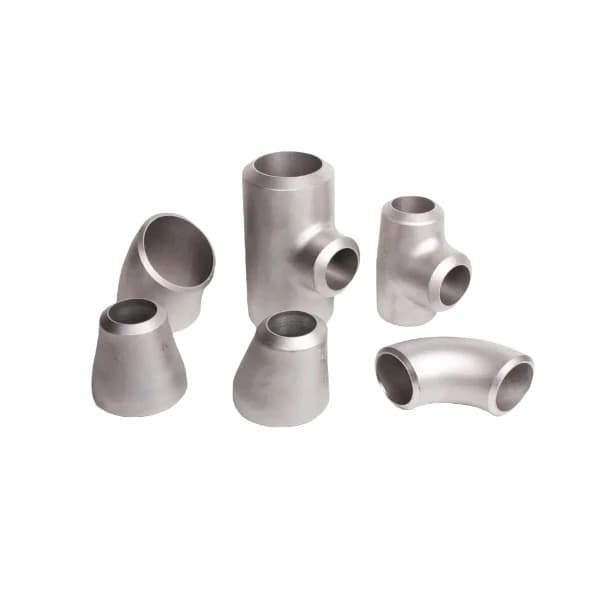
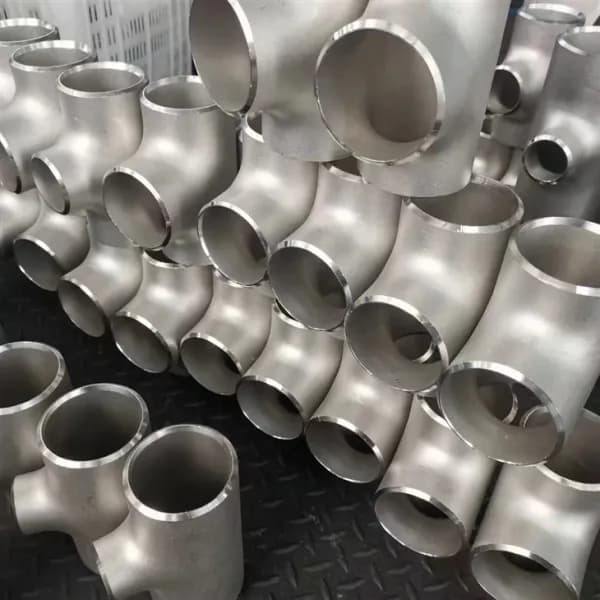
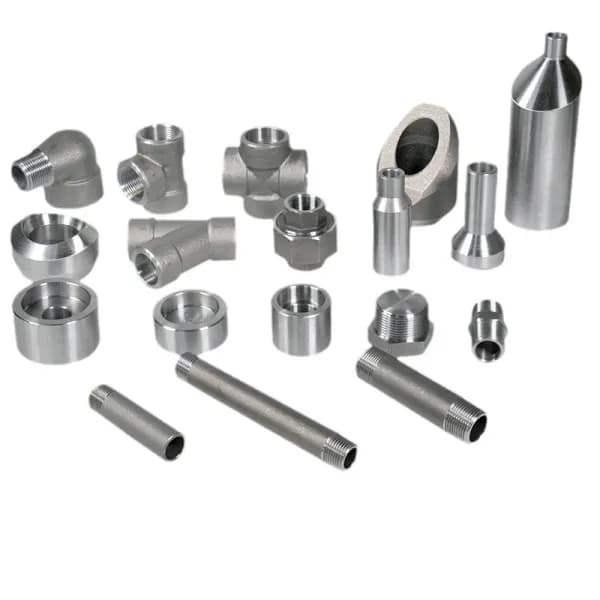
Forged pipe fittings are the small-bore, high-pressure connection range for socket-weld and threaded piping: elbows, tees, crosses, couplings, caps, plugs, bushings, unions, bosses, swaged nipples and branch outlets that are forged from solid stock and then machined, rather than cast or fabricated from pipe. This page covers the family as it is specified in practice — ASME B16.11 for the socket-welding and threaded shapes, with the MSS companion practices SP-79, SP-83, SP-95 and SP-97 covering the reducer inserts, unions, swaged nipples and bull plugs, and integrally reinforced branch outlets that sit alongside them.
Two words in the range name do most of the buying work. Forged means the fitting is hot worked from forging stock, bar, seamless pipe or seamless tubular product, which gives a sound, worked structure compared with a casting; ASME B16.11 in fact does not allow tees, elbows and crosses to be machined directly from bar stock, so a "bar-stock fitting" offered against B16.11 is itself a warning sign worth querying. Pipe fittings places the range on the socket-weld and threaded side of the family, within the wider Pipe Fittings group: it joins pipe at the fitting, while the butt-welding shapes that dominate larger bores follow ASME B16.9 and are covered separately under Stainless Steel Butt-Weld Fittings.
The range is bought by class and by material as much as by shape. Class numbers (2000, 3000, 6000, 9000) set how much pressure-containing metal the fitting carries, and the material specification — carbon steel to ASTM A105, low-temperature steel to ASTM A350 LF2, alloy and stainless steel to ASTM A182, and nickel alloys to ASTM B564 or B462 — sets what it is made of. Both belong on the RFQ together, because the dimensional standard and the material standard are two separate documents.
Product Range and Governing Standards
The standards below are not interchangeable labels; each one governs a different set of shapes, so a drawing that names a standard is really naming the product family. Confirm the edition and the combination of fitting type, size and class during quotation, because not every standard applies to every shape.
| Standard | Product scope it governs |
|---|---|
| ASME B16.11 | Forged fittings, socket-welding and threaded: ratings, dimensions, tolerances, marking and material requirements in sizes NPS 1/8 to NPS 4 (DN 6 to DN 100) |
| MSS SP-79 | Socket-welding reducer inserts, which convert a fitting socket into a reduced outlet after welding |
| MSS SP-83 | Class 3000 and 6000 steel pipe unions, socket-welding and threaded ends (carbon steel, alloy steel, stainless steels and nickel alloys) |
| MSS SP-95 | Swage(d) nipples and bull plugs — inline reducers and line-closing plugs outside the B16.11 shape list |
| MSS SP-97 | Integrally reinforced forged branch outlet fittings (weldolet, sockolet, threadolet, elbolet, latrolet and nipolet types) with socket-welding, threaded and butt-welding ends |
| BS 3799 | Legacy British Standard still named on older drawings for hex nipples, bosses and screwed or swaged shapes; confirm whether the project accepts it or requires the current edition of the governing standard |
| ASTM A733 | Pipe nipples in seamless and welded carbon steel and austenitic stainless steel, finished with standard pipe threads |
A short example shows how the split works on a real line list: a 1 in. Class 3000 socket-weld elbow is an ASME B16.11 part; a 1 in. x 3/4 in. socket-weld reduction at that point is an MSS SP-79 reducer insert; a screwed union closing a drain is MSS SP-83; and a 2 in. x 1 in. instrument branch taken off a 6 in. header is an MSS SP-97 branch outlet fitting, not an oversized B16.11 tee.
Pressure Classes and How They Are Rated
Class numbers in this range are designations, not pressure ratings. ASME B16.11 correlates each class with a schedule of straight seamless pipe of the same material, and the working pressure is then calculated for that pipe under the governing piping code, with allowances for corrosion, threading and other wall deductions. The correlation used for preliminary selection is:
| Class | End connection | Rating basis (connecting pipe) |
|---|---|---|
| Class 2000 | Threaded | Schedule 80 / XS |
| Class 3000 | Threaded | Schedule 160 |
| Class 6000 | Threaded | XXS |
| Class 3000 | Socket-welding | Schedule 80 / XS |
| Class 6000 | Socket-welding | Schedule 160 |
| Class 9000 | Socket-welding | XXS |
Reading the table carefully pays for itself. The same class number does not carry the same rating basis across end types: a Class 3000 threaded fitting is correlated with Schedule 160 pipe, while a Class 3000 socket-welding fitting is correlated with Schedule 80 / XS. In practice a higher class generally means heavier pressure-containing dimensions rather than a fixed psi figure, and the allowable pressure depends on the material, the size and the design temperature. Threaded fittings are available in Classes 2000, 3000 and 6000, and socket-welding fittings in Classes 3000, 6000 and 9000; where a fitting combines one threaded and one socket-welding end, the combination must be read conservatively and confirmed against the piping code.
Fitting Types and End Connections
The B16.11 shape list is deliberately compact, and the end connection decides what is on the shelf:
- Available in both socket-welding and threaded ends: 90° and 45° elbows, tees, crosses, couplings, half couplings, caps, bosses and couplets.
- Threaded only: street elbows, plugs (square, hexagon and round head) and bushings (hexagon and flush) — these shapes exist to be screwed, so they have no socket-weld version.
- Socket-welding companions from the MSS series: reducer inserts to MSS SP-79 and unions to MSS SP-83.
- Inline and branch companions: swaged nipples and bull plugs to MSS SP-95, and integrally reinforced branch outlet fittings to MSS SP-97.
Socket-welding assembly inserts the plain-end pipe into the fitting socket against an internal collar, backs the pipe off roughly 1/8 in. for thermal expansion and closes the joint with a fillet weld, so socket dimensions, socket depth and the expansion gap are inspection items in their own right. Threaded assembly instead draws the mating taper threads into engagement, which is why thread form, thread quality and thread engagement replace welding procedure as the controlling checks. The two joint designs use different installation procedures and different class ranges, and the permitted joint type belongs to the project specification and the piping code, not to supplier preference.
Materials and Material Standards
ASME B16.11 permits fittings to be produced from forgings, bar, seamless pipe or seamless tubular products conforming to the wrought fitting specifications ASTM A234, A403, A420, A815 or B366, or to the forging specifications A105, A182, A350, B462 or B564 — with the bar-stock restriction on tees, elbows and crosses noted above. The commonly used starting points group as follows:
| Material family | Typical specification | Notes for the RFQ |
|---|---|---|
| Carbon steel | ASTM A105 / A105N | The default forged carbon steel for ambient piping service; pairs with A106 pipe and A234 WPB butt-weld fittings in the same system |
| Low-temperature carbon steel | ASTM A350 LF2 | Impact-tested grade for low-temperature service; state the class within LF2 |
| Alloy steel (Cr-Mo) | ASTM A182 F5, F9, F11, F12, F22, F91 | Grade selected to match the connecting pipe in the high-temperature system |
| Stainless steel | ASTM A182 F304/304L/304H, F316/316L/316H, F321, F347 | Forged stainless fittings; the H grades carry controlled carbon for elevated temperature |
| Duplex and super duplex | ASTM A182 F51, F53, F55 (or A815) | Chloride service; confirm the UNS with the purchase order |
| Nickel alloys | ASTM B564 (ASME SB564) or B462 — UNS N06600, N06625, N08825, N10276, N04400, N08020 and related grades | Inconel, Monel, Hastelloy and Alloy 20 family forgings; the material specification is ordered separately from the B16.11 dimension |
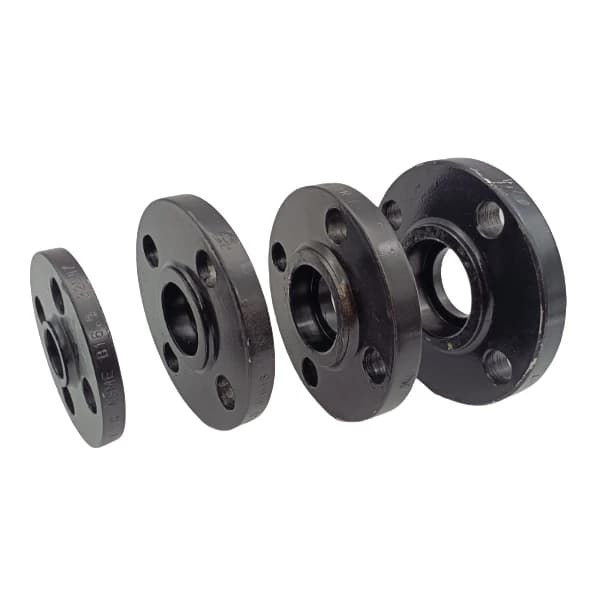
The practical mistake to avoid is quoting a dimension standard as if it were a material. A "B16.11 Class 3000 elbow" says nothing about chemistry until the material line is added, and a nickel-alloy fitting ordered for an Inconel line should name the UNS and the B564 or B462 specification explicitly rather than relying on the shape standard. The same discipline applies across the connection family: an A105 fitting belongs with A105 Carbon Steel Flange material in the same line, a screwed connection often closes with a companion Carbon Steel Threaded Flange, and the forged stainless shapes have a parallel range in Forged Stainless Flanges. Surface treatment is a separate line again: anti-rust oil, phosphate coating, hot-dip galvanizing or electro-galvanizing are each material- and service-dependent, so state the coating only after the base material is fixed.
Thread Standards for Threaded Fittings
Internal and external threads on ASME B16.11 threaded fittings are American National Standard Taper Pipe Threads (NPT) to ASME B1.20.1. BSP threads are a different system: BSPT (the R series of ISO 7-1) and BSPP (the G series of ISO 228-1) use a 55-degree flank angle against the 60-degree flank of NPT, and the pitches differ at most sizes, so the two will start together and will not seal. A BSP-threaded fitting is therefore not an ASME B16.11 threaded fitting in the strict sense, and mixing the two on site is a leak waiting to happen. State the thread form, the governing thread standard and whether each end is male or female in the RFQ; NPT, BSPT and BSPP are not interchangeable designations.
Applications
Forged fittings earn their keep where the bore is small and the pressure is not. They are commonly specified for compact high-pressure connections in oil and gas refining and petrochemical plants, power-generation and boiler systems, heat exchangers and pressure vessels, chemical and sample lines, instrument takeoffs, hydraulic and lubrication circuits, and marine and shipboard piping. They are equally the standard answer on small-bore branches and drains where a full ASME B16.9 butt-weld fitting would be disproportionate to the line size. Service limits — temperature, fluid, corrosion allowance and code requirements — come from the piping design, and the fitting material is selected to match rather than the other way round.
How to Order Forged Pipe Fittings
A complete line item removes most of the back-and-forth in quotation. Include:
- Fitting type and governing standard (elbow, tee, coupling, union, swaged nipple, branch outlet and so on, with the standard the drawing names).
- Size and configuration; for reducing and branch items give both the run and the outlet size.
- End connection — socket-weld, threaded or a combination — and for threaded ends the thread form, designation and male/female configuration.
- Class and the connecting pipe size with schedule or wall thickness; the class and the pipe wall must be matched before the fitting is released.
- Material specification, grade or UNS, and any supplementary requirements such as impact testing.
- Surface treatment or coating, if required.
- Quantity for each line item.
- Inspection and documentation: the material test certificate type (for example EN 10204 3.1), traceability level, dimensional reports, NDE and any third-party involvement.
- Marking, packaging and delivery requirements; each fitting carries size, class, material grade and heat number as standard marking practice under B16.11.
- Drawing or datasheet for non-standard shapes, which are reviewed for feasibility before acceptance.
Common Questions about Forged Pipe Fittings
What is the difference between Class 3000 and Class 6000 forged fittings?
Class 6000 fittings carry heavier pressure-containing dimensions than Class 3000 fittings of the same size and material, because the class is correlated with a heavier connecting-pipe wall: Schedule 160 against Schedule 80 / XS for socket-welding ends, and XXS against Schedule 160 for threaded ends. The class number itself is not a pressure rating — the allowable working pressure is calculated for the equivalent pipe under the governing piping code, and it varies with material, size and temperature. Confirm material, size, design conditions and the applicable code before fixing the class.
Can forged pipe fittings be supplied above NPS 4?
Not in the ASME B16.11 range: it stops at NPS 4 (DN 100). An ASME B16.11 elbow, tee or coupling is not a 36 in. component — larger branch connections move to MSS SP-97 branch outlet fittings, larger inline transitions to MSS SP-95 swaged nipples, and larger butt-weld shapes to ASME B16.9. Those items are quoted per order with the run and branch combination stated, and a size claimed for one standard should never be carried across to another.
Are threaded and socket-weld fittings interchangeable?
No. They use different joint designs, different installation procedures and different class ranges: threaded fittings assemble on taper threads to ASME B1.20.1, while socket-weld fittings are fillet welded after the pipe is set against the socket collar with an expansion gap. The permitted joint type must be confirmed against the project specification and the piping code, and a fitting that combines one of each end must be read conservatively.
Which material standard applies to Inconel and other nickel alloy forged fittings?
Nickel-alloy forged fittings are specified with a material standard of their own — ASTM B564 (ASME SB564) for nickel alloy forgings, or B462 for the corrosive high-temperature flange, fitting and valve grades — with the UNS stated on the line item, for example N06625 for Alloy 625, N06600 for Alloy 600, N08825 for Alloy 825, N10276 for Hastelloy C-276 or N04400 for Monel 400. The shape standard remains ASME B16.11; the two documents travel together and neither substitutes for the other. The material-specific fitting groups on this site are collected under Inconel Pipe Fittings and the neighbouring nickel-alloy categories.
What should an RFQ for forged fittings contain?
Fitting type and standard, sizes including run and outlet where the item reduces, end connection and thread form, class with the connecting-pipe schedule, material specification and grade, quantity, surface treatment, certificate and inspection requirements, and marking and packaging instructions. Sending those ten lines with the enquiry is the fastest route to a quotable, verifiable offer.