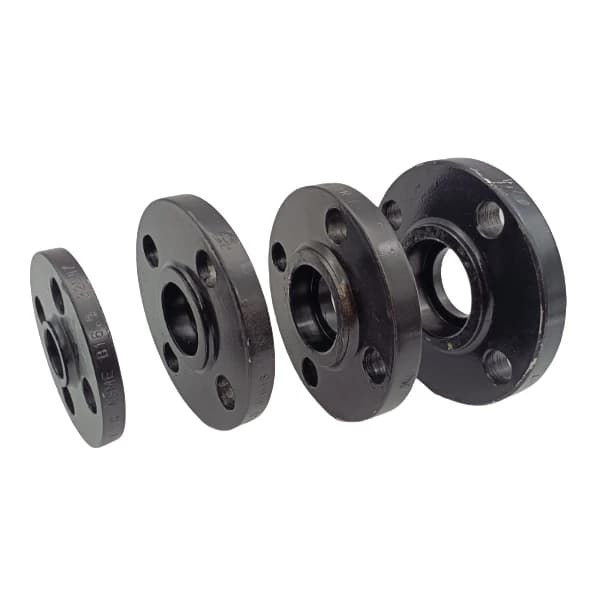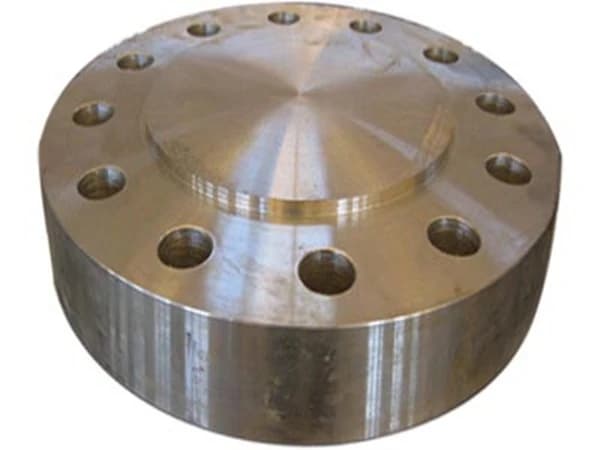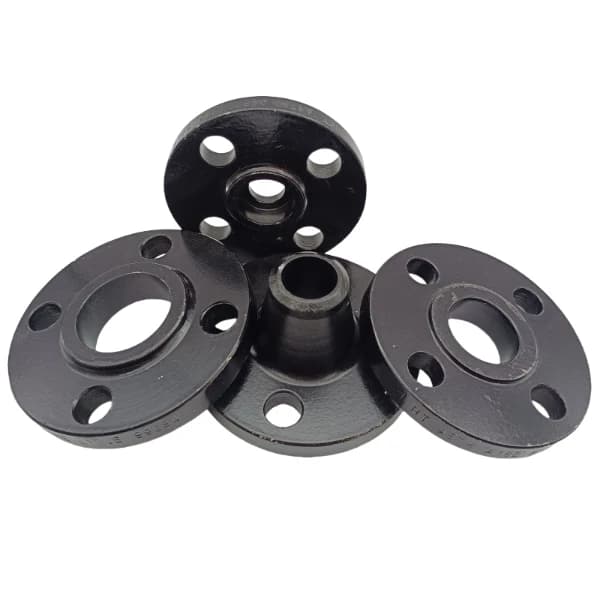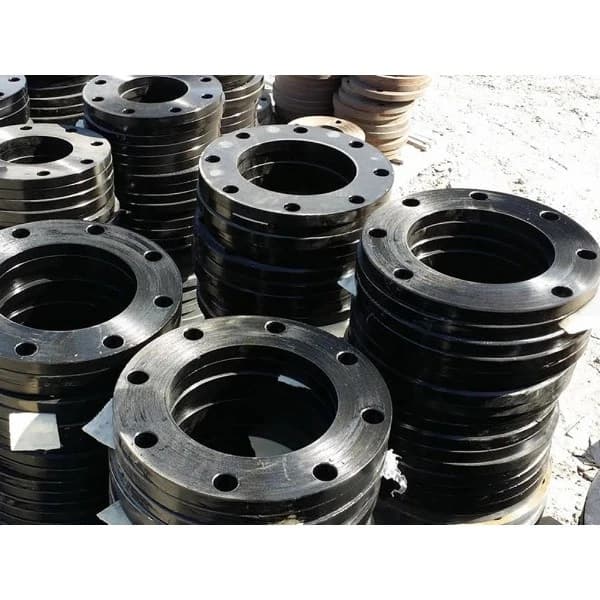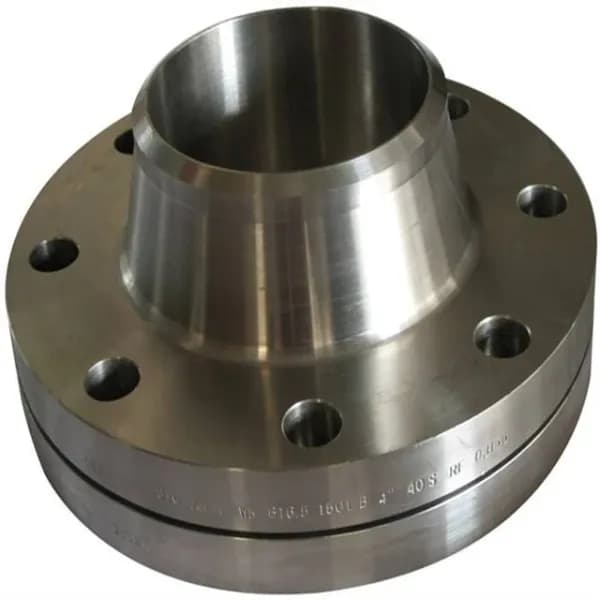
ASTM A350 LF2 Low Temperature Carbon Steel Flanges
ASTM A350 LF2 is the carbon steel forging grade used for flanges in piping that has to keep its toughness when the metal temperature drops. The specification behind it, ASTM A350/A350M, covers forged and ring-rolled carbon and low-alloy steel flanges, forged fittings and valves that require notch toughness testing, so an LF2 flange is not released on chemistry and tensile results alone - it also carries a Charpy V-notch impact test result at a controlled test temperature.
LF2 is supplied in two material classes. Class 1 and Class 2 are both LF2 material with the same tensile and yield requirements; what separates them is the impact test condition and the absorbed energy the forging has to reach. That distinction is set out in the tables below, because it is the single most common source of confusion in LF2 enquiries - and the one that decides whether an order is quoted for the right class.
A350/A350M defines the material only. Flange size, pressure Class, facing, drilling and bore come from a separate dimensional standard, normally ASME B16.5 or ASME B16.47 for large-diameter flanges. An LF2 forging is also required to meet A961/A961M, the common requirements specification for steel flanges; where the two conflict, A350/A350M governs.
Low-temperature carbon steel piping components are usually specified as a set: ASTM A333 Grade 6 pipe and ASTM A420 WPL6 fittings are the companions most often named alongside A350 LF2 flanges. They are complementary specifications for the same service, not interchangeable materials, and the final combination is fixed by the piping code, the design temperature and the project specification.
Specification Range and Applicable Standards
The table below lists the reference envelope for an A350 LF2 flange. Size and Class values are the ranges given by the dimensional standards themselves, not a stock list; the flange you order is built to the items you state on the purchase order.
| Material standard | ASTM A350/A350M (ASME SA350), Grade LF2; UNS K03011 |
| Material class | Class 1 or Class 2, as stated on the purchase order |
| Product form | Forged or ring-rolled flange, heat treated and impact tested |
| Pressure Class | Selected from the applicable dimensional standard. ASME B16.5 covers Class 150, 300, 400, 600, 900, 1500 and 2500; Class 2500 is limited to NPS 1/2 through NPS 12 |
| Size range | NPS 1/2 through NPS 24 to ASME B16.5; NPS 26 through NPS 60 to ASME B16.47 Series A or Series B |
| Flange type | Weld neck, slip-on, socket weld, lap joint, threaded and blind, to the specified dimensional standard |
| Facing | Raised face (RF), flat face (FF) or ring type joint (RTJ), as specified |
| Bore and schedule | Bore matched to the connected pipe wall or schedule where a bored flange is required |
| Common requirements | A961/A961M applies. Supplementary requirements of either specification apply only when they are named on the order |
The flange type does not change the material requirement. A weld neck, blind or slip-on flange in Class 150 service is the same LF2 forging grade as one in Class 900 service; only the geometry, the pressure Class and the impact test condition specified for the heat differ.
Chemical Composition of A350 LF2 (Heat Analysis)
The limits below are the heat analysis requirements for Grade LF2. Residual elements are individually capped and also subject to two cumulative limits, so a certificate can pass on each single element and still fail on the combination.
| Carbon (C) | 0.30 max |
| Manganese (Mn) | 0.60 - 1.35 |
| Phosphorus (P) | 0.035 max |
| Sulfur (S) | 0.040 max |
| Silicon (Si) | 0.15 - 0.30 |
| Nickel (Ni) | 0.40 max |
| Chromium (Cr) | 0.30 max |
| Molybdenum (Mo) | 0.12 max |
| Copper (Cu) | 0.40 max |
| Columbium (Nb) | 0.02 max |
| Vanadium (V) | 0.08 max |
Four notes travel with that table. The sum of copper, nickel, chromium, molybdenum and vanadium shall not exceed 1.00 percent on heat analysis, and the sum of chromium and molybdenum shall not exceed 0.32 percent. When vacuum carbon deoxidation is specified as a supplementary requirement, silicon is limited to 0.12 percent maximum instead of the 0.15 percent floor shown above. The columbium limit may be raised by agreement. Leaded steels are not permitted for this grade.
Mechanical Properties at Room Temperature
Tensile, yield, elongation, reduction of area and hardness are the same requirements for Class 1 and Class 2. A supplier table that shows a higher minimum yield for Class 2 is describing another material - see the note after the impact table.
| Tensile strength | 70 - 95 ksi [485 - 655 MPa] |
| Yield strength, min (0.2 percent offset) | 36 ksi [250 MPa] |
| Elongation, min, standard round specimen (4D gauge length) | 22 percent |
| Elongation, min, strip specimen for wall thickness 5/16 in. and over, 2 in. gauge length | 30 percent |
| Reduction of area, min | 30 percent |
| Hardness, max, tested after the final heat treatment | 197 HBW |
Two details matter when you read a mill certificate against this table. First, the elongation value depends on the specimen type, so a 22 percent result and a 30 percent result can both be correct for the same grade - check which specimen the certificate reports. Second, the hardness limit applies after the final heat treatment, which is why a normalized or quenched and tempered certificate is the right place to look for it.
Charpy Impact Test Requirements: Class 1 and Class 2
Impact testing is what A350/A350M exists for, and it is where the two LF2 classes separate. Both are tested with standard 10 mm by 10 mm Charpy V-notch specimens; sub-size specimens are permitted with energy values taken from the proportional table. The table below gives the standard-size requirements for each class.
| Class 1 | Test temperature -50 F [-46 C] | Average of 3 specimens, min 15 ft-lbf [20 J] | One specimen, min 12 ft-lbf [16 J] |
| Class 2 | Test temperature 0 F [-18 C] | Average of 3 specimens, min 20 ft-lbf [27 J] | One specimen, min 15 ft-lbf [20 J] |
Read the two rows together and the logic is visible. Class 1 is qualified at the colder test temperature with the lower energy requirement; Class 2 is tested at the warmer temperature but has to absorb more energy. Neither class is automatically the better buy - the class is chosen from the minimum design metal temperature and the fracture margin the project asks for, and the test temperature stated on the order should match the condition the design is being qualified against. A figure quoted as a single minimum impact energy, without a class and a test temperature, does not identify a requirement.
One frequent error is worth naming. Supplier tables that state "A350 LF2 Class 2, minimum yield 52 ksi (360 MPa), 44 percent above Class 1" are carrying the A694 F52 value into an A350 page. In A350/A350M, Class 1 and Class 2 share the same 36 ksi [250 MPa] minimum yield and the same 70 - 95 ksi [485 - 655 MPa] tensile range; the class changes the impact condition, not the strength level. If an enquiry needs a 52 ksi minimum yield, that is a different material specification and should be quoted as such.
Heat Treatment Conditions
An LF2 forging is delivered in one of three heat treatment conditions, and the condition is part of the requirement rather than a mill preference. The standard requires the forging to cool substantially below the transformation range after hot working and before the heat treatment reheat.
| Normalized | Heat to a temperature that produces an austenitic structure, hold long enough for uniform temperature through the section, then cool uniformly in still air |
| Normalized and tempered | Normalize, then reheat to 1100 F [590 C] minimum; hold at temperature for at least 30 min per inch of maximum thickness, and never less than 30 minutes; cool in still air |
| Quenched and tempered | Austenitize and quench in a suitable liquid medium (a two-stage partial re-austenitize route is also permitted); temper by reheating to between 1100 F [590 C] and the lower transformation temperature, with the same 30 min per inch holding rule |
Tempering temperature is a common transcription trap here. Figures in the region of 1600 - 1725 F [870 - 940 C] austenitizing with a 1000 - 1225 F [540 - 665 C] reheat belong to the precipitation heat treatment of the LF787 grades, not to LF2. For LF2 the tempering floor in both the normalized and tempered and the quenched and tempered routes is 1100 F [590 C]; a certificate showing a lower tempering temperature for an LF2 flange should be queried before the material is accepted.
A350 LF2 and A105: Choosing Between the Two Carbon Steel Forgings
A105 and A350 LF2 look alike on a chemistry sheet and share the same minimum tensile and yield values, which is why the choice is so often made on temperature alone. The real difference is the impact test requirement: A105 has none unless the purchaser adds one, while LF2 cannot be released without it. The comparison below keeps the two grades side by side.
| Carbon, max | A350 LF2: 0.30 percent | A105: 0.35 percent |
| Manganese | A350 LF2: 0.60 - 1.35 percent | A105: 0.60 - 1.05 percent |
| Silicon | A350 LF2: 0.15 - 0.30 percent | A105: 0.10 - 0.35 percent |
| Tensile strength | A350 LF2: 70 - 95 ksi [485 - 655 MPa] | A105: 70 ksi [485 MPa] minimum |
| Yield strength, min | A350 LF2: 36 ksi [250 MPa] | A105: 36 ksi [250 MPa] |
| Elongation and reduction of area, min | A350 LF2: 22 percent and 30 percent | A105: 22 percent and 30 percent |
| Hardness, max | A350 LF2: 197 HBW | A105: 197 HBW |
| Impact testing | A350 LF2: mandatory Charpy V-notch, by class | A105: not required unless specified as a supplementary requirement |
| Heat treatment | A350 LF2: normalized, normalized and tempered, or quenched and tempered | A105: not mandatory in every case; specified when the order or the design condition calls for it |
| Typical use | A350 LF2: low-temperature piping where the design temperature falls below the point at which the applicable code allows non-impact-tested carbon steel | A105: ambient to elevated temperature service in general process piping |
The decision rule is straightforward. Where the minimum design metal temperature is inside the range the applicable piping code permits without impact testing, A105 is the economical answer; below it, the material is upgraded to A350 LF2, and for services colder still the grade moves to LF3 rather than staying on LF2. Because the upgrade is driven by a design input, the minimum design metal temperature is one of the first items to state in an enquiry. Both grades are listed for ASME B16.5 flanges, and the allowable pressure at the design temperature is read from the material group and temperature row of the applicable standard edition rather than from the grade name.
A105 carbon steel flanges are covered in more detail on the A105 carbon steel flange page.
Flange Types, Facings and Dimensional Standards
The dimensional standard is chosen by size first and then by the pressure Class the line needs. The table below shows which of the commonly ordered flange types are available in LF2 material and which facing and standard pairing applies.
| Weld neck (WN) | RF, FF or RTJ | ASME B16.5 NPS 1/2 - 24; ASME B16.47 Series A or B NPS 26 - 60 |
| Blind (BL) | RF, FF or RTJ | ASME B16.5 NPS 1/2 - 24; ASME B16.47 Series A or B NPS 26 - 60 |
| Slip-on (SO) | RF or FF | ASME B16.5 |
| Socket weld (SW) | RF or FF | ASME B16.5 |
| Threaded (TH) | RF or FF | ASME B16.5; threads to ASME B1.20.1 |
| Lap joint (LJ) | RF or FF | ASME B16.5, used with a stub end of a compatible material |
Series A of ASME B16.47 follows the MSS SP-44 flange family and Series B follows the API 605 family; the two have different dimensions and are not interchangeable on the same bolting, so the series letter belongs on the enquiry whenever a flange larger than NPS 24 is required. For weld neck flanges, the bore and the welding end have to match the connected pipe - a wall thickness or schedule should be stated with the order.
Applications for ASTM A350 LF2 Flanges
LF2 flanges are specified where a carbon steel flange is the right engineering choice but the service is cold enough that brittle fracture has to be controlled by testing rather than assumed. Typical service includes:
- LNG receiving, send-out and regasification piping, where carbon steel is used away from direct liquefied gas contact
- Cryogenic process lines in petrochemical plants, including ethylene and propylene refrigeration circuits
- Cold-climate oil, gas and gas-processing piping, compressor station piping and winterized facilities
- Industrial refrigeration, cold storage and brine or glycol circuits
- Air separation and nitrogen or oxygen liquefaction piping, cold box connections and storage tank nozzles
- Storage and loading facilities for liquefied gases where a tested forging is required by the project specification
The impact test qualifies the forging material; it does not make the flange suitable for every cryogenic duty. Where the process fluid is directly on a liquefied gas at temperatures well below the LF2 test range, austenitic stainless or a nickel steel grade is normally the material of record. Application temperature, fluid and the applicable code clause should be checked together before the grade is fixed.
Ordering Information
An LF2 flange enquiry that carries the following items can be quoted and produced without a clarification round:
- ASTM A350/A350M edition and the material class (Class 1 or Class 2)
- Dimensional standard and size: ASME B16.5 or ASME B16.47 (Series A or B), with the NPS
- Flange pressure Class and type, with the facing (RF, FF or RTJ)
- Bore or pipe schedule where the flange is bored for a specific wall thickness
- Minimum design metal temperature and the impact test condition required by the project
- Quantity, and the documentation to be supplied with the material (certificate type, heat treatment records, impact test results)
- Any supplementary requirement from A350/A350M or A961/A961M to be applied, including a hydrostatic test where the project asks for one
Common Questions about ASTM A350 LF2 Flanges
Is A350 LF2 Class 1 the same as ASME Class 150?
No. LF2 Class 1 is a material classification under ASTM A350/A350M and describes the impact test condition and energy requirement of the forging. ASME Class 150 is a flange pressure-temperature rating and dimensional designation. Both appear on the same flange, but they are decided separately and neither substitutes for the other.
What is the difference between A350 LF2 Class 1 and Class 2?
The impact test condition. Class 1 is tested at -50 F [-46 C] with a minimum average absorbed energy of 15 ft-lbf [20 J] over three specimens and 12 ft-lbf [16 J] for a single specimen; Class 2 is tested at 0 F [-18 C] with a minimum average of 20 ft-lbf [27 J] and 15 ft-lbf [20 J] for a single specimen. Tensile strength, yield strength, elongation, reduction of area and hardness requirements are identical for both classes.
Does ASTM A350/A350M define the dimensions of an LF2 flange?
No. A350/A350M defines the material, the heat treatment and the notch toughness requirement. Dimensions, facings, drilling and pressure Class come from ASME B16.5 for NPS 1/2 through NPS 24, or from ASME B16.47 Series A or Series B for NPS 26 through NPS 60.
Can an A350 LF2 flange be supplied without impact testing?
Not as LF2 material. Impact testing is part of the grade requirement, and the test temperature and energy acceptance follow the class selected. A flange supplied without impact test records is normally being offered to a different specification, such as A105, and should be quoted as such so the material can be accepted against the right standard.
What information is needed for an A350 LF2 flange quotation?
The specification edition and material class, the dimensional standard and NPS, the flange pressure Class, type and facing, the bore or pipe schedule, the minimum design metal temperature, the quantity and the documentation package. Stating the design temperature with the size and class is what allows the class selection to be confirmed before production.
Related Carbon Steel Flange Ranges
A350 LF2 sits inside the wider carbon steel flange range, alongside the general-service A105 grade and the high-yield pipeline forgings. Compare the carbon steel flange range for the full material selection, and the ASME B16.5 A694 Grade F60 page where a higher minimum yield is required for high-pressure transmission rather than low-temperature toughness.