What API 5L Pipe Fittings Are — and What They Are Not
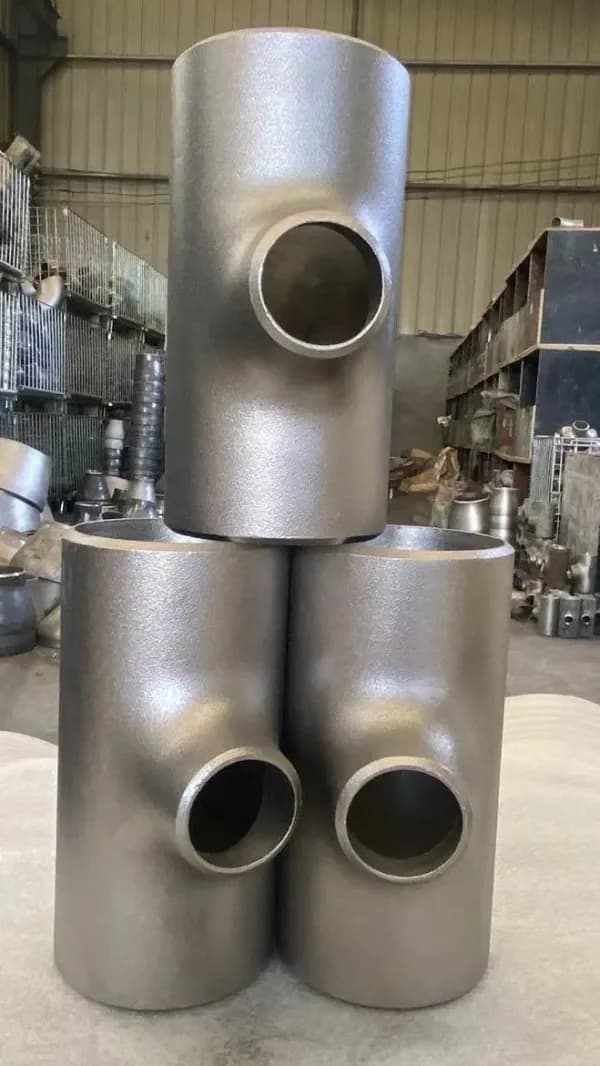
API 5L pipe fittings are the butt-weld components that connect, redirect, change diameter, and branch the high-pressure oil, gas, and petrochemical pipelines built from API 5L line pipe. This page covers the family as a whole: which standards actually govern the fittings, how the WPHY fitting grades map to API 5L X grades such as X52, X65, and X70, and what to confirm before ordering. Shape-level detail is on the sibling pages for the ASTM A53 90° LR elbow and the carbon steel concentric reducer.
One boundary matters more than anything else on this page. API 5L (and its ISO equivalent, ISO 3183) is the specification for line pipe — it does not cover fittings. When the market says "API 5L fittings" or "X65 fittings", it means fittings whose strength and toughness are matched to the API 5L pipe they are welded into. The fittings themselves are ordered to fitting standards: ASME B16.9 or MSS SP-75 for dimensions, and ASTM A860 WPHY, A234 WPB/WPC, or A420 WPL6 for the material. Quoting a fitting "to API 5L" without naming the material standard is a warning sign on any quotation you receive.
Standards That Govern These Fittings
Butt-weld pipeline fittings sit under several standards at once — one for the pipe they match, one or two for dimensions, and a separate one for the fitting material itself. The table below shows who does what, so you can check any quotation line by line.
| Role | Standard | What it covers |
|---|---|---|
| Line pipe the fittings match | API 5L / ISO 3183 | Seamless and welded line pipe, PSL1 and PSL2, grades B through X80 (L245–L555) |
| Butt-weld fitting dimensions, including short-radius elbows and returns | ASME B16.9-2024 | Factory-made wrought butt-welding fittings, NPS 1/2 through NPS 48 (DN 15–1200). Short-radius (1.0D) elbows and 180° returns are in this edition; they are not ordered as a current ASME B16.28 item |
| Withdrawn short-radius standard | ASME B16.28-1994 (withdrawn) | Last edition covered wrought steel butt-welding short-radius elbows and returns. That scope was incorporated into ASME B16.9. A purchase order that still names B16.28 is accepted only against the stated B16.9 edition, not as a live standard |
| Weld end preparation | ASME B16.25 | Bevel ends for field butt welding to pipe |
| Fitting material, high-yield pipeline duty | ASTM A860/A860M | Wrought high-strength ferritic steel butt-welding fittings, grades WPHY 42/46/52/60/65/70 |
| Large-size high-test fittings | MSS SP-75 | High-test wrought butt-welding fittings with a WPHY-42 to WPHY-70 grade ladder, a separate standard from ASME B16.9, not one combined NPS span |
| Fitting material, general process duty | ASTM A234/A234M | WPB and WPC carbon steel fittings for moderate-temperature process piping |
| Fitting material, low-temperature service | ASTM A420/A420M | WPL6 carbon steel fittings, impact tested for low-temperature service |
| Pipeline delivery conditions | ISO 15590-2:2021 | Technical delivery conditions for pipeline transportation fittings, with separate non-sour and sour classes |
| European market alternative | EN 10253-2 | Butt-welding pipe fittings in non-alloy and ferritic alloy steels with specific inspection requirements (different center-to-end dimensions from B16.9 — never mix the two on one line) |
| Sour service material selection | NACE MR0175 / ISO 15156 | Material selection for H₂S-containing environments, with HIC/SSC test requirements |
Adjacent standards belong to adjacent products, not to this page: ISO 15590-1 covers induction bends, ISO 15590-3 covers pipeline flanges (typically ASTM A694 high-yield forgings), and ASME B16.11 covers forged socket-weld and threaded fittings for small-bore connections — see our forged pipe fittings page for that family.
How WPHY Fitting Grades Match API 5L X Grades
The X in API 5L X52 or X65 is not a chemistry code. The number after it is the specified minimum yield strength of the pipe in ksi (thousands of psi), and the same strength appears in the L-series designation in MPa: X52 = L360, X65 = L450, X70 = L485. The WPHY ("wrought pipe high yield") fitting grades follow exactly the same logic, which is why a WPHY 65 fitting is the matching component for an X65 (L450) pipeline.
The table below aligns the ASTM A860 fitting grades with the API 5L pipe grades they are normally welded to, using the published A860 strength requirements.
| A860 fitting grade | API 5L pipe grade | L designation (MPa) | Fitting yield, min ksi [MPa] | Fitting tensile, ksi [MPa] | Elongation, min % (4D) |
|---|---|---|---|---|---|
| WPHY 42 | X42 | L290 | 42 [290] | 60–85 [415–585] | 25 |
| WPHY 46 | X46 | L320 | 46 [315] | 63–88 [435–605] | 25 |
| WPHY 52 | X52 | L360 | 52 [360] | 66–91 [455–625] | 25 |
| WPHY 60 | X60 | L415 | 60 [415] | 75–100 [515–690] | 20 |
| WPHY 65 | X65 | L450 | 65 [450] | 77–102 [530–705] | 20 |
| WPHY 70 | X70 | L485 | 70 [485] | 80–105 [550–725] | 20 |
Two ordering cautions come straight out of this table. First, the published A860 grade ladder has no WPHY 56, while MSS SP-75 does include a WPHY-56 grade — so if your line pipe is X56, tell us the pipe grade and we will confirm the fitting grade before quoting rather than assume one. Second, for lower-duty lines, an ASTM A234 WPB fitting (tensile 415–585 MPa, yield 240 MPa minimum) is the ordinary carbon steel choice strength-matched to Grade B / A106 Gr B pipe; using it against X60 or X70 pipe would make the fitting the weak point of the run, which is exactly what the WPHY ladder exists to prevent.
Chemical Composition and Mechanical Properties
The chemistry below is the ASTM A860/A860M heat analysis for all WPHY grades — one composition band covering the whole strength ladder, with tight sulfur and a carbon-equivalent cap for field weldability. Confirm the values against the standard edition cited on your purchase order, because limits do move between revisions.
| Element (heat analysis) | Limit, % |
|---|---|
| Carbon (C) | 0.20 max |
| Manganese (Mn) | 1.00–1.45 |
| Phosphorus (P) | 0.030 max |
| Sulfur (S) | 0.010 max |
| Silicon (Si) | 0.15–0.40 |
| Nickel (Ni) | 0.50 max |
| Chromium (Cr) | 0.30 max |
| Molybdenum (Mo) | 0.25 max |
| Copper (Cu) | 0.35 max |
| Titanium (Ti) | 0.05 max |
| Vanadium (V) | 0.10 max |
| Columbium (Cb/Nb) | 0.04 max |
| V + Cb | 0.12 max |
| Aluminum (Al) | 0.06 max |
| Carbon equivalent (CE) | 0.42 max (CE = C + Mn/6 + (Cr+Mo+V)/5 + (Ni+Cu)/15) |
| Ni + Cr + Mo + Cu | 1.00 max combined |
The mechanical requirements are grade-dependent and come with conditions that matter at acceptance: yield is measured at 0.2% offset and may not exceed the specified minimum by more than 15 ksi (105 MPa); elongation is 4D on standard round specimens; and every set of fittings is impact tested, because toughness — not just strength — is what the WPHY grades are bought for.
| Requirement | Value |
|---|---|
| Tensile testing | Per grade, see table above |
| Charpy V-notch impact test temperature | −50 °F [−46 °C] |
| CVN absorbed energy, 10×10 mm specimens | 30 ft·lbf (40 J) average / 25 ft·lbf (34 J) minimum single value; smaller sub-size specimens have reduced requirements |
| Lateral expansion, full-size specimens | 0.64 mm (25 mils) min |
| Hardness | 22 HRC (235 HBW) max |
| Delivery condition | All fittings heat treated: normalizing, quenching + tempering, or stress relieving |
| Melting practice | Fully killed, fine-grain material with fine, well-dispersed sulfide inclusions for notch toughness and HIC resistance |
Fitting Types, Sizes and Dimensional Route
Standard B16.9 shapes cover the branches, turns, and transitions of a pipeline; long-radius induction bends are ordered as a separate product. The table below lists the common types and where each one is dimensioned.
| Fitting type | Variants | Dimensional standard |
|---|---|---|
| Elbows | 45°, 90°, 180°; long radius (R = 1.5D) and short radius (R = 1.0D) | ASME B16.9-2024 for both long-radius and short-radius elbows and 180° returns. ASME B16.28-1994 is withdrawn and is not the ordering standard |
| Tees | Equal and reducing | ASME B16.9 |
| Reducers | Concentric (aligned centerlines) and eccentric (flat top, avoids gas/liquid pocketing at low points) | ASME B16.9 |
| Caps | Butt-weld end caps for dead-ending a line | ASME B16.9 |
| Stub ends | Lap-joint stub ends for use with backing flanges | MSS SP-43 types (confirm type and length per order) |
| Crosses and laterals | Equal/reducing crosses, 45° laterals | ASME B16.9 |
| Induction bends | 3D, 5D and longer radii, hot-formed from pipe | ISO 15590-1 (separate product — confirm bend radius and pipe grade per order) |
Size follows the pipe, not the fitting: NPS 1/2 through NPS 48 (DN 15–1200) under ASME B16.9, with wall thickness stated as the schedule or nominal wall matched to the connecting pipe so the weld joint is flush inside and out. Availability in any specific grade-and-size combination is confirmed per order, ASME B16.9 dimensions are ordered to ASME B16.9. Large high-test fittings are ordered to MSS SP-75 and confirmed before the order. This page does not combine the two standards into one NPS span.
Short-radius elbows and 180° returns on this page are dimensioned to ASME B16.9-2024. ASME B16.28-1994 was the last edition of the separate short-radius standard; ASME states that this scope is now included in B16.9. A drawing or specification that still names B16.28 is not the ordering standard for these fittings unless the purchase order names the B16.9 edition that replaces it. This statement is for this product only and is not copied from another fitting page.
Pressure Ratings, Testing and Documentation
A butt-weld fitting does not have its own pressure-temperature rating. Unlike a flange, it is rated by the pipe it is welded into: the fitting wall is ordered to the pipe grade and schedule, and the assembly is designed under the governing code — ASME B31.4 for liquid hydrocarbons, B31.8 for gas transmission and distribution, B31.3 for process piping. Any supplier table quoting a fixed "API 5L fitting pressure rating" is reprinting a pipe design table, not a fitting property; ask for the design basis instead.
What the standards do require on the fitting itself: full-length radiographic examination of weld seams on fusion-welded fittings to ASME Section V / Section VIII UW-51 acceptance; liquid penetrant or magnetic particle examination of cold-formed tees; the Charpy impact, hardness, and tensile testing listed above; and heat treatment records on the mill test report. Certificates are supplied to EN 10204 3.1 as standard, with 3.2 available on request.
Sour Service and Low-Temperature Options
PSL1 and PSL2 are pipe concepts — PSL2 adds impact testing, tighter chemistry, and 100% NDE on the pipe. You cannot order a "PSL2 fitting", but the same intent carries into the fitting order through two routes. Under ISO 15590-2:2021, pipeline fittings are delivered in one of two classes: one for non-sour service and one for sour service, replacing the three-class A/B/C system of the 2003 edition — so specify the class, and do not let a quotation cite the withdrawn 2003 edition. For H₂S-containing service, material selection follows NACE MR0175/ISO 15156, with HIC and SSC testing on the fitting material; the fine-sulfide melting practice required by A860 supports this, but sour acceptance is proven by test, not assumed.
For low-temperature duty outside the pipeline itself, ASTM A420 WPL6 fittings (yield 240 MPa min, impact tested at −46 °C) are the standard carbon steel answer; confirm the design minimum temperature and we will match the fitting grade to it.
Ordering Information
To quote API 5L pipeline fittings accurately, send us: the fitting types and angles; NPS and schedule (or pipe OD and wall thickness); the pipe grade to match (X42–X70 or L290–L485) or the target fitting grade (WPHY 42–70, A234 WPB/WPC, or A420 WPL6); seamless or fusion-welded construction; service class — non-sour or sour (NACE MR0175/ISO 15156); any impact test temperature other than the −46 °C standard; end preparation; any coating requirement (bare, painted, or FBE/3LPE-coated); and quantity with delivery port. All of these are confirmed per order before quotation rather than promised from a catalog.
Common Questions about API 5L Pipe Fittings
Are API 5L pipe fittings actually made to the API 5L standard?
No. API 5L is the line pipe specification and does not cover fittings. Fittings matched to API 5L X-grade pipe are manufactured to ASTM A860 (WPHY 42–70), A234 WPB/WPC, or A420 WPL6 for material, ASME B16.9-2024 (long-radius and short-radius elbows and returns) or MSS SP-75 for dimensions, and ISO 15590-2:2021 for pipeline delivery class. ASME B16.28-1994 is withdrawn; do not order short-radius fittings to it. A quotation should name the fitting standards, not just "API 5L".
Which WPHY grade matches API 5L X52, X65 or X70 pipe?
The WPHY number equals the X number in ksi minimum yield: WPHY 52 for X52 (L360), WPHY 65 for X65 (L450), WPHY 70 for X70 (L485), and so on down to WPHY 42 for X42. One caution: the published ASTM A860 ladder runs 42/46/52/60/65/70 with no WPHY 56, while MSS SP-75 lists WPHY-56 — so if your pipe is X56, confirm the fitting grade with us at inquiry stage.
Do butt-weld pipeline fittings have their own pressure rating?
No. A B16.9 butt-weld fitting takes the rating of the pipe it is joined to — same grade, same wall — and the line is designed under ASME B31.4, B31.8, or B31.3. Fixed "fitting pressure rating" tables published by some suppliers are actually pipe design tables. Ask for the design basis (code, design pressure and temperature, corrosion allowance) with your inquiry.
What do I need to include for a quotation?
Five things: fitting types and angles; NPS and schedule or wall; the pipe grade to match or the fitting grade to order; seamless or fusion-welded construction; and the service class (non-sour or sour per NACE MR0175/ISO 15156) with any special impact temperature. Add coating, quantity, and destination port and we can quote complete. Related pages: API 5L Grade B seamless pipe (PSL1/PSL2) for the pipe itself, or the carbon steel pipe fittings category for the rest of the family.