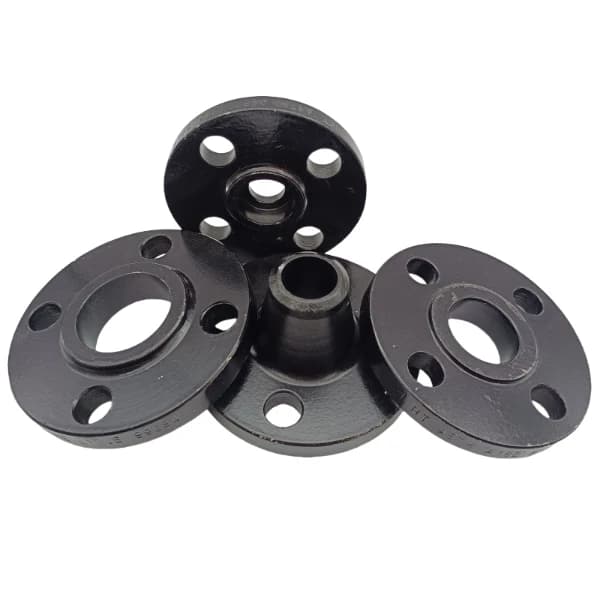
Product Description
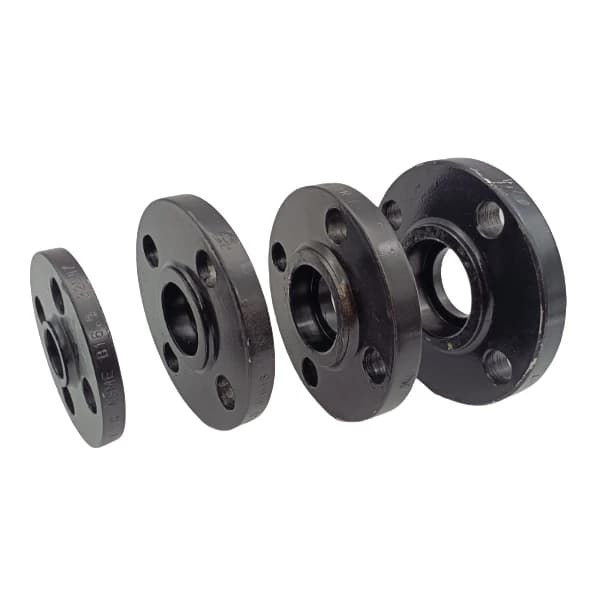
A carbon steel lap joint flange is a two-piece flanged joint. A forged ASTM A105 backing ring slides over the pipe and carries the bolting load, while a separate ASME B16.9 lap joint stub end is butt-welded to the pipe and provides the gasket seating surface. Because the ring is never welded and never touches the line fluid, it can be turned into any bolt position during assembly, and it can be re-used when the stub end is cut off and replaced.
The ring is dimensioned to ASME B16.5, NPS 1/2 through NPS 24, and is supplied in Class 150, 300, 400, and 600. A105 is listed in ASME B16.5 material group 1.1, so the allowable working pressure is read from the Group 1.1 table at the design temperature, never from the class number alone. This page covers the carbon steel route: an A105 forged ring paired with an ASTM A234 WPB stub end for carbon steel pipe. Where the pipe is an alloy, duplex or stainless grade, the same ring design is available with the stub end made in the matching grade, so that only the wetted part is upgraded.
How a Lap Joint Flange Works
Two parts, two jobs. The stub end is welded to the pipe: it is the only part that seals, and the only part in contact with the process fluid. The backing ring sits behind the stub end's lap, presses on it and transfers the bolt load. Neither part is welded to the other, so the ring turns freely on the pipe.
Three consequences matter in procurement:
- Bolt-hole alignment stops being a pipe-rotation problem. On large-diameter or awkward spools the ring is simply turned until its holes line up with the mating flange.
- Material cost can be split. The ring may be carbon steel while the stub end matches an alloy, duplex or stainless pipe. Only the wetted part needs the expensive grade.
- The joint is more flexible than a one-piece flange. ASME B31.3 addresses this explicitly (para. 302.3.5), which is why a weld neck flange is normally specified instead in severe cyclic service.
Two limits follow from the same design. The assembly can never be stronger than the stub end and its weld to the pipe, and the ring carries no sealing face of its own: the seating surface belongs to the stub end lap, so the facing has to be specified with the stub end rather than with the ring.
Chemical Composition of ASTM A105
The backing ring is normally a forged ASTM A105 (ASME SA-105) part. The heat chemistry below is the specification requirement, and a mill test certificate is issued against the actual heat.
| Element | Requirement, % |
|---|---|
| Carbon (C) | 0.35 max |
| Manganese (Mn) | 0.60 - 1.05 |
| Phosphorus (P) | 0.035 max |
| Sulfur (S) | 0.040 max |
| Silicon (Si) | 0.10 - 0.35 |
| Copper (Cu) | 0.40 max |
| Nickel (Ni) | 0.40 max |
| Chromium (Cr) | 0.30 max |
| Molybdenum (Mo) | 0.12 max |
| Vanadium (V) | 0.08 max |
Cumulative limits also apply: Cu + Ni + Cr + Mo + V shall not exceed 1.00%, and Cr + Mo shall not exceed 0.32%. Manganese may rise above 1.05% in step with a reduction in carbon, and the carbon equivalent CE = C + Mn/6 + (Cr + Mo + V)/5 + (Ni + Cu)/15 is held at 0.47 or below. A105 is designated UNS K03504; its approximate European equivalents are EN 10222-2 P245GH and P250GH (W.Nr. 1.0460).
Mechanical Properties of ASTM A105
The values below are minimum acceptance requirements for the finished forging, not typical averages. A105 is not a low-temperature grade: below -29 C the impact toughness is not guaranteed and ASTM A350 LF2 is used instead.
| Property | Requirement |
|---|---|
| Tensile strength | 485 MPa (70 ksi) min |
| Yield strength | 250 MPa (36 ksi) min |
| Elongation | 22% min |
| Reduction of area | 30% min |
| Hardness | 197 HBW max. 137–197 HBW applies when a small forging is accepted on hardness only, and when the purchaser checks hardness. |
| Service temperature range | -29 to 425 C (-20 to 800 F) |
Heat treatment is not mandatory for A105 in general, but it is mandatory for B16.5 flanges in Class 400, 900, 1500 and 2500, for special-design flanges whose design pressure at temperature exceeds the Class 300 rating, and for forged parts over 4 in. in Class 300. Forgings above 4 in. controlling thickness are normalized, or normalized and tempered, and are marked A105N. For sour service the material must also satisfy NACE MR0175 / ISO 15156, which caps hardness at 22 HRC (187 HBW).
Pressure-Temperature Rating of the Assembly
A class designator is not a pressure in psi. The allowable working pressure of a B16.5 flange is read from the material-group table at the design temperature, and it falls as the temperature rises. For A105, which is Group 1.1, the anchor row at ambient temperature is given below.
| B16.5 material group | Class | Max. allowable working pressure at -29 to 38 C (-20 to 100 F) |
|---|---|---|
| 1.1 (ASTM A105) | Class 150 | 285 psig (19.7 bar) |
| 1.1 (ASTM A105) | Class 300 | 740 psig (51.0 bar) |
| 1.1 (ASTM A105) | Class 600 | 1,480 psig (102.0 bar) |
Descriptions that call a Class 150 flange a "150 psi" flange are quoting the class number, not the rating: at ambient temperature a Group 1.1 Class 150 flange is rated 285 psig, and the same flange derates heavily as the temperature approaches its 425 C service ceiling. Rating rows above ambient are edition-specific, so the figure for the design temperature must be read from the ASME B16.5 edition named in the project specification.
The assembly rating is the lower of two numbers: the ring's tabulated B16.5 rating for its group, class and temperature, and the rating of the stub end, which ASME B16.9 does not tabulate at all. A standard B16.9 stub end obtains its pressure capability from its wall thickness by calculation under ASME B31.3. A stub end in the same material and wall as the pipe will match the pipe, but a thin-wall or short-pattern stub end can govern the whole joint, so where the duty is demanding it is better to specify a heavier stub end than a higher class of ring alone.
Stub End Dimensions to ASME B16.9
The stub end is ordered to ASME B16.9 in either the long or the short pattern. The long pattern is the standard pattern; the short pattern must be called out on the order. The dimensions below are the standard table values in millimetres.
| NPS | Barrel OD, max | Barrel OD, min | Length F, long pattern | Length F, short pattern | Fillet radius R | Lap diameter G |
|---|---|---|---|---|---|---|
| 1/2 | 22.8 | 20.5 | 76 | 51 | 3 | 35 |
| 3/4 | 28.1 | 25.9 | 76 | 51 | 3 | 43 |
| 1 | 35.0 | 32.6 | 102 | 51 | 3 | 51 |
| 1 1/4 | 43.6 | 41.4 | 102 | 51 | 5 | 64 |
| 1 1/2 | 49.9 | 47.5 | 102 | 51 | 6 | 73 |
| 2 | 62.4 | 59.5 | 152 | 64 | 8 | 92 |
| 2 1/2 | 75.3 | 72.2 | 152 | 64 | 8 | 106 |
| 3 | 91.3 | 88.1 | 152 | 64 | 10 | 127 |
| 3 1/2 | 104.0 | 100.8 | 152 | 76 | 10 | 140 |
| 4 | 116.7 | 113.5 | 152 | 76 | 11 | 157 |
| 5 | 144.3 | 140.5 | 203 | 76 | 11 | 185 |
| 6 | 171.3 | 167.5 | 203 | 89 | 13 | 218 |
| 8 | 222.1 | 218.3 | 203 | 102 | 13 | 270 |
| 10 | 277.2 | 272.3 | 254 | 127 | 13 | 324 |
| 12 | 328.0 | 323.1 | 254 | 152 | 13 | 381 |
| 14 | 359.9 | 354.8 | 305 | 152 | 13 | 413 |
| 16 | 411.0 | 405.6 | 305 | 152 | 13 | 470 |
| 18 | 462.0 | 456.0 | 305 | 152 | 13 | 533 |
| 20 | 514.0 | 507.0 | 305 | 152 | 13 | 584 |
| 22 | 565.0 | 558.0 | 305 | 152 | 13 | 641 |
| 24 | 616.0 | 609.0 | 305 | 152 | 13 | 692 |
Two standard notes matter at order stage. The lap thickness shall not be less than the nominal pipe wall thickness; and where a short-pattern stub end is used with larger flanges in Class 300 or 600, or with most sizes in Class 900 and above, the length may have to be increased so that the flange does not cover the butt weld. The lap diameter and the gasket face finish follow ASME B16.5 for the class, and the back face of the lap is machined to sit squarely on the backing ring.
Lap Joint Compared with Slip-On and Weld Neck Flanges
All three patterns join a pipe to a flanged connection, and they are not interchangeable where the line is opened regularly, is built from expensive pipe, or sees severe cycling. The table below sets out the differences that decide the choice.
| Feature | Lap joint | Slip-on | Weld neck |
|---|---|---|---|
| Connection to the pipe | Stub end butt-welded; ring loose | Two fillet welds to the pipe | One full-penetration butt weld |
| Is the flange itself welded? | No | Yes | Yes |
| Bolt-hole alignment | Ring rotates freely | Fixed, pipe must be turned | Fixed, pipe must be turned |
| Disassembly | Ring slides off; stub end stays welded | Cut both fillet welds | Cut the butt weld |
| Flange re-use | Ring is re-usable | Not re-usable | Not re-usable |
| Material cost when the pipe is alloy | Lowest: only the stub end follows the pipe grade | Whole flange follows the pipe grade | Whole flange follows the pipe grade |
| Usual class range | Class 150, 300, 400, and 600 | Class 150, 300, 400, and 600 | Class 150 to 2500 |
| Fatigue and severe cyclic service | Least rigid of the three; welded pipe runs are preferred | Fillet welds concentrate stress | Best: smooth stress path |
| Typical choice when | Frequent opening, hard alignment, expensive or lined pipe | Low pressure, low cost, general utility service | High pressure, high temperature, critical duty |
Which Carbon Steel Grades Are Available for the Ring
ASTM A105 is the forged carbon steel grade that ASME B16.5 actually lists, in material group 1.1, and it is the default for this product. Two other carbon steel grades are asked for often enough that their status should be clear before they are quoted.
- ASTM A350 LF2 - a low-temperature carbon steel forging with mandatory Charpy impact testing. It sits in the same ASME B16.5 material group as A105 and is used where the design temperature falls below -29 C. It is a different purchase order line from A105, not a substitute that can be assumed.
- Q235 (GB/T 700) and 20# (GB/T 699) - Chinese domestic grades used widely for Chinese-standard flanges in the GB/T 9112 and HG/T 20592 series. Neither grade appears in the ASME B16.5 material group tables, so a ring made in Q235 or 20# cannot be presented as a B16.5-rated component. They can be quoted for non-code or non-pressure work only, and only with the purchaser's written acceptance of the substitution.
None of this changes the fact that the ring is not wetted, so it does not need the corrosion resistance of the pipe. Where the pipe is stainless, the usual pairing is a ring in A182 F304 or F316 with a stub end in the same grade; where only the ring is to be stainless and the pipe is carbon steel, the stub end must still match the pipe.
Applications
Lap joint flanges are chosen where the line is opened often, where bolt holes are hard to line up, or where the wetted material has to be upgraded without upgrading the whole flange. Typical duties include:
- Chemical and petrochemical process lines that are stripped, cleaned or inspected at intervals, including neutral and mildly corrosive service.
- Water supply, drainage and fire protection networks, where large diameters make bolt-hole alignment the practical problem.
- Oil and gas auxiliary systems, utility headers, skids and tie-ins into existing pipework.
- Mining and slurry lines that are rotated or replaced on a wear schedule.
- Pipelines, vessels and pump or exchanger connections built from alloy, stainless or lined pipe, where the ring stays carbon steel and only the stub end follows the pipe grade.
Carbon steel is not corrosion resistant on its own, so coating is part of the specification rather than an optional extra: black paint, oil, galvanizing or a two-pack coating should be named on the order wherever the ring will be left exposed. Light surface rust on an unprotected ring is normal and is not evidence of a material defect. Once coated, the ring should still turn freely on the stub end, so the coating is normally kept off the seating shoulder.
Ordering Information
A lap joint flange cannot be quoted from the ring alone, because half of the assembly is the stub end. For a firm quotation please state:
- Size and pressure class - NPS or DN, and Class 150, 300, 400, or 600.
- Stub end: pattern (long or short), material (A234 WPB as standard for carbon steel pipe, or the grade matching the pipe), and whether the length has to be increased to clear the butt weld.
- Facing on the stub end lap - RF, FF or RTJ - together with the mating flange it has to seal against.
- Ring material and surface protection, and whether rings and stub ends are supplied as a pair or separately.
- Quantity, and any marking, tagging or packing requirement.
- Certification and supplementary requirements: mill test certificate to EN 10204 3.1, impact testing, hardness limit, NACE MR0175 / ISO 15156, or third-party inspection.
- Applicable standard edition and design temperature, so that the pressure rating is read from the correct table.
Common Questions about Carbon Steel Lap Joint Flanges
Does a Class 150 carbon steel lap joint flange hold 150 psi?
No. "150" is a class designator, not a pressure in psi. For ASTM A105, which is ASME B16.5 material group 1.1, the maximum allowable working pressure is 285 psig at -29 to 38 C, and it reduces as the temperature rises. Read the Group 1.1 row for the design temperature in the ASME B16.5 edition named in your specification.
What has to be ordered - the ring, or the ring plus a stub end?
Both. The ring alone cannot make a joint. The stub end is welded to the pipe, provides the gasket seating face and is the only wetted part; the ring is a loose backing ring that presses on the stub end's lap. Specify the pattern, material and facing of the stub end at the same time as the ring.
How does a lap joint flange differ from a slip-on flange?
A slip-on flange is welded to the pipe with two fillet welds and cannot move once installed. A lap joint ring is not welded at all: it rotates on the stub end, so bolt holes can be aligned without turning the pipe, and the ring can be re-used when the stub end is cut off and replaced. A slip-on is cheaper piece for piece; a lap joint is chosen when the pipe grade is expensive or the joint is opened regularly.
Can the backing ring and the stub end be different materials?
Yes, and it is the main cost lever in this design. Because the ring is not wetted it can be A105 carbon steel while the stub end follows an alloy, duplex or stainless pipe. The stub end must match or be compatible with the pipe it is welded to; the ring only has to carry the bolting load and survive the external environment.
Which stub end pattern should I order, long or short?
The long pattern is the standard one and is the safe default where there is room along the pipe. The short pattern saves space, but with larger flanges in Class 300 and 600, and with most sizes in Class 900 and above, the standard short length may have to be increased so that the flange does not cover the butt weld. Whichever pattern is chosen, say so on the order.
What information is needed before a quotation can be confirmed?
Size and class, stub end pattern and material, the facing, the ring material and coating, quantity, and the certificate or supplementary test you need. Giving the design temperature and the applicable standard edition as well lets the pressure rating be read from the correct table instead of assumed from the class number.
Compare this item with the Carbon Steel Flange range, the A105 carbon steel flange page for the material itself, and the one-piece alternatives: plate flange and threaded flange.