
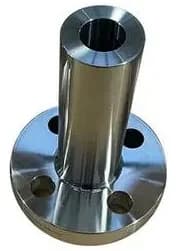
A reducing flange is one flange body with two different bores, so a pipe size change and a flanged joint happen in the same piece. Use it when the drawing names that one-piece joint and the size pair is a standard combination. When the pair is uncommon, or when the reducer and the flange should be bought and inspected separately, specify a carbon steel concentric reducer plus a standard flange of the same grade. This page does not publish a stock range, a price, or a pressure rating for every size step.
What a Reducing Flange Is
The large end matches the larger pipe. The small end matches the smaller pipe. The bolt circle and the outside diameter follow the larger flange size, so the reducing flange bolts to a standard flange of that larger size. The facing is still a separate order item: raised face, flat face, or ring-type joint. Do not treat "reducing" as a facing.
An eccentric bore lines the tops of the two bores so a horizontal liquid line does not hold a high-point pocket. A concentric bore keeps both centerlines on one axis. The drawing has to say which one. A photo of the flange does not prove the bore is eccentric, and it does not prove the pressure class.
What the Standard Covers, and What It Does Not
For NPS 1/2 through NPS 24, flange outline, facing, drilling, and class are read from ASME B16.5. Class 2500 in that standard stops at NPS 12. NPS 26 and larger is ASME B16.47, and the order has to name Series A or Series B. B16.5 does not set the forging chemistry. The material is a separate line, most often ASTM A105 for carbon steel or ASTM A182 for stainless and alloy forgings.
A published dimension table is the only place a bore, thickness, or bolt count should come from. This article does not reprint one. Outside diameter, thickness, and bolt count change with both NPS and class, so a single row of numbers without the class is not an order.
How to Choose the Material
The forging grade does not change because the bore steps down. An ASTM A105 carbon steel flange is the usual forging for non-corrosive service that is not a low-temperature design. It is not ASTM A350 LF2. Order LF2 when the design requires impact testing. It is also not ASTM A694, which is the high-yield forging used when the flange has to match transmission line pipe.
For corrosive water, steam, or low-chloride process service, the matching stainless forging is an ASTM A182 F304 flange. F304L is the low-carbon grade when the weld procedure needs it. F316 or F316L is the molybdenum grade when the fluid is a chloride case. The mill certificate for the heat is the chemistry record. A grade name on this page is not that certificate.
Reducing Flange or Reducer Plus Flange
| Question | Use a reducing flange | Use a reducer plus a standard flange |
|---|---|---|
| What is being bought | One forged body with two bores | A butt-weld reducer and a separate flange |
| Centerline | Concentric or eccentric, as the drawing says | A concentric reducer keeps both centerlines on one axis |
| Replacement | The whole flange comes out together | The reducer can be replaced without changing the flange |
| Uncommon size pair | Confirm the pair exists in the named standard before ordering | Usually easier to source from standard ends |
A concentric reducer is a fitting, not a flange. Its ends are ordered large end first, and each end takes the wall of the pipe it welds to. Putting the two components in one sentence does not make them one product form.
What a Reducing Flange Does Not Prove
It does not set the line pressure. Class is the B16.5 series. Allowable pressure is read from the material group at the design temperature in the edition named on the order. It does not prove the bore is eccentric, and it does not prove the flange was forged rather than cut from plate. ASTM A105 does not cover raw plate.
It also does not replace a slip-on flange or a weld neck flange of one bore. Those are joint types. A reducing flange can be ordered as one of those types, but the type, the two NPS sizes, and the class are three fields.
What to Confirm on the Inquiry
- Large-end NPS and small-end NPS, written as a pair, plus concentric or eccentric.
- Flange type: weld neck, slip-on, or the type the drawing names.
- ASME class, or the B16.47 series if the large end is above NPS 24.
- Facing, and the ring number if the facing is ring-type joint.
- Forging specification and grade, and the edition if the order requires one.
- Design pressure, design temperature, and whether impact testing applies.
- Quantity and the document: a material test report for the heat, not a catalog range.



