Product Description
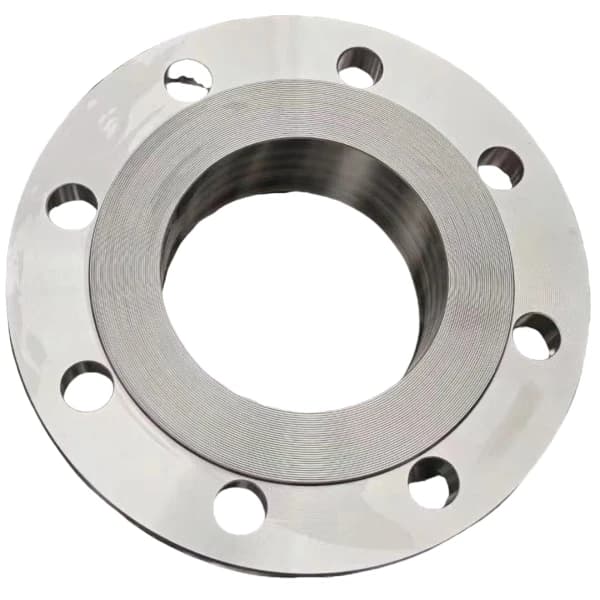
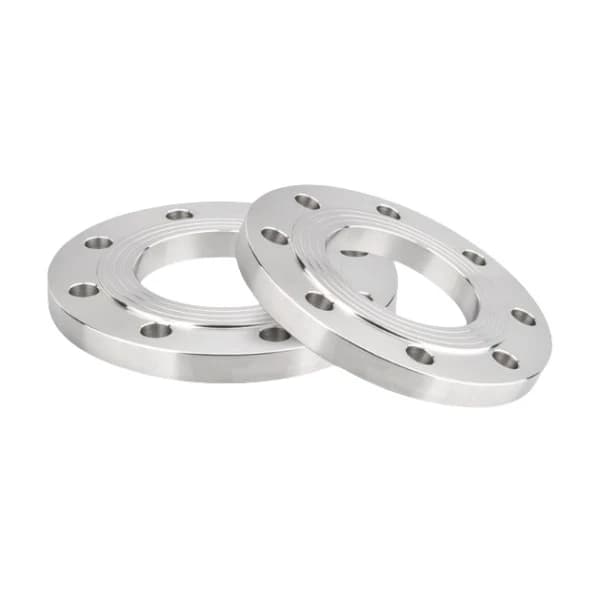
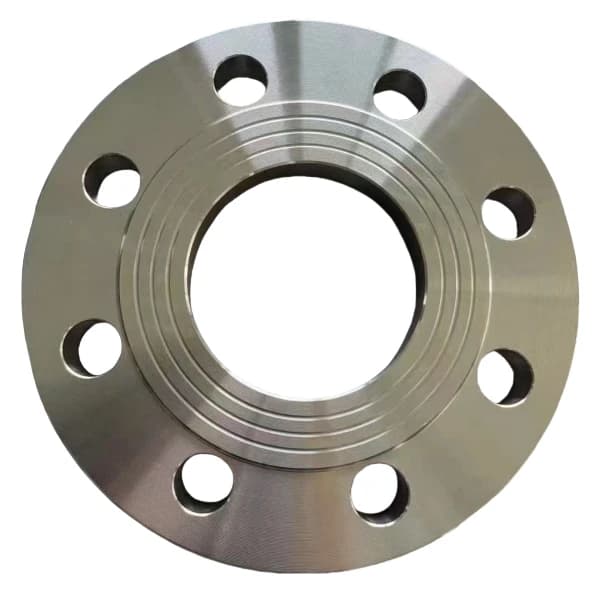
A 304 stainless steel flange is a forged flanged fitting made from the 304 austenitic grade and ordered to ASTM A182/A182M, Grade F304 (UNS S30400, EN 1.4301). Dimensions, facings, bolt holes and marking follow ASME B16.5, so the flange bolts to other components built to the same Class and nominal size. This grade covers the full B16.5 type list: weld neck, slip-on, blind, socket weld, threaded and lap joint, plus reducing flanges where a size step is needed.
304 is chosen for general corrosion resistance and for service where carbon steel would rust: process and cooling water, steam and condensate, food and dairy circuits, low-chloride chemicals and utility piping. It is not a chloride grade and it has no molybdenum, and Class is a rating class rather than a pressure. What fixes the quotation is the type, nominal size, Class, facing, bore or pipe schedule, face finish and inspection documents - not the grade name on its own.
Grade and Product Scope
This is the 304 / F304 flange page. The forging grade is F304, UNS S30400, which is the material also designated 1.4301 and X5CrNi18-10 in the European system and SUS 304 in the Japanese system when it is bought as bar or plate. The flange itself is ordered as a forging to A182, which is a separate product standard with its own chemistry table and its own testing rules. The table below sets out what this page covers and where a separately specified item begins.
| Item | This page | Do not treat it as |
|---|---|---|
| Grade | 304 stainless steel, ASTM A182 Grade F304, UNS S30400 | F304L (S30403), F316 (S31600), F304H (S30409), or a dual-certified heat quoted as one grade without stating which one |
| Form | Forged or rolled flange: weld neck, slip-on, blind, socket weld, threaded, lap joint | A cast flange to ASTM A351 CF8, or a flange machined from bar stock |
| Dimensions | ASME B16.5, NPS 1/2 through NPS 24 | ASME B16.47 large-diameter flanges, or EN 1092-1 and JIS B2220 flanges |
| Rating | Class 150 through Class 1500; Class 2500 to NPS 12 | A single pressure in bar or psi that applies at every temperature |
Two boundaries decide whether a delivered flange is the item described here. A182 covers forged and rolled products, so a flange machined from bar is a different item - section 1.2 of the standard sends bar-machined parts to A479/A479M, A739 or A511/A511M. And A182 products are limited to 10,000 lb (4,540 kg) each; larger or heavier flanged parts are ordered to A336/A336M or A965/A965M. If an offer is based on castings or on bar stock, it is not this product.
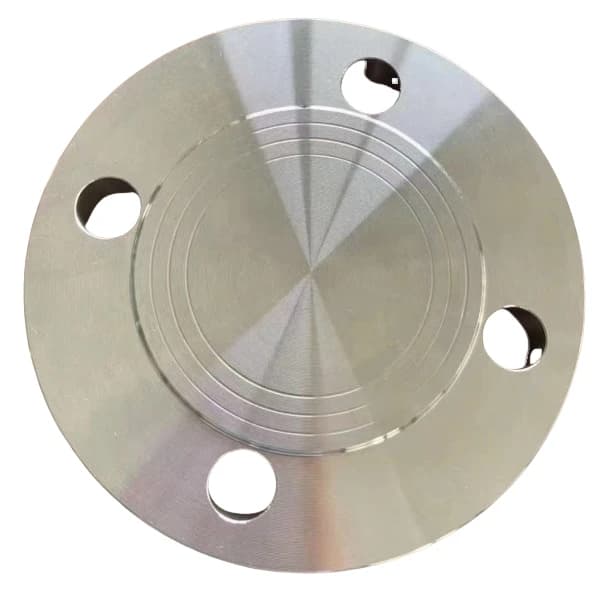
This page sits inside the stainless steel flange range. The multi-grade version of that range - 304, 316L and 321 on one page - is the ASME B16.5 stainless steel flanges page, and the forging route across those grades is covered by forged stainless flanges. Where 304 is the wrong grade, the substitutes are separate items: ASTM A182 F347 flanges for stabilised high-temperature service and ASTM A182 F22 alloy steel flanges for high-pressure, high-temperature duty. A blind flange, which has no bore and closes the end of a line, is a separate form and is described on its own page.
How a 304 Flange Is Specified
A flange order is never complete with the grade alone. Each variable below changes the drawing, the machining or the test documentation, so any one left open comes back as a clarification before the quotation. The table lists what is normally fixed first and what a change in each one actually moves.
| Variable | What to state | Why it matters |
|---|---|---|
| Flange type | Weld neck, slip-on, blind, socket weld, threaded or lap joint | Decides the joint design and the weld detail, and whether the joint can be opened without cutting the pipe |
| Nominal size | NPS, with the DN equivalent if the drawing is metric | Selects the dimension row in the ASME B16.5 table for that type and Class |
| Rating class | Class 150, 300, 400, 600, 900, 1500 or 2500 | Sets thickness, bolt size and bolt circle. One Class cannot be substituted for another by adding bolts |
| Facing | Raised face (RF), flat face (FF) or ring joint (RTJ) | Decides the gasket and the face machining; the raised face height itself changes with the Class |
| Bore | Pipe schedule or a stated bore, for weld neck, socket weld and threaded types | The bore has to match the adjoining pipe wall, not only the nominal size |
| Documents | Material test report, plus any inspection the project requires | Decides what is tested and how the flange is marked |
One statement that used to appear here is not on that list. The earlier version of this page quoted a 515-690 MPa tensile range and a Class 300 pressure as though they were the flange rating. A182 sets a minimum tensile strength, not a range with a 690 MPa ceiling, and a Class 300 flange has no single pressure value at all. One worked example of how the bore, the schedule and the Class interact on a single item is set out on the NPS 6 Class 300 weld neck flange page.
Chemical Composition and Mechanical Properties
The composition and the room-temperature mechanical requirements for Grade F304 in ASTM A182/A182M are given below as the standard publishes them, cross-checked against several independent compilations. The edition named on the purchase order governs, and the material test report for the heat supplied is the document that acceptance is based on. Percentages are maximums unless a range is shown.
| Element | F304 (UNS S30400) |
|---|---|
| Carbon, C | 0.08 max |
| Manganese, Mn | 2.00 max |
| Phosphorus, P | 0.045 max |
| Sulfur, S | 0.030 max |
| Silicon, Si | 1.00 max |
| Chromium, Cr | 18.0-20.0 |
| Nickel, Ni | 8.0-11.0 |
| Nitrogen, N | 0.10 max |
Those limits are the A182 forging values. A plate or sheet standard for the same 304 material sets slightly different limits - silicon 0.75 max instead of 1.00 max, for example - so a composition table copied from a plate page can make a compliant forging look out of specification. The mechanical requirements are minimums at room temperature, and the Class does not change them: the Class changes the dimensions and the rating table, not the grade.
| Property | Requirement for F304 |
|---|---|
| Tensile strength, min | 515 MPa (75 ksi) |
| Yield strength, 0.2 % offset, min | 205 MPa (30 ksi) |
| Elongation in 2 in. (50 mm) or 4D, min | 30 % |
| Reduction of area, min | 50 % |
| Sections over 5 in. (130 mm) thick | Minimum tensile strength 485 MPa (70 ksi) |
| Brinell hardness | No limit is specified for the austenitic grades |
Reduction of area is a forging requirement and is not normally imposed on plate. Hardness is not a graded property here: the A182 table leaves that column empty for the austenitic grades, so a supplier who quotes a tight HBW window, or who presents 690 MPa as an upper limit that the material must meet, is quoting a house rule rather than the standard.
ASME B16.5 Size, Class and Facing Limits
ASME B16.5 covers pipe flanges and flanged fittings from NPS 1/2 through NPS 24 and sets the pressure-temperature ratings, dimensions, tolerances, marking and testing, together with requirements and recommendations for bolting, gaskets and flanged joints. Size coverage is not identical for every Class, and the raised face height changes with the Class, so the two are read together.
| Rating class | Sizes covered by ASME B16.5 | Raised face height |
|---|---|---|
| Class 150, 300, 400, 600, 900, 1500 | NPS 1/2 through NPS 24 | 1/16 in. (1.6 mm) in Class 150 and 300; 1/4 in. (6.4 mm) in Class 400 and above |
| Class 2500 | NPS 1/2 through NPS 12 only | 1/4 in. (6.4 mm) |
| NPS 26 and larger | Outside B16.5 - ASME B16.47 Series A or Series B applies | 1/4 in. (6.4 mm) in B16.47 |
The raised face is one reason two flanges of the same size but different Class will not make up against each other: the face heights differ, and the metric tables in the same standard state 2 mm and 7 mm for the same two groups. Order one Class and one facing, and check that the mating flange uses the same convention. A ring joint flange has a grooved face instead, and the groove number has to match the ring gasket number; the raised face is the normal choice up to Class 600. Flat face is for mating to cast iron, plastic-lined or other brittle equipment, where a raised face would load the mating flange unevenly.
B16.5 is also where the allowable pressure comes from, and it does not come from the Class number alone. For a given Class and material group the maximum allowable pressure is read from the pressure-temperature table at the design temperature and falls as the temperature rises. A182 F304 is a group 2.1 material in the current edition, while the low-carbon F304L sits in group 2.3 and is read from a different, lower table. That is why this page publishes no single MPa figure for Class 300 or for any other Class: the number belongs to the group table and the design temperature, and how it is applied to a line is decided by the piping code, for example ASME B31.3 for process piping.
Forge Grade or Plate-Made Flange?
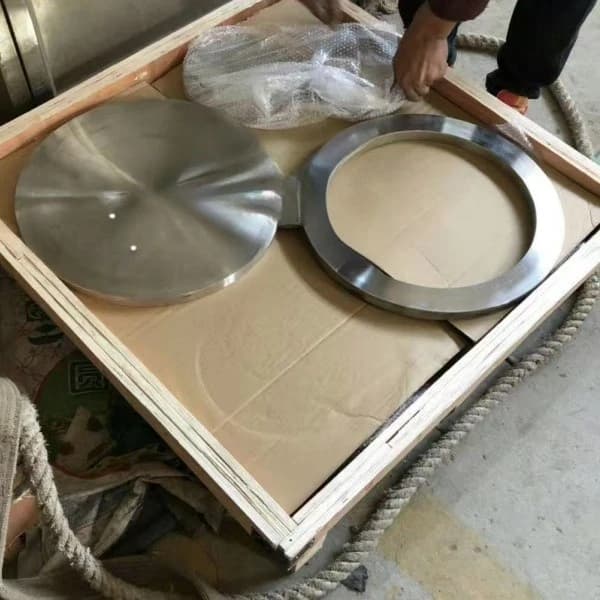
ASME B16.5 permits blind flanges and certain reducing flanges to be made from plate, and hubless slip-on and plate flanges are often produced that way. The finished part is still a 304 stainless steel flange, but the material standard named on the certificate changes with the route, and the two routes do not carry the same grade marking or the same test rules. It is worth asking which route an offer is based on before comparing prices.
| Route | Material standard on the certificate | What changes for the buyer |
|---|---|---|
| Forged or rolled | ASTM A182/A182M Grade F304 | The flange can be marked F304 and carries the forging requirements, including reduction of area and the solution-annealing record |
| Cut from plate | ASTM A240/A240M Type 304 | Composition limits differ - silicon 0.75 max against 1.00 max in the forging table - and the marking is the plate type, not F304 |
| Machined from bar | ASTM A479/A479M or an equivalent bar specification | Not an A182 product at all; section 1.2 of A182 refers bar-machined parts to the bar specifications |
| Cast | ASTM A351 Grade CF8 | A casting from the same family, with its own chemistry table and marking; it is not a forging |
The practical consequence is a documentation question rather than a metallurgical one. If the drawing says A182 F304, a plate-made blind flange does not satisfy it. If the drawing only says 304 flange, both routes can be offered, and the quotation should state which one it is so that the mill certificate matches the requirement.
304, 304L or 316: Which Grade for the Flange
These grades look alike on a drawing and are not interchangeable on an order. The L grade is the low-carbon version of 304 with lower minimum tensile and yield strengths, and it sits in a different material group in ASME B16.5, which means a lower pressure-temperature table. 316 is a different alloy, with molybdenum added for pitting and chloride resistance.
| Grade | Carbon, max | UNS | Minimum tensile / yield | B16.5 material group | Normally chosen when |
|---|---|---|---|---|---|
| F304 | 0.08 % | S30400 | 515 / 205 MPa | 2.1 | General 304 flange service, where the full 304 strength is needed |
| F304L | 0.030 % | S30403 | 485 / 170 MPa | 2.3 | Welded assemblies that are not solution annealed after welding |
| F316 / F316L | 0.08 % / 0.030 % | S31600 / S31603 | 515 / 205 MPa and 485 / 170 MPa | 2.2 / 2.3 | Chloride-bearing or more aggressive process duty, on a separate product page |
Dual-certified heats marked F304/F304L are common, because a low-carbon heat often meets both sets of mechanicals. That is a materials fact, not a permission slip: if the design uses the group 2.1 table, the certificate has to show the non-L tensile and yield values, or the flange does not qualify for that table. The L grades are not a route to better corrosion resistance; they are a route to avoiding sensitisation in a weld heat-affected zone.
On corrosion, 304 carries no molybdenum. It performs well in fresh water, steam, food-contact duty and mildly corrosive service, which is why it is the default for utility and process lines that simply need clean stainless. It is not the grade for seawater, brine or hot chloride-bearing streams, where pitting and chloride stress-corrosion cracking are the failure modes; 316, duplex or a higher alloy is selected there, and even then suitability depends on chloride level, temperature, oxygen and stress rather than on the grade name alone.
Material Characteristics and Heat Treatment
A182 requires the austenitic grades to be supplied solution treated: heated to 1040 °C (1900 °F) minimum and quenched, with the quench cooling below 260 °C (500 °F). That is why the heat treatment record is part of the certificate. The anneal is what restores corrosion resistance after forging and machining, and it cannot be judged from the outside of the flange.
Three practical points follow from it. After hot working, the forging is cooled below 538 °C (1000 °F) before the heat treatment cycle, as the standard requires. 304 is not hardened by heat treatment, so there is no hardened 304 condition to order. And intergranular corrosion testing to ASTM A262, or impact, ultrasonic, magnetic particle and radiographic examination, can all be added - but A182 applies supplementary requirements only when the purchaser names them on the order, so a project that needs one has to put it in the enquiry rather than assume it.
Two characteristics are often misread on site. Cold working raises the magnetic response of 304, so a magnet is not a grade test and a slightly magnetic flange is not a wrong-material flange. And austenitic stainless steel has higher thermal expansion and lower thermal conductivity than carbon steel, which affects bolt-up and welding practice but not the grade marking.
Applications
304 flanges are used where a stainless flanged joint is needed and the service does not justify 316 or a duplex grade: potable and process water, cooling water and utilities, steam and condensate, compressed air, food and beverage and dairy circuits, pharmaceutical and clean-service pipework, low-chloride chemical and petrochemical lines, pulp and paper, and general industrial piping that has to stay rust-free.
They are not the right choice for seawater or chloride-rich streams, for stagnant high-chloride service, or where the process relies on molybdenum-bearing stainless steel. The flange also does not define the pressure or temperature limit of the line: that comes from the rating table at the design condition and from the piping code. Sour service to NACE MR0175 / ISO 15156, cryogenic duty and elevated-temperature duty each need their own review rather than a grade substitution.
Ordering Information
Send these details and the flange can be quoted without a second round of questions:
- Flange type and quantity.
- Nominal size in NPS, with DN if the drawing is metric.
- Rating class.
- Facing - RF, FF or RTJ - and the face finish if the gasket supplier specifies one.
- Bore, or the pipe schedule for weld neck, socket weld and threaded types; state whether the adjoining pipe is seamless or welded.
- Grade: F304, or F304L / F316 / F316L if that is what the drawing calls for.
- Documents and inspection: material test report to EN 10204 3.1, plus any impact, intergranular corrosion, ultrasonic, magnetic particle or third-party inspection the project requires.
- Marking, packing and delivery requirements.
Availability, lead time and commercial terms are confirmed per enquiry.
Common Questions about 304 Stainless Steel Flanges
These are the questions that decide most 304 flange enquiries, and the answers follow the same standards as the sections above.
Is this flange 304 or 304L?
As written, this page is 304: ASTM A182 Grade F304, UNS S30400, carbon 0.08 % max. F304L is UNS S30403 with carbon 0.030 % max, lower minimum tensile and yield strengths, and a different material group in ASME B16.5, so it is ordered as its own grade. Dual-certified F304/F304L heats exist; if the design uses the group 2.1 table, ask for the certificate to show the non-L mechanical properties.
Does Class 300 mean the flange is rated at 300 psi?
No. Class is a rating class, not a pressure. The maximum allowable pressure for a Class 300 A182 F304 flange is read from the ASME B16.5 pressure-temperature table for material group 2.1 at the design temperature, and it decreases as the temperature rises. That is why no single pressure figure is quoted on this page.
Which facing should I order?
Raised face is the default for steel piping and takes a spiral-wound or sheet gasket. Flat face is for mating to cast iron, plastic-lined or other brittle equipment. Ring joint is for high-pressure service and needs a matching ring gasket by groove number. The raised face height is 1/16 in. (1.6 mm) in Class 150 and 300 and 1/4 in. (6.4 mm) from Class 400 upward, so the facing and the Class have to be read together.
Can a 304 flange be bolted to an EN 1092-1 PN 16 flange?
Not directly. Class and PN are separate rating systems and the dimensions are not the same. As one worked example, a DN 100 Class 150 and a DN 100 PN 16 flange both use eight bolts, but the bolt circles, outside diameters and raised face heights differ, so the joint will not make up. Use one standard and one rating system on both sides of a joint, or a transition piece made for the purpose.
Is a plate-made 304 blind flange the same as a forged F304 flange?
The part can look identical and is still 304 stainless steel, but it is not an A182 F304 flange. ASME B16.5 allows blind flanges and certain reducing flanges to be made from plate, and the material certificate then refers to ASTM A240 Type 304, which has different composition limits and different test rules, and the flange is not marked with the F304 grade. Tell us which document the project requires.
How are availability and commercial terms confirmed?
Availability, lead time, documents and commercial terms are confirmed for each enquiry.