
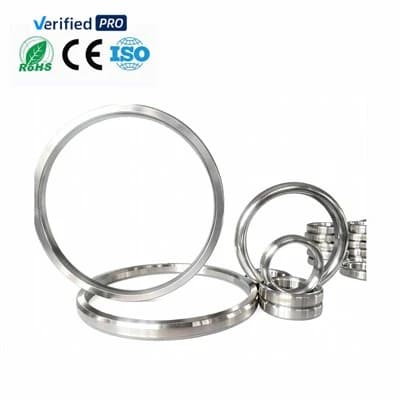
A lap joint flange connection is a two-piece assembly: a loose ASME B16.5 backing ring and a separate ASME B16.9 stub end that is butt-welded to the pipe. The ring supplies the bolt pattern and load path, while the stub end supplies the gasket seating surface and pipe connection.
Two parts must be specified together
The backing ring slides over the pipe and sits behind the lap of the stub end. It is not welded to the pipe or to the stub end, so it can rotate for bolt-hole alignment. The stub end is the wetted part, is butt-welded to the pipe, and presents the sealing face to the mating flange. A ring by itself cannot complete the joint, and a stub end without the correct ring does not provide the required drilling and bolting arrangement.
For the verified carbon steel lap joint flange product, the ring follows ASME B16.5 and the stub end follows ASME B16.9. The covered size range is NPS 1/2 through NPS 24, with Class 150, 300, 400, and 600 options. These are dimensional-standard classes, not direct pressure values. The order must state one NPS and one class for each line item.
For one verified dimensional example, an NPS 2 ASME B16.9 stub end has a listed F length of 152 mm in the long pattern and 64 mm in the short pattern. That difference shows why the pattern belongs on the purchase order; final dimensions must still be checked against the edition named by the project.
Specification boundary
| Assembly field | What to state on the order | Why it matters |
|---|---|---|
| Backing ring | ASME B16.5 edition, NPS, class, ring material, and coating | Controls the drilling, bolting geometry, ring envelope, and external protection |
| Stub end | ASME B16.9 edition, long or short pattern, material, wall or schedule, and facing | Controls the pipe weld, lap, gasket seating surface, and fit behind the ring |
| Available envelope | NPS 1/2-24; Class 150, 300, 400, or 600 | Prevents an inquiry from implying an unsupported size or class |
| Pairing | State whether rings and stub ends are supplied as matched pairs or as separate items | Prevents quantity and compatibility ambiguity |
| Documents | Required material certificate, inspection records, marking, and supplementary tests | Defines the release package instead of assuming it from the product name |
The ring and stub end may use different materials because only the stub end contacts the line fluid. For a carbon steel assembly, identify the carbon steel ring material and the stub-end material compatible with the pipe. If the pipe is alloy, stainless, duplex, or lined, state the required stub-end material explicitly rather than assuming that the ring grade applies to both parts. This material split can limit the higher-cost alloy to the wetted component, but compatibility still has to be approved for the actual piping specification.
Lap joint versus slip-on and weld neck
| Feature | Lap joint | Slip-on | Weld neck |
|---|---|---|---|
| Parts at the pipe end | Loose ring plus separate stub end | One flange slipped over the pipe | One flanged hub aligned with the pipe |
| Connection to pipe | Stub end uses a butt weld; ring is not welded | Flange is attached with fillet welds | Flange hub uses a butt weld |
| Gasket seating surface | On the stub-end lap | On the flange | On the flange |
| Bolt-hole alignment | Ring can rotate after the stub end is welded | Drilling becomes fixed when installed | Drilling becomes fixed when installed |
| Material definition | Ring and stub end are separate purchase fields | One flange material is specified | One flange material is specified |
Do not substitute one type for another only because the NPS and class match. A slip-on flange changes the weld detail and places the sealing face on the flange itself. A weld neck flange also places the face and drilling on one component, with its hub butt-welded directly to the pipe. A lap joint keeps the drilling on the loose ring and the sealing face on the separate stub end. The drawing, piping class, mating connection, and approved weld detail must therefore identify the intended type.
Procurement checklist
- State the ASME B16.5 edition, NPS, and one class: 150, 300, 400, or 600.
- State the ring material, required surface protection, quantity, and marking.
- State ASME B16.9 for the stub end, plus long or short pattern, material, wall or schedule, and quantity.
- State the stub-end facing required to match the mating flange and gasket arrangement.
- Provide the pipe standard, grade, outside diameter, and wall so the butt-weld end and material pairing can be checked.
- Confirm whether the quotation covers complete pairs or separate rings and stub ends.
- List certificates, inspection records, marking, packing, and any supplementary test required by the project.
A purchase description should name both components on the same line or on cross-referenced lines. Before release, check that NPS, class, drilling, stub-end pattern, pipe wall, facing, material pairing, and quantities agree. This is more reliable than copying a long dimensional table into the inquiry, because the stated standards and edition control the detailed dimensions.
What are the two parts of a lap joint assembly?
A stub end is welded to the pipe and a loose backing flange rotates around it for bolt alignment.
When is this design useful?
It simplifies alignment and can reduce the cost of alloy systems by limiting alloy material to the stub end.



