
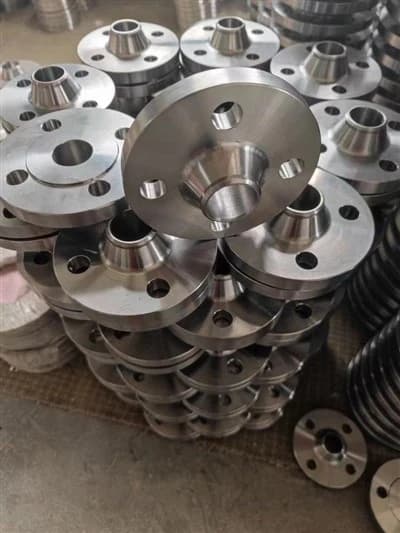
"HPHT" is a purchasing shorthand, not a standard definition. In practice it means a flanged joint whose design temperature and design pressure push carbon steel out of its useful range, usually Class 900 and above. Selecting such a joint is a materials and design-code exercise, not a catalogue exercise.
What HPHT Service Does to a Flanged Joint
Four mechanisms drive the specification, and each one changes what you have to ask for on the inquiry.
- Creep. Under sustained load at elevated temperature, steel deforms slowly with time. Chrome-moly steels enter the creep range at roughly 425 °C (800 °F) and above, which is where carbon steel stops being a safe choice.
- Stress rupture and thermal fatigue. Start-up, shutdown and load swings add cycles to an already time-dependent failure mode, so the joint has to be designed for a life, not just a load.
- High-temperature hydrogen attack. Atomic hydrogen diffuses into the steel and reacts with carbides, forming methane that causes internal fissuring. Operating limits are defined by industry envelopes such as API RP 941, and they must be confirmed against the design code for the actual hydrogen partial pressure.
- Loss of bolt preload. Gasket relaxation and the different thermal expansion of flange, bolts and pipe can unload the joint even when each part was correctly specified.
Carbon steel forgings such as an ASTM A105 carbon steel flange are common and economical, but A105 is not a creep-resistant material. Once the design temperature enters the creep range, the joint moves to chrome-moly or nickel-base forgings.
Material Groups Used for HPHT Flanges
| Material group | Common forging specification | Why it is chosen | Confirm on the inquiry |
|---|---|---|---|
| 1.25Cr-0.5Mo | ASTM A182 F11 (Class 1, 2 or 3) | Creep resistance with manageable welding and PWHT | Class, temper condition, PWHT record, hardness after PWHT |
| 2.25Cr-1Mo | ASTM A182 F22 (Class 1 or 3) | Higher creep strength; widely used where hydrogen is present | Class, PWHT cycle, hardness after PWHT, NDT extent |
| 9Cr-1Mo-V | ASTM A182 F91 | High creep strength, allowing thinner walls at the same duty | Normalising and tempering records, PWHT temperature window |
| 9Cr-0.5Mo-1.8W-V | ASTM A182 F92 | Higher creep strength than F91 for advanced steam conditions | Tungsten content, heat-treatment records, welding consumables |
| Nickel-base | ASTM B564 UNS N06625 | Used when temperature and corrosion exceed the Cr-Mo range; significantly more expensive | UNS number, solution annealing condition, availability and price |
A temperature limit is not a property of the forging alone. It depends on the code edition, the allowable stress table, the section thickness and the environment. Confirm the allowable temperature and allowable stress from the governing design code rather than from a supplier datasheet.
Pressure Class, Facing and Size Limits
ASME B16.5 covers NPS 1/2 through NPS 24 in Classes 150, 300, 400, 600, 900, 1500 and 2500. Above NPS 24 the standard does not apply; large-diameter flanges fall under ASME B16.47, which absorbed the withdrawn API 605 practice into its Series B.
A class number is not a pressure. The allowable working pressure of a given class falls as temperature rises, so the pressure-temperature table for the material group has to be read at the design temperature. Class 900 is common for heavy-wall refinery and utility piping, Class 1500 for reactor circuit lines, and Class 2500 for the most severe duties.
Ring-type joint (RTJ) facings are widely specified at high class because they give metal-to-metal sealing with ring gaskets made to ASME B16.20. RTJ only works if the groove geometry, finish and gasket hardness are compatible, so the mating flange, the ring number and the gasket specification must be ordered together. An ASTM A182 F51 RTJ/RF blind flange shows how facing and class are stated on a single line item.
The flange material should also match the piping it is welded to. The pipe counterpart of the F11 material group is ASTM A335 P11 seamless chrome-moly pipe, and plate components in the same group are supplied to ASTM A387 Grade 11 chrome-moly plate.
Welding, PWHT and Examination
- Preheat and interpass temperature control prevents hydrogen-induced cracking in chrome-moly weld metal; the values come from the qualified welding procedure, not from a general rule.
- Post-weld heat treatment is required by ASME B31.3 Process Piping as a function of material group and thickness. Confirm the applicable requirement for your material group and wall thickness.
- Consumables must match the base material so the weld metal keeps creep strength and does not become a soft or brittle link.
- Hardness testing after PWHT is the usual evidence that stress relief was achieved; ask for the values and the acceptance range.
- Examination extent is set by the fluid service category and design conditions in the piping code, not by a blanket 100% rule. Confirm the required percentage on the isometrics and the piping class.
What Cannot Decide the Selection
A photograph, a magnet test, a spark test or an "equivalent grade" statement cannot qualify a flange for HPHT service. What qualifies it is the material test report: forging specification, class or grade, heat number, heat-treatment condition, chemical analysis, mechanical results and the examination actually performed.
What to Confirm with Your Inquiry
- Design pressure and design temperature, plus the governing design code and edition
- Forging specification and grade or class (A182 F11 / F22 / F91, B564 N06625, or your own specification)
- Size, rating and facing (NPS, ASME B16.5 class, RF or RTJ, ring number and groove detail)
- Matching pipe and plate material group, wall thickness or schedule
- PWHT requirement, hardness acceptance range and post-PWHT testing
- Examination extent and acceptance standard, plus any third-party inspection
- Certificate type required (EN 10204 3.1 or 3.2) and any additional testing
Send the list above with your enquiry so the quotation is built on the same specification you will inspect against.



