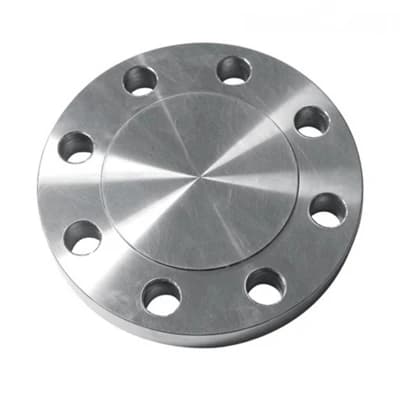
Product Description
This page covers a single, clearly defined item: an ASTM A182 Grade F51 duplex stainless steel blind flange in NPS 6 (DN 150), supplied with either a ring type joint (RTJ) facing or a raised face (RF) facing - one facing per order, because the two seal designs are not interchangeable. Dimensions and pressure classes follow ASME B16.5. A part from this line, marked "ASTM A182 GR. F51 RTJ ASME B16.5 6" 2500LB", documents the configuration the workshop has actually produced in this size: NPS 6, Class 2500, RTJ facing. Other class and facing combinations for this size are quoted per order.
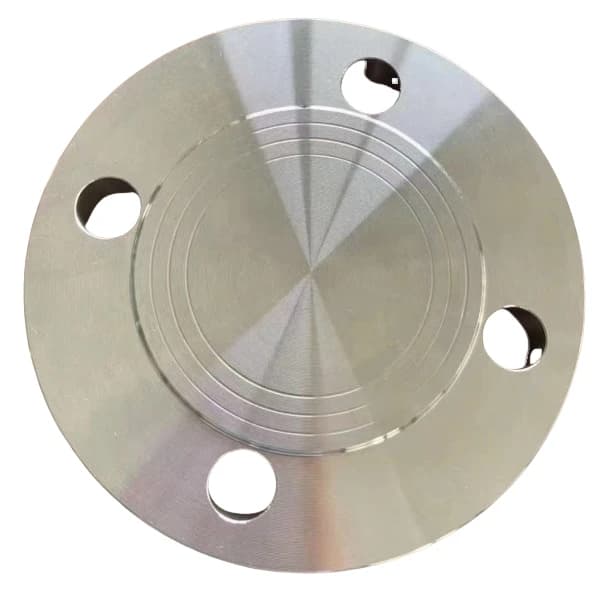
A blind flange is a solid disc with no bore. Where every other flange in the line lets media pass through, the blind closes the end: a pipeline terminus, a vessel nozzle awaiting future extension, or a joint kept for maintenance access so the line can be reopened by removing bolts instead of cutting pipe. Because there is no bore, the full pressure load lands on the disc rather than being carried by a hub-and-shell structure, which is why a blind is the heaviest flange in its size and class and why its thickness column is read differently from other flange types.
Chemically, F51 is the ASTM A182 forging designation of UNS S31803 - the original "Duplex 2205" chemistry, W.Nr. 1.4462. On the material test certificate the same melting lot may appear under either the A182 F51 designation or the UNS number; both refer to the same duplex austenite-ferrite steel. If your drawing names UNS S32205 (A182 F60) instead, that is the nitrogen-tightened variant of the same family and should be confirmed as a separate line item.
Chemical Composition and Mechanical Properties of A182 F51
The table below lists the heat-analysis limits that ASTM A182 places on Grade F51 forgings, cross-checked across four independent compilations of the standard; the mechanical row is the solution-annealed minimum that the certificate must meet. Values on a delivered certificate are heat results, and a production lot is accepted against the ordered edition of the standard.
| Element (heat analysis, wt%) | ASTM A182 Grade F51 / UNS S31803 |
|---|---|
| Carbon (C) | 0.030 max |
| Manganese (Mn) | 2.00 max |
| Phosphorus (P) | 0.030 max |
| Sulfur (S) | 0.020 max |
| Silicon (Si) | 1.00 max |
| Chromium (Cr) | 21.0 - 23.0 |
| Nickel (Ni) | 4.50 - 6.50 |
| Molybdenum (Mo) | 2.50 - 3.50 |
| Nitrogen (N) | 0.08 - 0.20 |
| Iron (Fe) | Balance |
Mechanical requirements apply to the solution-annealed condition, which is the only delivery condition in which a duplex forging develops its balanced austenite-ferrite structure.
| Mechanical property (solution annealed) | Minimum requirement |
|---|---|
| Tensile strength | 620 MPa (90 ksi) min |
| Yield strength, 0.2% offset | 450 MPa (65 ksi) min |
| Elongation in 2 in. / 50 mm | 25% min |
| Reduction of area | 45% min |
| Hardness | Per the ordered edition of the specification |
The yield figure is 450 MPa against 170 MPa for annealed 316L, which is the structural argument for duplex in high-pressure flanged joints. The hardness ceiling quoted for this grade is 290 HBW and 293 HBW, depending on the product standard; the certificate and the order-cited edition decide which ceiling applies.
ASME B16.5 Pressure Classes and the Group 2.8 Rating Table
The Class number on a flange is a dimensional and rating index, not a pressure value. The working pressure a Class 150 or Class 2500 F51 blind may hold is read from the ASME B16.5 pressure-temperature table for its material group, and it steps down as design temperature rises - the way class, material group and temperature combine is summarized on our ASME B16.5 stainless steel flanges page. A182 F51 / S31803 sits in ASME B16.5 Material Group 2.8 together with the S31803 plate grade. The anchor row of that table is reproduced below; intermediate temperature rows differ between editions, so the current B16.5 table governs the design value.
| Material group | Forging / plate designation | Working pressure at -20 to 100°F (-29 to 38°C), psig by class |
|---|---|---|
| B16.5 Group 2.8 | A182 Gr. F51 / A240 Gr. S31803 | CL 150 = 290 | CL 300 = 750 | CL 400 = 1,000 | CL 600 = 1,500 | CL 900 = 2,250 | CL 1,500 = 3,750 | CL 2,500 = 6,250 |
Three boundaries of the B16.5 system matter when ordering this part. First, Class 2500 is dimensioned only for NPS 1/2 through NPS 12, so NPS 6 is inside the range, while the remaining classes run to NPS 24; beyond NPS 26 the flanges move to ASME B16.47. Second, the Group 2.8 rating tables carry a footnote that B16.5 and B16.47 duplex flanges shall not be used below -60°F (-51°C) or above 600°F (315°C); duplex strength falls off and embrittlement mechanisms take over outside that window. Third, ratings in the group table already embody the duplex material properties - there is no separate "duplex bonus" to apply on top of a Class figure.
RTJ and RF Facings: One per Order, Not Interchangeable
The name of this product names two facings because the factory produces both; an order must select one. The two designs seal by different mechanisms, use different gaskets, and must match the mating flange - an RTJ face cannot seal against a raised face, and mixing the two is the single most expensive facing mistake in flange procurement.
| Criterion | Raised face (RF) | Ring type joint (RTJ) |
|---|---|---|
| Sealing surface | Flat machined face, slightly raised above the bolt-face plane | Precision-machined groove in the flange face |
| Gasket | Soft or semi-metallic: spiral wound, sheet, double-jacketed | Solid metal ring gasket, oval or octagonal cross-section, per ASME B16.20 (R, RX, BX styles) |
| Seal mechanism | Gasket compression between the two faces | Metal-to-metal: the ring deforms into the groove |
| Typical service | General process and steel-to-steel joints; the default facing | High-pressure and critical service; common from Class 600 upward and required on API 6A / 6BX connections |
| Raised face height | 1/16 in. (1.6 mm) in Class 150 and 300; 1/4 in. (6.4 mm) in Class 400 and above | Not applicable - groove depth and dimensions come from the B16.5 ring-joint tables |
| Face finish | Serrated stock finish, 125-250 µin Ra | Groove faces machined smooth and free of scratches; finish and tolerance per the standard |
For an RTJ order, the ring gasket is part of the joint, not an accessory: the gasket style, R number and material must match the groove, and the softer ring material deforms against the harder flange. Our ASME B16.20 oval ring-joint gasket page covers the gasket side of this joint, including the oval versus octagonal cross-section distinction.
Why the Blind Carries the Full Pressure Load
Because the disc has no bore, system pressure pushes on the full disc area and tries to bow it outward from the center. ASME B16.5 answers this with the thickness column T of the blind-flange dimension table, measured across the base of the flange rather than across a raised face. Two practical consequences follow for a buyer. The first is handling: an NPS 6 Class 2500 blind is a heavy, rigid disc, and larger sizes in Class 300 and above need lifting provision at receiving. The second is compatibility: never bolt a blind of a lower class against mating flanges of a higher class. The bolt patterns may appear close enough to draw up, but the disc thickness was not designed for that pressure, and the joint is under-strength at exactly the point where the line is dead-ended.
A plain blind can also be modified, and each modification changes the part enough that it must be quoted, not assumed. A center NPT tap (commonly 1/4 in. or 1/2 in.) turns the blind into an instrumentation connection for a gauge, vent or drain. A bored and drilled blind can act as a reducing flange at a dead end. High-hub blinds carry an extended hub on the back face to stiffen the disc and spread bolt load on high-pressure large-bore work. State any of these requirements explicitly in the enquiry.
Blind Flange or Spectacle Blind?
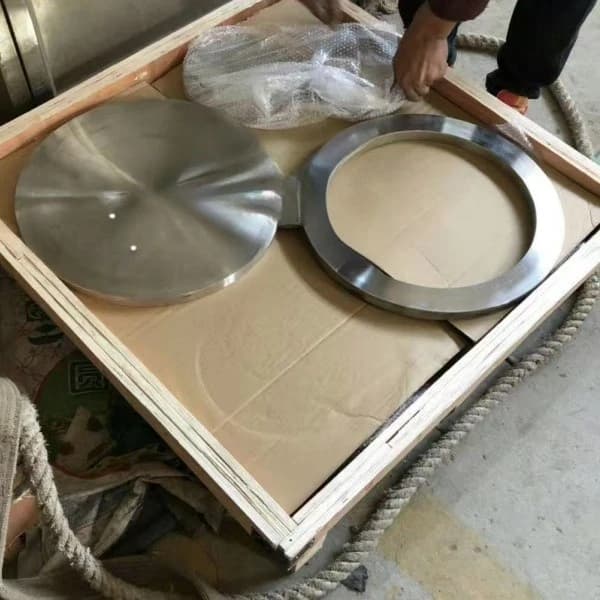
If the line will be isolated once and stay isolated, a blind flange is the right part. If the same joint alternates between flow and positive isolation during turnarounds, a spectacle blind (figure 8) or a paddle blank and spacer set stays in the line and rotates or swaps instead of being removed. Those line blanks are governed by ASME B16.48, not by B16.5, and they must match the class and facing of the flanges they sit between. Ordering a B16.5 blind where the line design calls for a B16.48 line blank - or the reverse - is a common cross-standard mix-up worth checking before the enquiry is sent.
Duplex F51 Material Characteristics
Duplex 2205 combines roughly equal parts austenite and ferrite. The ferrite carries the high yield strength; the austenite restores toughness and weldability; and the combined chemistry - 22% chromium, 3% molybdenum and controlled nitrogen - gives chloride pitting and crevice performance well beyond 316L, together with strong resistance to chloride stress-corrosion cracking, the classic austenitic failure mode in hot chloride service. The pitting resistance equivalent number (PREN) computed from the chromium, molybdenum and nitrogen printed above is 30.5 to 37.8; PREN is a selection aid, not an acceptance value, and qualification for a specific medium always returns to project testing and service data.
Two metallurgical boundaries deserve attention before the material is specified. Duplex steels embrittle through the 475°C ferrite decomposition and through intermetallic precipitation at higher temperatures, which is why long-term service is kept below 300°C as a selection practice, not as a B16.5 rating, and why the B16.5 Group 2.8 tables stop at 600°F (315°C). Related to this, stress relief in the 600-900°C band is not an available heat treatment for this grade - if a formed or welded part needs property restoration, the treatment is a full solution anneal followed by a rapid quench, which is also the delivery condition in which the forging is supplied.
For fabrication, the reference practice for the 2205 family is a matching ER2209 duplex filler, controlled heat input, limited interpass temperature, and pickling and passivation after welding to restore the passive film; grinding alone does not restore the corrosion margin. Where the service is sour (H2S-containing), NACE MR0175 / ISO 15156 lists this material family for qualification, but applicability depends on the specific environment class of the project, and the sour-service envelope must be confirmed against that document rather than assumed from the grade name.
Applications
The NPS 6 F51 blind flange is specified where a chloride-bearing line at moderate-to-high pressure needs a removable end closure. Typical screening contexts include offshore and onshore oil and gas piping and manifolds, seawater cooling and firewater lines, desalination and reverse-osmosis systems, chemical and petrochemical process lines handling chloride streams, flue gas desulfurization circuits, and pulp and paper bleaching equipment. These are selection contexts, not performance guarantees: suitability for a specific medium, temperature and pressure combination follows from the project design code and the service data, not from the grade name alone. Where the wider family is needed, our Duplex 2205 flange page covers the full flange-type range in this material, and our S31803 blind flange page covers blind configurations across the full size and class range.
Ordering Information
A quotation for this part is assembled from a short, fixed list of details. The marked example on this page - NPS 6, Class 2500, RTJ - shows how those details appear in the workshop marking on the finished flange.
| Order element | What to state |
|---|---|
| Size | NPS 6 (DN 150) for this page; other sizes quoted per order |
| Pressure class | ASME B16.5 Class 150 / 300 / 400 / 600 / 900 / 1500 / 2500 - name one; Class 2500 runs only to NPS 12 |
| Facing | RTJ or RF, one per order; for RTJ state the ring gasket style and R number (or let us select it from the B16.5 groove table) |
| Gasket and bolting | State whether gaskets and studs are to be quoted with the flange |
| Material certificate | State the certificate type the project requires; heat results are reported against the ordered edition of A182 |
| Inspection and NDE | Additional examination (PMI, hydrostatic, NDE) is quoted when it is named on the order |
| Service details | Medium, design temperature and pressure for sour or chloride service qualification |
Common Questions about the A182 F51 6 in Blind Flange
Is ASTM A182 F51 the same material as UNS S31803 or Duplex 2205?
Yes. S31803 is the UNS number, F51 is the forging grade under ASTM A182, and "Duplex 2205" is the industry trade name for the same 22Cr-5Ni-3Mo-N chemistry. On drawings and certificates the terms are used interchangeably. The nitrogen-tightened variant UNS S32205 (A182 F60) is closely related but is a separate chemistry with tighter Cr, Mo and N minimums, and most new procurement names it explicitly.
Can an RTJ blind flange be bolted against a raised face flange?
No. The RTJ face has a groove that needs a metal ring gasket; the raised face needs a soft or semi-metallic gasket on a flat surface. The two faces cannot form a seal against each other, and no adapter arrangement should be improvised - the facing of the blind must match the facing of the mating flange, which is why an order must select one facing.
Which pressure classes can the NPS 6 F51 blind flange be supplied in?
The marked part photographed for this page documents NPS 6, Class 2500, RTJ as a produced configuration. The other B16.5 classes for this size are quoted per order - send the class with the enquiry. Remember that Class 2500 is dimensioned only up to NPS 12, so NPS 6 is inside that class's range, and that the working pressure of any class is read from the Group 2.8 pressure-temperature table at design temperature, not from the class number.
What gasket does an RTJ blind flange require?
A solid metal ring gasket to ASME B16.20 in the style and R number matching the B16.5 groove - oval or octagonal cross-section in style R, or the pressure-energized RX and BX styles where the service calls for them. The ring material is selected softer than the flange so it deforms into the groove; state the ring material or ask for it to be selected with the joint.
Why does the class number not tell me the working pressure directly?
Because the allowable pressure is a function of class, material group and temperature together. A Class 150 F51 blind and a Class 150 A105 blind share dimensions but sit in different B16.5 material groups with different rating tables. The Group 2.8 anchor row is reproduced on this page; the value at your design temperature comes from the current edition of the table.
What should I include in an enquiry for this flange?
Size (NPS 6), class, facing - and for RTJ the gasket details - plus the certificate type, any inspection requirements, and the service medium with design temperature and pressure. Those items are exactly the ones the workshop marking on a finished flange carries, which is why quoting starts from them.