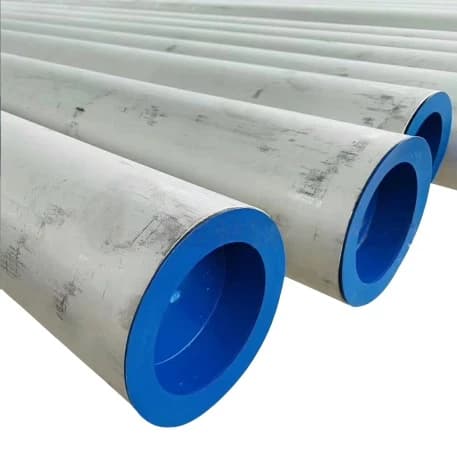
Product Description
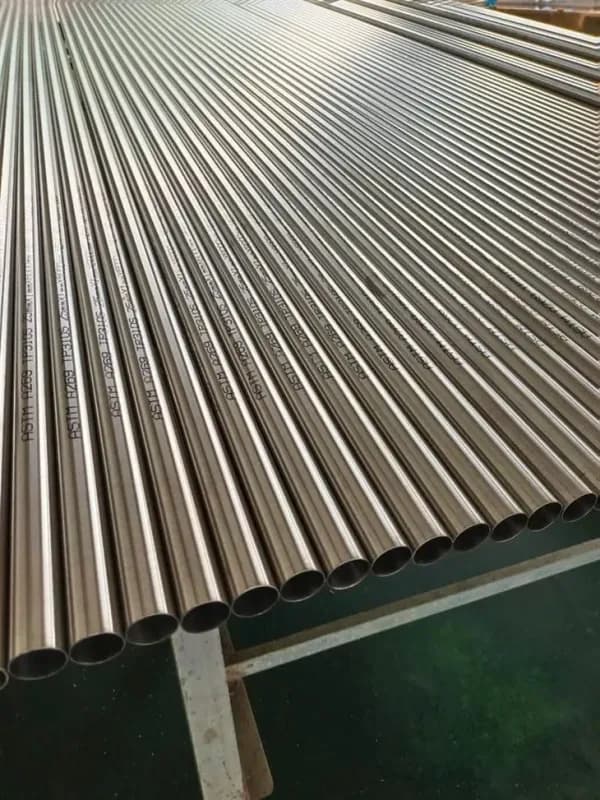
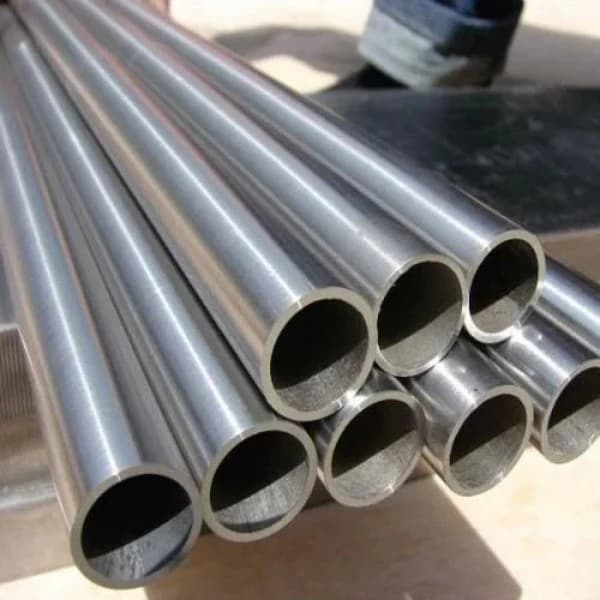
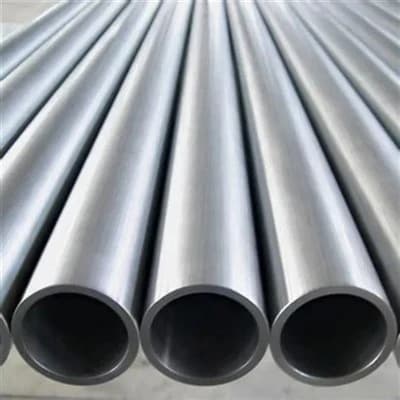
316L stainless steel pipe is the low-carbon, molybdenum-bearing austenitic grade specified when a process line or a water line carries chlorides. Under ASTM A312 / ASME SA312 it is designated TP316L, UNS S31603; the same alloy is written EN 1.4404 and JIS SUS 316L in European and Japanese purchasing specifications. The molybdenum is what separates it from the 18-8 grades: a minimum of 2.00% Mo raises resistance to chloride pitting and crevice corrosion, which is why 316L is the working choice for seawater, desalination, chlorinated and reclaimed water, wastewater, and many chemical process streams.
The L matters as much as the molybdenum on a welded line. TP316L is limited to 0.035% carbon, low enough to keep chromium carbide precipitation out of the weld heat-affected zone, so the pipe does not need post-weld heat treatment to stay resistant to intergranular corrosion. For pipe that will be welded, orbital or manual, the L grade is the safer specification, and the price difference against standard TP316 is small.
Corrosion performance in service still depends on the water or process chemistry, the chloride level, temperature, flow velocity, and the welding procedure. This page therefore uses the ASTM A312 grade limits as the technical basis and leaves every supply dimension, wall thickness and length to be confirmed on the order.
Chemical Composition per ASTM A312 TP316L
The limits below are the ASTM A312 / SA312 requirements for TP316L (UNS S31603), not a mill analysis of one heat. One caution when you compare data sheets online: the pipe standard and the plate standard are not interchangeable. ASTM A240 plate limits silicon to 0.75%, while ASTM A312 pipe allows 1.00%. Several grade comparison tables copy the plate figure into the pipe column, so check which standard a supplier table was built from before you use it.
| Element | TP316L requirement, % by weight |
|---|---|
| Carbon (C), max | 0.035 |
| Manganese (Mn), max | 2.00 |
| Phosphorus (P), max | 0.045 |
| Sulfur (S), max | 0.030 |
| Silicon (Si), max | 1.00 |
| Chromium (Cr) | 16.0 - 18.0 |
| Nickel (Ni) | 10.0 - 14.0 |
| Molybdenum (Mo) | 2.00 - 3.00 |
| Iron (Fe) | Balance |
Mechanical Properties per ASTM A312 TP316L
These are the minimum tensile requirements of ASTM A312 for TP316L, measured after the solution anneal the standard makes mandatory. Elongation depends on the direction the test piece is taken from, so state which direction your specification requires. Hardness is not the governing acceptance value in A312; it is reported on the mill certificate only when the order asks for it, and published reference values differ between sources.
| Property | TP316L requirement |
|---|---|
| Tensile strength, min | 485 MPa (70 ksi) |
| Yield strength, 0.2% offset, min | 170 MPa (25 ksi) |
| Elongation in 2 in., min, longitudinal | 35% |
| Elongation in 2 in., min, transverse | 25% |
| Heat treatment | Solution annealed at 1040 °C (1900 °F) minimum, then rapidly cooled |
| Hardness | Not an A312 acceptance criterion; confirm on the order if a value is required |
Where 316L Pipe Is Used
Water and process service is where the molybdenum earns its cost. The list below follows the duty, not the industry label, because the same plant often runs several of these services at once and each one can justify a different grade.
- Chlorinated and reclaimed water. Chloride in the water is the main driver of stainless pitting. Where chloride runs high, or where the line is dosed with hypochlorite, 316L is the usual specification and 304 is not.
- Wastewater and effluent. Treatment plant lines see sulfides, chlorides and a shifting mix of industrial discharge. 316L is the standard material for the corrosive sections.
- Seawater, desalination and coastal supply. Intake, RO permeate and brine handling lines are specified in 316L as a minimum, with duplex grades considered where chloride and temperature both run high.
- High-purity water and WFI loops. Pharmaceutical purified water and water-for-injection loops are built to avoid dead legs, and 316L with a polished or electropolished bore is the usual requirement.
- Food and beverage. Juices, carbonated drinks and electrolyte-containing products are more aggressive to the passive film than plain potable water, so 316L is chosen over 304 for those lines.
- Chemical process and dosing lines, cooling water and heat exchangers. Where the cooling medium is brackish or chemically treated, 316L gives the margin that 304 does not.
Where the water is fresh, low in chloride and at ambient temperature, the 18-8 grades remain the economical answer. Compare that route on the 304 stainless steel seamless pipe page before you spend the alloy premium.
Seamless or Welded: State It on the Order
ASTM A312 covers seamless (SMLS), welded (WLD) and heavily cold worked (HCW) pipe under one specification, so the grade alone does not tell the mill which route you want. Welded pipe is the normal supply for process and water service: it is made by automatic welding without filler metal, then solution annealed and pickled, which restores the corrosion resistance across the seam. Seamless is specified when the design code requires it or when the service is critical enough that a seam is not acceptable.
| Factor | Seamless (SMLS) | Welded (WLD) |
|---|---|---|
| How it is made | Hot or cold finished from solid billet, no weld seam | Rolled from plate or strip, automatically welded without filler metal, then solution annealed |
| Wall thickness uniformity | Slight eccentricity is possible | Very uniform, because it starts from flat strip |
| Surface finish | Good | Excellent, from cold rolled strip |
| Common size coverage | Common enquiry range NPS 1/8 to NPS 24, not a supply commitment | Common enquiry range NPS 1/8 to NPS 30, easier in large diameters, not a supply commitment |
| Where it is specified | High pressure or critical service, or where the design code requires seamless | Standard process piping, water service and general corrosive duty |
| Extra examination | Standard A312 mechanical and hydrostatic tests | Weld seam non-destructive examination in addition |
Above roughly NPS 30, large-diameter stainless pipe normally moves to ASTM A358 (electric fusion welded) or ASTM A778 (welded pipe for general corrosive service) rather than A312. State the route on the enquiry so the quotation is not built on an assumption.
316L or 304: Decide on the Chloride Level
The choice is a chloride decision, not a quality decision. 304 carries about 18% chromium and 8% nickel with no molybdenum, and it performs well in freshwater, low-chloride potable water and many food media. 316L adds 2.00 - 3.00% molybdenum, which raises the pitting resistance equivalent number. On the composition in the table above, and without nitrogen, that number is about 23 to 28. It is not an acceptance value.
Chloride thresholds quoted in the trade, such as 200 ppm as the point where 304 stops being comfortable, are engineering rules of thumb rather than a limit written into any pipe standard. Actual behaviour depends on temperature, pH, stagnation, crevices, weld condition and surface finish. Use the threshold to shortlist the grade, then confirm the selection with your corrosion or process engineer for the specific analysis of the water.
Dimensions, Schedules and Tolerances
Stainless pipe wall thickness is ordered by schedule to ASME B36.19M, and the schedule does the same job as a wall thickness call-out: SCH 10S is the workhorse for process and water lines, SCH 40S is used for higher pressure, and SCH 80S where the design calls for extra wall. The table below is a dimension reference for writing an enquiry, not a stock list; availability of any NPS and schedule is confirmed against the order.
| NPS | Outside diameter, mm | SCH 10S wall, mm | SCH 40S wall, mm | SCH 80S wall, mm |
|---|---|---|---|---|
| 1/2 | 21.3 | 2.11 | 2.77 | 3.73 |
| 3/4 | 26.7 | 2.11 | 2.87 | 3.91 |
| 1 | 33.4 | 2.77 | 3.38 | 4.55 |
| 1-1/2 | 48.3 | 2.77 | 3.68 | 5.08 |
| 2 | 60.3 | 2.77 | 3.91 | 5.54 |
| 3 | 88.9 | 3.05 | 5.49 | 7.62 |
| 4 | 114.3 | 3.05 | 6.02 | 8.56 |
| 6 | 168.3 | 3.40 | 7.11 | 10.97 |
| 8 | 219.1 | 3.76 | 8.18 | 12.70 |
| 10 | 273.1 | 4.19 | 9.27 | 12.70 |
| 12 | 323.9 | 4.57 | 10.31 | 12.70 |
Name the NPS or outside diameter, the schedule or wall thickness, and the required length so the quotation can be based on the actual configuration.
Documentation and Inspection
Ask for an EN 10204 Type 3.1 mill test certificate with the heat number, the chemical analysis and the mechanical test results; that is the normal documentation package for A312 pipe. The extra items buyers often want are purchaser-specified, not automatic: positive material identification (PMI), an intergranular corrosion test such as ASTM A262 Practice E, hydrostatic or non-destructive test certificates, and third-party inspection. A312 requires them only when the order says so, so list them explicitly or they will not be quoted.
Ordering Information
An enquiry that can be priced without a second round of questions contains the following.
- Specification: ASTM A312 or ASME SA312, or the standard your project specification names
- Grade and designation: TP316L, UNS S31603, or EN 1.4404 / SUS 316L where the project uses those
- Manufacturing route: seamless or welded, and whether heavily cold worked pipe is acceptable
- Size: NPS or DN, or the outside diameter in millimetres
- Wall: schedule (5S, 10S, 40S, 80S) or a wall thickness in millimetres
- Length: single random, double random, or cut to length
- End finish: plain end, or bevelled end for butt welding
- Surface: solution annealed and pickled as standard; polished or electropolished for hygienic duty
- Quantity, by size and schedule
- Service conditions: fluid, chloride content, temperature and pressure
- Documents and tests: EN 10204 3.1 as standard, plus any PMI, intergranular corrosion, hydrostatic or third-party inspection required
For the small-bore, thin-wall end of the same alloy family, see our ASTM A213 TP304 / TP316L heat exchanger tubes, which are quoted against the tubing standards rather than A312.
Frequently Asked Questions
These are the questions most often asked before a 316L pipe order is placed.
What is the difference between TP316 and TP316L pipe?
Carbon. TP316 allows up to 0.08% carbon and TP316L up to 0.035%, and that difference decides whether chromium carbides precipitate in the weld heat-affected zone. The lower carbon of TP316L keeps the weld zone resistant to intergranular corrosion without post-weld heat treatment, which is why the L grade is specified for anything that will be welded. The trade-off is strength: the A312 minimum tensile is 515 MPa for TP316 and 485 MPa for TP316L, so if a design needs the higher minimum, it has to be stated on the order.
When should a water line be specified in 316L instead of 304?
Chloride content is the deciding variable. Fresh, low-chloride potable water and many food media are well served by 304 or 304L. Once chloride runs high, as in seawater, desalination, chlorinated water, chemical wastewater or coastal salt-spray exposure, the molybdenum in 316L is what protects against pitting and crevice attack. The 200 ppm chloride figure often quoted as the switch-over point is a rule of thumb rather than a standard limit, so confirm the selection against the actual water analysis and temperature.
Do I need seamless pipe for water and process service?
Usually not. Welded ASTM A312 pipe, automatic welded without filler metal and then solution annealed and pickled, is the standard supply for process and water lines, and it gives more uniform wall thickness because it starts from flat strip. Seamless is specified where the design code requires it, where the service is critical, or where cyclic fatigue makes a weld seam an unacceptable crack initiation site. State the route you want on the enquiry rather than leaving it to be assumed.
Which documents come with the pipe?
Expect an EN 10204 Type 3.1 mill test certificate showing the heat number, chemical analysis and mechanical test results. PMI testing, intergranular corrosion testing to ASTM A262 Practice E, hydrostatic test certificates and third-party inspection are supplementary requirements: A312 only obliges the mill to carry them out when the purchase order specifies them, so list them or they will not be included.
What dimensions must be on a 316L pipe enquiry?
Give the NPS or DN, or the outside diameter in millimetres, plus the schedule or the wall thickness in millimetres, the length and whether you need random or cut lengths, the end finish, the manufacturing route, the quantity and the service conditions including chloride content. A schedule number on its own is not enough: SCH 40S wall differs with every pipe size, so always pair the schedule with the size.