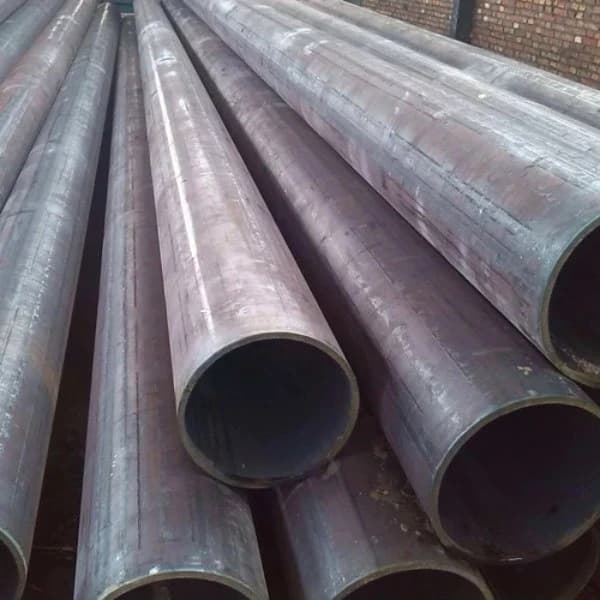
Product Description
Carbon steel line pipe to API 5L (ISO 3183) is made for conveying gas, water and oil in the petroleum and natural gas industries. This page covers the family selection in one place: PSL1 and PSL2 quality levels, Grades A, B and X42 to X70 under the dual designation system (L210 to L485), and the seamless or welded manufacturing routes, so that buyers can fix the grade, quality level and size envelope before requesting a quotation.
Line pipe works in gathering and transmission systems that move crude oil, natural gas and natural gas liquids from producing fields to processing plants, refineries and storage. Selection is driven by the design code of the pipeline system, the required toughness at the lowest service temperature, the seam type and the quality level, rather than by the grade number alone. That is why this page states the PSL level, the delivery condition designations and the test regime next to the strength tables instead of publishing single "guaranteed" values.
Carbon steel line pipe is not corrosion-resistant by itself: corrosion protection is part of the supply specification, not a property of the material. Bare, varnished, FBE, 3LPE or 3PP coating systems are confirmed per order together with the operating medium. Design pressure and temperature limits are set by the applicable pipeline design code, such as ASME B31.4 or ASME B31.8, applied to the selected grade, wall thickness and seam type; they are not derived from the grade number alone.
PSL1 and PSL2 Quality Levels
API 5L defines two product specification levels with the same strength grades but different quality and test regimes. The table below summarizes the structural differences that decide which level belongs on the enquiry.
| Item | PSL1 | PSL2 |
|---|---|---|
| Chemical limits | Standard limits (P max 0.030%, S max 0.030%) | Stricter carbon, phosphorus and sulfur limits (P max 0.025%, S max 0.015%) plus carbon equivalent control |
| Strength requirements | Minimum yield and tensile strength only | Minimum and maximum yield and tensile strength, with a maximum yield-to-tensile ratio of 0.93 |
| Impact toughness | Charpy testing not required | Charpy V-notch testing required (0 °C reference for standard sizes) |
| Non-destructive testing | Not required for each pipe | Ultrasonic or equivalent examination of each pipe |
| Hydrostatic test | Per the standard, with substitution options | Performed on each pipe; not substituted by NDT |
| Delivery condition designations | As-rolled base grades (X52, etc.) | N (normalized), Q (quenched and tempered), M (thermo-mechanically rolled), e.g. X52N/X52Q/X52M; S-suffix variants for sour service |
| Typical service | General onshore transmission and distribution | High-pressure long-distance lines, offshore, sour service, low-temperature service |
Exact per-grade PSL2 upper limits depend on the delivery condition and the governing edition, so they are confirmed against the ordered API 5L edition at quotation instead of being reproduced here. If the design code or the operator specification calls out PSL2, state it on the enquiry together with any annex requirements.
Chemical Composition (PSL1, Reference)
The values below are the PSL1 ladle and product analysis requirements for wall thickness up to 25 mm, reproduced for reference from the API 5L 46th edition. Note that the specification sets different carbon maxima for the seamless and the welded routes, which is the most common cause of conflicting tables found online; both columns are given here.
| Grade | ISO 3183 name | C max, seamless (%) | C max, welded (%) | Mn max (%) | P max (%) | S max (%) |
|---|---|---|---|---|---|---|
| A | L210 | 0.22 | 0.22 | 0.90 | 0.030 | 0.030 |
| B | L245 | 0.28 | 0.26 | 1.20 | 0.030 | 0.030 |
| X42 | L290 | 0.28 | 0.26 | 1.30 | 0.030 | 0.030 |
| X46 | L320 | 0.28 | 0.26 | 1.40 | 0.030 | 0.030 |
| X52 | L360 | 0.28 | 0.26 | 1.40 | 0.030 | 0.030 |
| X56 | L390 | 0.28 | 0.26 | 1.40 | 0.030 | 0.030 |
| X60 | L415 | 0.28 | 0.26 | 1.40 | 0.030 | 0.030 |
| X65 | L450 | 0.28 | 0.26 | 1.45 | 0.030 | 0.030 |
| X70 | L485 | 0.28 | 0.26 | 1.65 | 0.030 | 0.030 |
For each 0.01% of carbon below the specified maximum, the manganese maximum may rise by 0.05%, up to 1.65% for grades B to X52, 1.75% above X52 below X70 and 2.00% for X70. Residual copper, nickel and chromium are limited to 0.50% each and molybdenum to 0.15%; niobium, vanadium and titanium sums apply per the standard unless otherwise agreed. For seamless X60 to X70 the manganese maximum is commonly 1.40% unless otherwise agreed. Walls above 25 mm and any deviation from the values above are subject to agreement at order, and the governing edition is confirmed on the mill test certificate.
Mechanical Properties (PSL1 Minimums, Reference)
The table lists the minimum yield and tensile strength for the pipe body in SI units, with the ISO 3183 names that carry the same number in MPa. Elongation minimums are calculated from the API 5L formula for the ordered grade and specimen size, so no single universal value is quoted.
| Grade | ISO 3183 name | Minimum yield strength (MPa) | Minimum tensile strength (MPa) |
|---|---|---|---|
| A | L210 | 210 | 335 |
| B | L245 | 245 | 415 |
| X42 | L290 | 290 | 415 |
| X46 | L320 | 320 | 435 |
| X52 | L360 | 360 | 460 |
| X56 | L390 | 390 | 490 |
| X60 | L415 | 415 | 520 |
| X65 | L450 | 450 | 535 |
| X70 | L485 | 485 | 570 |
PSL2 grades keep these minimums and add the upper limits, the yield-to-tensile ratio and the toughness requirements summarized above. Welded routes additionally test the weld seam to the standard's tensile requirements. Because the design margin of a pipeline comes from the design code calculation rather than from the bare minimums, the grade is selected against the design factor, wall and toughness class, then confirmed at order.
Material Characteristics
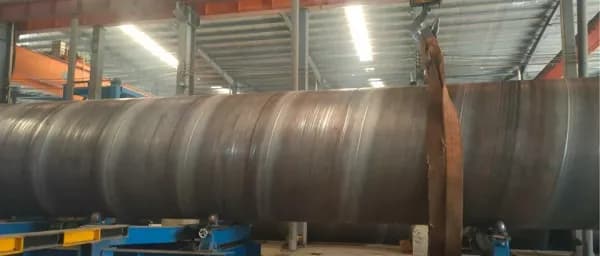
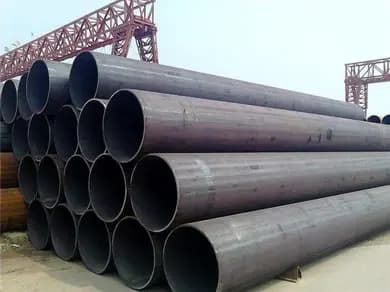
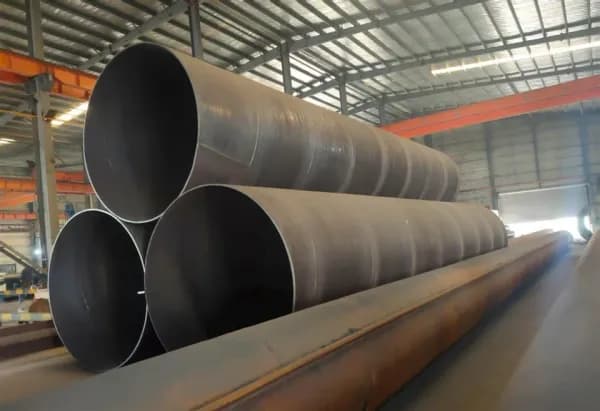
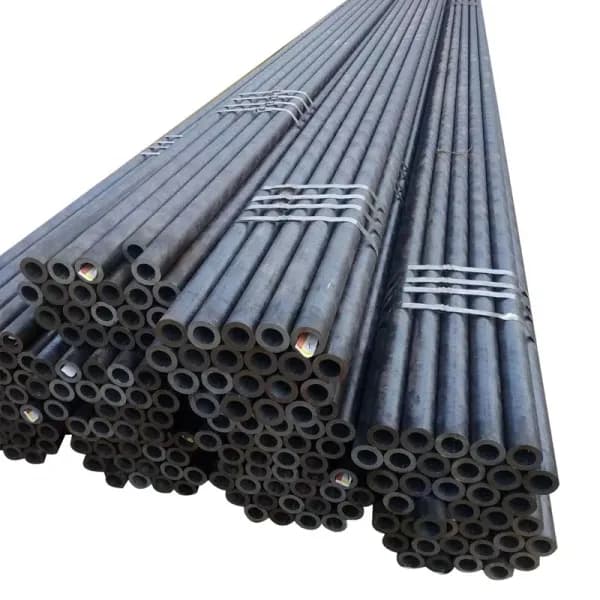
Seamless pipe offers a continuous body without a longitudinal weld and is the usual choice for smaller and medium outside diameters and higher-pressure service. Electric resistance welding (ERW/HFW) covers the medium-diameter range with tight dimensional control. Longitudinal submerged arc welding (LSAW) serves large-diameter, long-distance lines, and spiral (helical) submerged arc welding (SAWH) produces large diameters economically from coiled strip. Not every process is available for every grade and quality level; some processes are excluded for PSL2, so the route is confirmed together with the grade at order. Spiral (SAWH) pipe is supplied from 219 mm outside diameter with a 3 mm to 22 mm wall, which is narrower than the 21.3 mm to 1422 mm and 2 mm to 25 mm family on this page. See the dedicated API Spec 5L spiral steel pipe and large diameter straight seam welded pipe pages.
PSL2 delivery conditions are designated with a suffix: N for normalized, Q for quenched and tempered and M for thermo-mechanically rolled, with sour-service variants carrying an additional S designation. Weldability is controlled through the carbon equivalent limits of PSL2 and is executed with qualified welding procedures and consumables matched to the grade and wall. Coating, bevel and threading options do not change the grade; they complete the supply specification agreed at order.
Applications
Typical duties are onshore and offshore transmission pipelines for natural gas, crude oil and refined products, gathering and flowline systems in producing fields, gas distribution networks, and water injection or water transmission lines inside petroleum and natural gas industry scope. Higher grades such as X60 to X70 are usually reserved for high-pressure, long-distance systems where wall thickness saving offsets the stricter quality regime, while Grade B remains the workhorse for distribution and utility lines.
Line pipe is not the same product as the pipe used inside the wellbore: casing and tubing follow API 5CT with their own grade system and connections, and are covered on the oil and gas casing pipe page. General-purpose ASTM A53 pipe (black or hot-dipped galvanized, for ordinary steam, water, gas and air lines) and ASTM A106 high-temperature seamless pipe belong to our seamless carbon steel pipe range and are selected by different rules; the two families are not interchangeable on a design calculation.
Ordering Information
To quote carbon steel line pipe against the exact envelope, provide: the grade and PSL level (for example API 5L X52 PSL2), the outside diameter and wall thickness, the length range and single or double random lengths, the end finish (plain, beveled, or threaded and coupled), the manufacturing route if your specification fixes it, the delivery condition suffix for PSL2 (N, Q, M, or S-suffix sour service), the coating system, any impact test temperature or supplemental annex requirement, and the quantity with destination. Enquiries that state the design code and the medium allow the grade, quality level and test regime to be confirmed in one pass instead of a generic size quote.
Companion items can be sourced with the pipe: API 5L grade pipe fittings match the line grade, and the full carbon steel pipe range, including spiral and hydraulic lines, is listed under the pipe and tube category. For general-service seamless requirements outside API 5L scope, send the standard, grade and service conditions with the enquiry and the correct product family will be confirmed.
Common Questions about Carbon Steel Line Pipe
What is the difference between line pipe and casing pipe?
Line pipe conveys media along the pipeline after the well: it is made to API 5L, is graded by strength (Grade B, X42 to X70) and is welded or seamless with plain, beveled or threaded ends. Casing lines the wellbore during and after drilling: it is made to API 5CT, uses its own grade system (J55, K55, N80, L80 and so on) and short-round threaded or premium connections, and is loaded by the well, not by pipeline pressure. The two standards are not substitutes; send the well program for casing requirements and the pipeline design data for line pipe.
Should I order PSL1 or PSL2?
PSL1 is the standard quality level with minimum strength requirements and suits general onshore transmission and distribution. PSL2 adds upper and lower strength limits, a maximum yield-to-tensile ratio of 0.93, mandatory Charpy testing, per-pipe non-destructive examination, tighter chemistry with carbon equivalent control and per-pipe hydrostatic testing. If the design code, the operator specification, an offshore route, a low design temperature or a sour medium applies, PSL2 is normally required; state the code and the annex requirements on the enquiry so the level and the delivery condition suffix are confirmed together.
What do the X and L grade numbers mean?
They are the same minimum yield strength in two unit systems. The X number is the minimum yield strength in ksi, so X52 has a 52,000 psi minimum yield; the L number used by ISO 3183 is the same requirement in MPa, so X52 is L360 (360 MPa). Tensile minimums and the chemistry are what actually separate the grades, which is why the tables above are given per grade and the governing edition is confirmed at order.
Seamless or welded line pipe - which route should I choose?
Choose by diameter, pressure and specification. Seamless suits smaller and medium diameters and higher pressure with a weld-free body. ERW covers the medium range with tight tolerances. LSAW and spiral SAWH serve large diameters, with spiral production the economical option for long large-diameter lines. The route also interacts with the quality level: some processes are excluded for PSL2. If you already have a route fixed on the specification, send it with the enquiry; otherwise confirm the diameter first and the route options will be quoted per size.
Can sour-service (H2S) line pipe be supplied?
Sour service is handled as a PSL2 order with the S-suffix delivery conditions and HIC/SSC testing per the applicable annexes (NACE MR0175 / ISO 15156 alignment is commonly specified by the operator). Availability is grade-, size- and mill-qualified, so sour-service requirements are confirmed against the order details rather than assumed from the grade; include the partial pressure of H2S, the design temperature and the required test regime on the enquiry and the confirmation will state what the mill certifies for that size.