
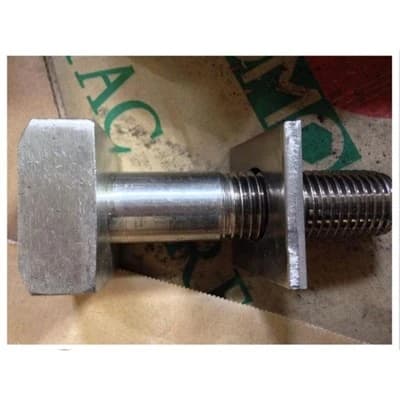
A bolted joint is a system, and the grade markings only mean something when the bolt, the nut and the washer are specified together against one standard. The usual failure is not a bolt that is too weak - it is a mismatched nut that strips, a coating that changes the torque-tension relationship, or a thread series that was never checked. Grades tell you what to order; they do not tell you what preload you achieved.
How Bolt Grades Are Defined
A grade is a bundle: chemistry range, manufacturing route, heat treatment, and the mechanical properties that result. Two systems cover most industrial work.
ASTM Grades for Pressure and High-Temperature Service
ASTM A193 covers alloy and stainless steel bolting for high-temperature and high-pressure service. B7 is chromium-molybdenum steel, quenched and tempered, and is the grade most often named for flanged joints in refinery and petrochemical service. B8 and B8M are the 304 and 316 stainless options for corrosive service. B16 is a chromium-molybdenum-vanadium grade used above the range where B7 is normally selected; the usable temperature for any of them is set by the allowable stress tables of the governing code, not by the grade name.
ASTM A320 covers alloy and stainless bolting for low-temperature service. L7 is the grade specified where impact toughness at low temperature has to be demonstrated, and the impact test temperature is an order line, not an automatic property.
SAE and Metric Property Classes
SAE J429 grades 2, 5 and 8 cover carbon and alloy steel bolts in inch sizes, and the grade is read from the head markings. ISO metric property classes such as 8.8, 10.9 and 12.9 are printed on the head. The marking is the practical check at goods receipt: unmarked bolts need laboratory hardness or chemical analysis before they can be accepted to a grade.
General-purpose carbon steel bolts are covered by ASTM A307, and stainless hex head bolts are usually specified to ASTM F593 or the equivalent ISO property class. For coated outdoor structural work, galvanized anchor bolts are specified to ASTM F1554 with the grade stated.
Matching Nuts to Bolts
The nut has to be strong enough that the bolt reaches its intended preload before the threads strip. ASTM A194 is written to pair with A193, and the pairing is part of the specification, not a preference:
| Bolt grade | Matching nut grade | Typical service |
|---|---|---|
| A193 B7 | A194 2H | High-temperature and high-pressure flanged joints |
| A193 B8 / B8M | A194 8 / 8M | Corrosive service, 304 and 316 bolting |
| A193 B16 | A194 7 | Elevated-temperature service above the usual B7 range |
| A320 L7 | A194 4 or 7, as specified | Low-temperature service with impact testing |
| SAE J429 grade 5 | SAE grade 5 nut | General machinery and equipment |
An under-strength nut becomes the weak point and strips first. An over-hard nut can gall, especially on stainless and duplex threads. Both outcomes look like a bolt failure at the joint and neither is.
What Washers Do and Do Not Do
Washers are load spreaders, not strength components. A flat washer distributes bearing stress so the clamped material is not crushed and the head or nut does not dig in. A hardened washer is used under a turned bolt head where the bearing surface needs it. Spring and tooth lock washers are intended to add resistance to rotation, and their effect on a correctly preloaded joint is limited - preload, not the washer, is what keeps a joint tight.
Washer material has to be compatible with both the fastener and the clamped part. Mixing stainless fasteners with carbon steel washers sets up a galvanic couple; the washer is usually the part that goes first.
Threads and Fit Classes
Inch threads follow the Unified Thread Standard: UNC for coarse, UNF for fine, UNEF for extra fine. Metric threads are written as diameter times pitch, so M12 x 1.75 is the coarse series and M12 x 1.25 the fine. Coarse threads assemble faster and tolerate damage better; fine threads give finer adjustment and better resistance to loosening.
Fit classes 1A/1B, 2A/2B and 3A/3B set the clearance, with 2A/2B the general-purpose choice. Coating has to be allowed for in the fit: hot-dip galvanized threads need an oversized tolerance to assemble after coating, which is why galvanized bolts and nuts are supplied as a matched set rather than mixed with plain components.
UNC and UNF of the same diameter are not interchangeable - the pitch differs, and forcing them cross-threads both parts. Check diameter and pitch before assembly.
Coatings and What They Change
Coating choice is a corrosion decision that has a mechanical side effect. Hot-dip galvanizing gives a thick zinc-iron layer, typically tens of micrometres, and needs the thread tolerance allowance described above. Zinc electroplating is thinner and is an indoor or moderate-environment choice. Zinc-flake coatings are used where hydrogen embrittlement is a concern on high-strength fasteners. Phosphate and black oxide give little corrosion protection on their own.
The mechanical side effect is the nut factor. Films that lubricate lower the friction coefficient, so the same torque produces more preload. Preload is normally targeted at a proportion of the bolt yield strength - commonly in the 60 to 75% range - which means the difference between a dry and a lubricated thread is the difference between a correct joint and a yielded bolt.
Anchor Bolts and Stud Bolts
Anchor bolts transfer load into concrete. Cast-in types - J, L and straight with a welded plate or deformed end - develop resistance mechanically. Post-installed types are expansion anchors, which work by friction immediately, or chemical anchors, which bond along the full embedment and need cure time and correct hole preparation. Anchor selection depends on concrete condition, embedment, edge distance and whether the hole is dry or wet, and it should follow the anchor manufacturer's published data.
Stud bolts are the standard bolting for flanged joints. They are threaded at both ends with a plain centre section, so nuts can be tightened from both sides and the preload is more even. Fully threaded studs and threaded rod are used where the grip length varies or where the assembly is not a flange joint.
Torque, Preload and Why a Chart Is Not Enough
The relationship is T = K x D x P, where T is torque, D is nominal diameter, P is the preload you want and K is the nut factor. K is not a constant of the bolt; it depends on the material pair, the coating, the lubrication and the surface finish, and it commonly lands somewhere in the 0.12 to 0.22 range. Because K moves that much, a torque chart built on an assumed K can put the real preload well off target.
For critical joints, the tightening method matters more than the table: torque with a measured K, torque plus angle, direct tension indication, or hydraulic tensioning. The sequence of tightening matters too, particularly on flanged joints where uneven bolt loading distorts the gasket. Our article on flange bolt torque covers the sequence before the chart.
Locking Methods
Three mechanisms are used, and they suit different joints. Mechanical locking - tab washers, cotter pins, safety wire - physically prevents rotation. Chemical locking uses anaerobic adhesive in the thread gap, with grades ranging from removable to permanent. Friction locking - nylon insert nuts, all-metal lock nuts, wedge lock washers - raises the resistance to relative motion. Nylon inserts have a temperature ceiling set by the polymer; all-metal types do not, which is what decides the choice on hot service.
What to Confirm with Your Inquiry
Fastener quotations are only comparable when the following are stated:
- Bolt specification and grade, for example ASTM A193 B7, and the matching nut specification and grade.
- Thread series and fit class: UNC, UNF, or metric pitch, plus coating tolerance allowance.
- Diameter and length, with grip length and the thread allowance beyond the nut.
- Material family: carbon steel, alloy steel, stainless steel hex head bolts, 304 stainless steel hex bolts to A2-70, or duplex 2205 stainless steel bolts.
- Coating or finish, and whether hydrogen embrittlement relief is required.
- Washer type, material and hardness where washers are included.
- Certification required, impact test temperature where applicable, and the inspection scope.
- Quantity per size, plus the delivery term.
Also confirm the nut source at the same time as the bolt. A matched set ordered together is easier to certify than a bolt bought to a grade and a nut bought to a price.



