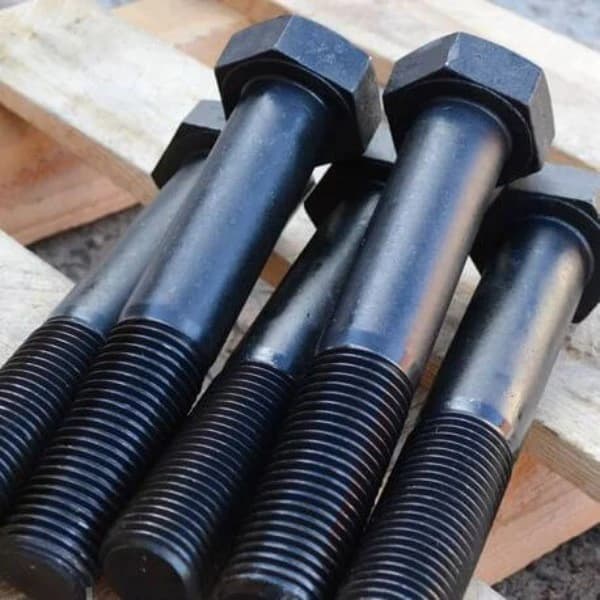
Product Description
ASTM A307 carbon steel bolts are the base-level, non-heat-treated fastener specification: the default callout when a joint does not need a high-strength structural bolt. The standard covers carbon steel bolts, studs and threaded rod from 1/4 in. through 4 in. diameter with a specified minimum tensile strength of 60,000 psi (414 MPa). It is an inch-series specification, so threads follow ASME B1.1 Unified inch threads (UNC coarse as standard, UNF on request) and hex dimensions follow ASME B18.2.1.
A307 is deliberately low-carbon steel with no required alloy content. No yield strength is specified, the fasteners are not heat treated, and the properties come from the base composition plus cold finishing. That is exactly why A307 suits general mechanical assembly, low-pressure flange bolting, non-structural framing, HVAC and plumbing support and similar low-stress work - and why it is the wrong callout wherever bolt strength is a design input.
ASTM A307 Grades: A, B and the Withdrawn Grade C
The grade letter in A307 does not describe a strength ladder. Grade A and Grade B are two different products for two different jobs, and Grade B carries a tensile ceiling rather than extra strength. The table below separates them, and records the third grade that no longer exists in the active standard.
| Grade | Application | Head form | Tensile strength |
|---|---|---|---|
| Grade A | General-purpose bolting: headed bolts, threaded rod and bent bolts | Hex or square; head form not restricted | 60 ksi (414 MPa) minimum, no maximum |
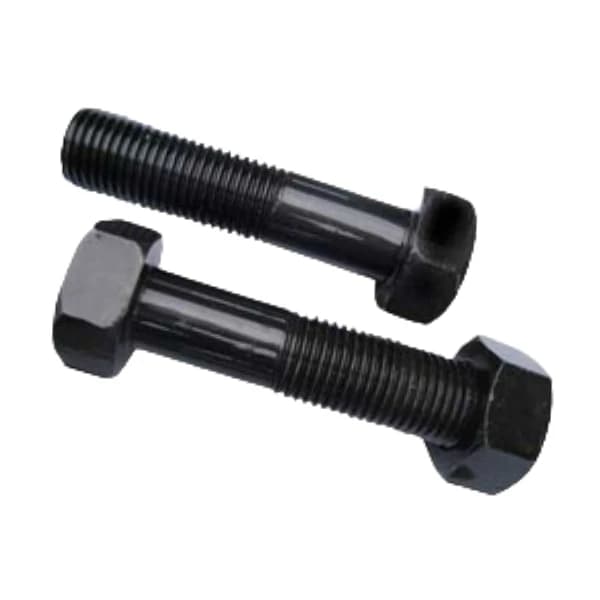
| Grade B | Flanged joints in piping systems with cast-iron flanges - the ceiling stops the cast-iron flange cracking | Heavy hex required | 60-100 ksi (414-690 MPa) |
| Grade C (withdrawn 2007) | Non-headed anchor bolts, bent or straight, for structural anchorage | Non-headed | Supplied as ASTM F1554 Grade 36, not as an A307 strength |
Grade C was removed from A307 in August 2007 and replaced by ASTM F1554 Grade 36. Where a project still calls out A307 Grade C, the anchor bolt is supplied as ASTM F1554 Grade 36. It is not supplied to an A307 strength. Anchor bolts in general are a separate product line - see the galvanized anchor bolts page for the F1554 and DIN 5299 routes.
Mechanical Properties and Chemical Requirements
The figures below are requirements of the specification, not measurements of a particular heat. Where a bolt is too short to tensile test, hardness becomes the acceptance property, so the full hardness band is quoted rather than an average.
| Property | Grade A | Grade B |
|---|---|---|
| Tensile strength | 60 ksi (414 MPa) min, no maximum | 60-100 ksi (414-690 MPa) |
| Yield strength | Not specified | |
| Elongation, 2 in. | 18% min | |
| Reduction of area | 35% min | |
| Hardness | Under 3 x diameter: 121-241 HBW (69-100 HRB). Longer: 241 HBW (100 HRB) maximum only | Under 3 x diameter: 121-212 HBW (69-95 HRB). Longer: 212 HBW (95 HRB) maximum only |
Because no yield is specified, an A307 bolt cannot be checked against, or substituted for, a grade whose design depends on minimum yield - that is the single most common mistake when an old BOM carries "A307" into a connection that has since been engineered.
The chemistry is checked by heat analysis; the figures below are the heat-analysis limits, with product-analysis tolerances allowed on top.
| Element | Grade A | Grade B |
|---|---|---|
| Carbon, max | 0.29% | 0.29% |
| Manganese, max | 1.20% | 1.20% |
| Phosphorus, max | 0.04% | 0.04% |
| Sulfur, max | 0.15% | 0.05% |
Note the one real chemistry difference between the grades: Grade B holds sulfur to 0.05%, while Grade A permits up to 0.15%. Higher sulfur improves machinability but lowers ductility and toughness, which is consistent with Grade A being the general bolt and Grade B being the one used against cast iron.
Threads, Dimensions and Marking
A307 is an inch-series specification, and that single fact decides several ordering questions. The points below cover the thread, the dimensional standards and the identification marks a buyer should expect on the head.
- Threads: Unified inch threads to ASME B1.1 - UNC coarse as the standard callout, UNF fine on request. External fit is Class 2A, matching Class 2B nuts.
- Dimensions: hex head bolt dimensions to ASME B18.2.1; matching nut dimensions to ASME B18.2.2.
- Diameter: 1/4 in. to 4 in. (6.35 mm to 101.6 mm) nominal.
- Length: cut to the ordered length. A307 does not define a length range or a stock length schedule; tell us the length you need rather than asking for "standard" lengths.
- Marking: Grade A is not required to be marked. Grade B must be marked "307B" or equivalent and must have a heavy hex head. The manufacturer's identification symbol may appear on either grade.
Metric hex bolts are a different specification, not a variant of A307. An M-size carbon steel hex bolt is ordered to ISO 4014 (part thread) or ISO 4017 (full thread) with a property class - 4.6, 4.8 or 8.8 - under ISO 898-1. An A307 certificate will not be issued against an M-size order, and a property class 8.8 bolt is not the same material as an A307 Grade A bolt. If your drawing mixes metric sizes with "A307", tell us which side of the drawing governs and we will confirm the correct standard and class before quoting.
Recommended Nuts and Washers
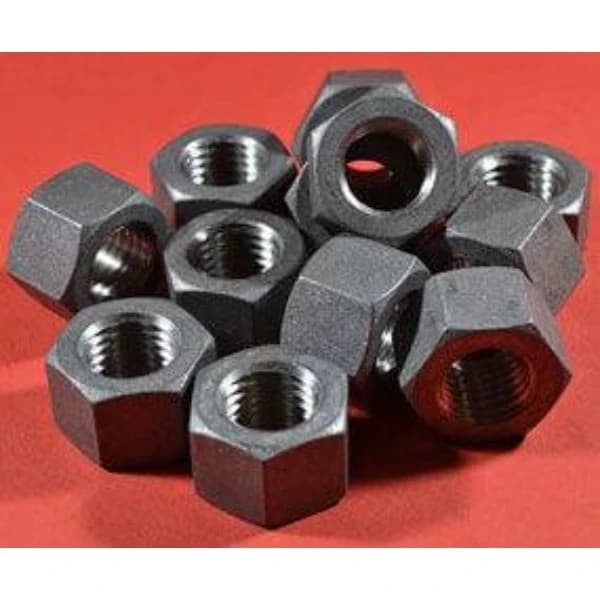
A307 specifies the bolt, not the nut. Pairing matters because the nut grade has to match the bolt grade and the diameter band, and cast-iron flange work needs a heavy hex nut. The pairings below are the ones the standard's companion hardware table supports.
| Bolt | Nut | Washer |
|---|---|---|
| Grade A, 1/4-1-1/2 in. | A563 Grade A hex | F844 plain flat |
| Grade A, 1-5/8-4 in. | A563 Grade A heavy hex | F844 plain flat |
| Grade B, all sizes | A563 Grade A heavy hex | F844 plain flat |
We can supply A307 bolts on their own or as a matched bolt-and-nut set. The nuts page for this family is ASTM A307 nuts, which covers the A563 pairing and the surface finishes in more detail.
What A307 Is Not For - and What to Specify Instead
Most of the cost of a wrong A307 order comes from using it where another specification belongs. The table maps the common requirements to the standard that actually covers them, so the decision can be made before the enquiry rather than after the goods arrive.
| Requirement | Specify instead |
|---|---|
| High-strength structural connections | ASTM F3125 (Grade A325 or A490), which absorbed the old A325 and A490 standards |
| Anchor bolts cast into concrete | ASTM F1554, Grade 36, 55 or 105 by load |
| Bolting at elevated temperature or pressure | ASTM A193, for example B7, with matching A194 nuts |
| Low-temperature service | ASTM A320, for example L7 |
| Corrosive environments | 304 or 316 stainless to ASTM F593, or a specified coating on carbon steel |
| A connection engineered on bolt yield strength | Any grade that specifies a yield - A307 does not |
A307 is also not a "cheaper A325". The two differ in alloy content, heat treatment, and the fact that one has a specified yield and a minimum proof load for pretensioned joints while the other has neither. Where a connection will be pretensioned, A307 is not the fastener, regardless of the diameter. For a same-family comparison of the higher-strength route, see 12.9 hex bolt; for a corrosion-resistant route, the stainless steel hex head bolts page covers the F593 option.
Applications
A307 is a general-purpose fastener, and the line between "general purpose" and "engineered connection" is what a buyer should check. The typical uses below all sit on the general-purpose side of that line, in non-corrosive or coated conditions.
- General mechanical assembly and machinery mounting
- Low-pressure flange bolting where Grade B is used against cast-iron flanges
- Non-structural steel framing and secondary steelwork
- HVAC ductwork, plumbing and pipe hangers and supports
- Fence, railing and general site hardware
- Equipment frames, guards and enclosures
Outside, or in any wet or chloride-bearing environment, plain carbon steel will corrode. Corrosion protection is a separate coating decision, not a property of A307: hot-dip galvanizing to ASTM F2329 or zinc electroplating to F1941 are the usual choices, and the coating, its thickness class and any thread allowance should be stated on the order. Note that a coating does not change the grade, the tensile strength or the "no yield specified" position of the base bolt.
Ordering Information
We supply A307 Grade A and Grade B bolts in the inch sizes, on their own or matched with A563 nuts and F844 washers. To quote accurately, send the following with your enquiry:
- Grade: A or B (and whether the joint mates with a cast-iron flange)
- Diameter and thread: UNC or UNF, and the thread length if part-threaded
- Length, in inches, and the quantity
- Head form: hex, heavy hex, square, or a bent/straight non-headed form
- Coating: plain, zinc electroplated or hot-dip galvanized, with the thickness class if specified
- Documentation: mill certificate, and whether you need the chemistry, tensile and hardness results stated on it
- Delivery: shipping marks and any packaging requirement
Where a drawing cites an old standard, send the drawing - we will confirm the grade and the standard that actually applies before quoting, rather than matching the old wording word for word.
Common Questions about ASTM A307 Bolts
Is ASTM A307 a structural bolt?
No. A307 is the base-level, non-heat-treated, low-stress specification, and it specifies no yield strength. High-strength structural bolting is ASTM F3125 (Grade A325 and A490). If the connection is engineered, pretensioned, or depends on bolt yield, use F3125 rather than A307.
What is the difference between A307 Grade A and Grade B?
Grade A is the general-purpose grade: headed bolts, threaded rod and bent bolts, any head form. Grade B is a specific product for flanged joints in piping systems with cast-iron flanges, supplied with a heavy hex head, and its 60-100 ksi tensile range is a ceiling intended to protect the cast-iron flange from cracking. Grade B is not simply a stronger Grade A.
What replaced A307 Grade C?
ASTM F1554 Grade 36. Grade C was the non-headed anchor-bolt grade and was withdrawn from A307 in August 2007. Old drawings that still cite "A307 Grade C" should be re-specified to F1554 Grade 36 on new work.
Can you supply A307 bolts with metric threads?
A307 is an inch-series specification: it covers 1/4 in. to 4 in. UNC or UNF threads to ASME B1.1, and it does not define metric threads. Metric carbon steel hex bolts are ordered to ISO 4014 or ISO 4017 with a property class under ISO 898-1. Tell us which standard your drawing actually requires and we will confirm the material and marking before quoting.
Should I use A307 or A325 / F3125?
Use A307 for general-purpose, low-stress fastening in non-corrosive or coated conditions. Use F3125 structural bolts wherever the connection is engineered, needs a specified minimum yield or proof load, or will be pretensioned. A307 has no specified yield, so it cannot substitute for a structural bolt of the same diameter.
Compare this item with the Carbon Steel Fasteners range before fixing grade, size and quantity.