

Stainless steel is an iron-based alloy whose corrosion resistance comes from a chromium-rich passive film on the surface. The industry definition of stainless steel starts at a minimum of about 10.5% chromium by mass. Everything described below follows one question: which step controls the composition, the mechanical properties, or the surface you will actually receive.
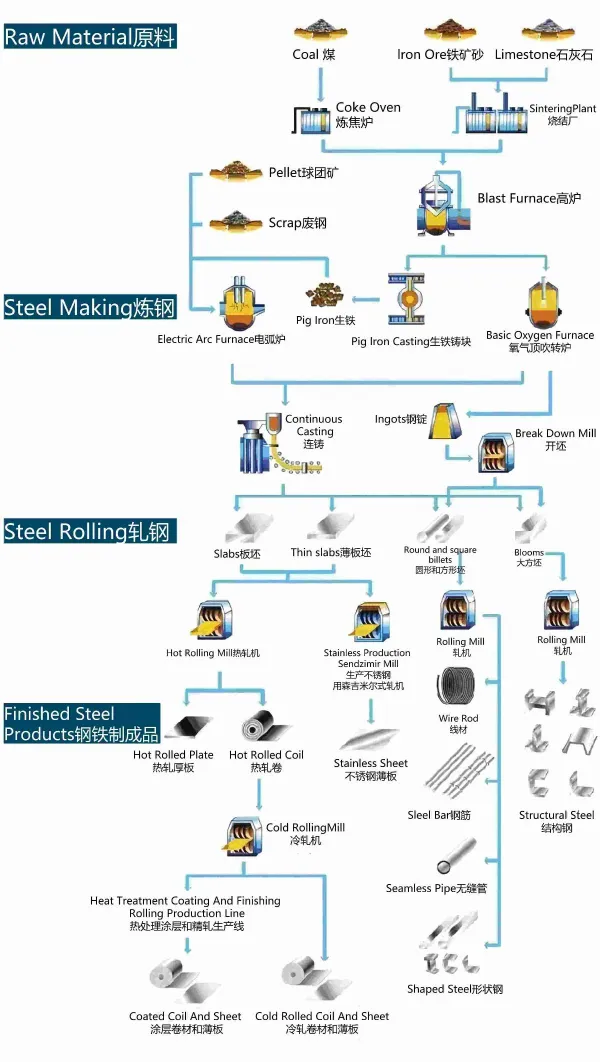
Step 1: Melting
Stainless steel is melted in an electric arc furnace, which uses graphite electrodes rather than coke as the heat source. The charge is a mix of stainless scrap, carbon steel scrap and ferroalloys such as ferrochrome and ferronickel. Because the furnace can run on a high scrap share, the melt composition coming out of the furnace is a starting point, not a finished grade.
Melting sets the rough chemistry and the tap temperature. It does not set the final carbon level, and it does not remove sulphur to the levels modern grades require.
Step 2: Refining (AOD and VOD)
Refining is the step that turns a melt into a grade. Two processes dominate:
- Argon oxygen decarburization (AOD). A controlled mixture of oxygen and argon is injected into the bath. Oxygen removes carbon, while the argon dilution keeps chromium from oxidising at the same time. AOD is the workhorse route for most austenitic, ferritic and duplex grades.
- Vacuum oxygen decarburization (VOD). Decarburization proceeds under reduced pressure, which allows very low carbon levels with limited chromium loss. VOD is used where the specification demands extra-low carbon or tighter control of nitrogen and sulphur.
This is also where trimming additions bring chromium, nickel, molybdenum and nitrogen into the specified range. If you want to know why two mills quote the same grade at different prices, the refining route and the number of trimming additions are usually part of the answer.
Step 3: Casting
Refined steel is cast continuously into billets, blooms or slabs, which replaced ingot casting in most plants decades ago. Continuous casting gives a more uniform structure and higher yield than ingot casting, and the semi-finished section determines which product forms the mill can roll afterwards.
- Slabs feed flat products: plate, sheet and strip.
- Billets feed long products: bar, wire rod and seamless tube feedstock.
- Blooms feed heavier sections and large-diameter seamless feedstock.
Step 4: Hot Rolling and Cold Rolling
Hot rolling reheats the cast section and reduces it to a mill product form. It breaks up the cast structure and sets the thickness range the mill can offer. Cold rolling follows when the order needs tighter thickness tolerance, a smoother surface or higher strength from work hardening; it is always followed by annealing because cold-worked stainless is not in its specified condition until it is heat treated.
| Attribute | Hot rolled | Cold rolled |
|---|---|---|
| Rolling temperature | Above the recrystallization temperature | Room temperature |
| Surface | Mill scale, requires pickling | Smooth and bright after annealing and pickling |
| Thickness tolerance | Wider | Tighter |
| Strength | Annealed condition | Higher strength if supplied in a work-hardened temper |
Step 5: Annealing and Pickling
Annealing reheats the steel to a controlled temperature and cools it under defined conditions. It restores ductility after cold work, dissolves unwanted precipitates and re-establishes the corrosion resistance the grade was designed for. For austenitic grades the annealing range is typically quoted around 1040-1120 °C, but the exact cycle belongs to the mill's procedure and the governing specification.
Annealing leaves an oxide scale, which is removed by pickling, usually in a mixed nitric-hydrofluoric acid bath, or by mechanical descaling and electropickling. The result is the clean, chromium-rich surface that the specified finish (for example 2B or No.1) refers to.
Step 6: Finishing and Cutting
Product is then cut and finished to order. Plate and heavy sections are cut by plasma, laser or sawing depending on thickness and edge quality requirements; sheet is sheared or laser cut. Surface finishes range from brushed mechanical finishes to electropolished surfaces, and passivation is applied when the specification calls for removal of free iron after fabrication.
For pipe, the route splits at this point: stainless steel seamless and welded pipe follow different routes from this stage, and the route is stated on the certificate because it affects the testing and the pressure rating.
Step 7: Testing and Certification
Composition is verified by optical emission spectrometry or equivalent, and mechanical properties by tensile, hardness and, where specified, impact testing to ASTM A370. Corrosion checks are added when the service demands them: intergranular corrosion testing to ASTM A262 for sensitization risk, and pitting testing to ASTM G48 for molybdenum-bearing grades.
The output the buyer receives is the material test report, normally to EN 10204 3.1, which ties the heat number to the chemical analysis, mechanical results and dimensions. Grade composition limits themselves are standardised, for example in ASTM A959, which harmonises wrought stainless grade compositions.
What Each Step Means for Your Order
- Composition control is set by refining. Ask which route was used if the grade has tight carbon or sulphur limits.
- Mechanical properties are set by the annealing cycle and any cold work. Ask for the condition, not just the grade.
- Surface and tolerance are set by the rolling and finishing route. State the finish and the tolerance on the order.
- Corrosion performance cannot be judged from appearance. If the service is aggressive, specify the corrosion test on the order.
Common product forms follow the same route: 304 stainless steel plate for general fabrication, and duplex stainless steel plate and sheet where higher strength and chloride resistance are required.
What to Confirm with Your Inquiry
- Grade and governing standard, including the edition or year you are buying to
- Product form, dimensions, quantity and tolerance
- Condition or finish: annealed and pickled, cold worked temper, surface finish designation
- Required testing: tensile, hardness, impact, intergranular corrosion, pitting, PMI
- Certificate type: EN 10204 3.1, or 3.2 where independent verification is required
- Any third-party inspection and the applicable inspection standard
Send these fields with your RFQ to Gangyou Steel and the quotation will state the condition and testing along with the price.



