
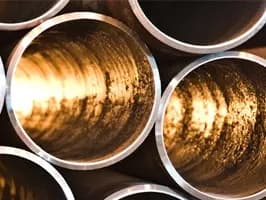
Chemical-service pipe is chosen against the fluid, not against a grade list. Media, concentration, temperature, pressure and chloride exposure all move the decision, and the piping class written for the plant is what fixes the material. ASME B31.3 is the usual design code for chemical and petrochemical plant piping. It is not a material selector.
Fluid service comes first
ASME B31.3 assigns a fluid service category, and the examination and testing requirements follow that category. A toxic or high-pressure service is not examined like a normal service. Confirm which category the line falls in before the material and wall are frozen, because the same pipe can carry different documentation requirements in two categories.
What drives the material decision
| Condition | Family usually considered | What has to be checked |
|---|---|---|
| Non-corrosive fluids, steam, water, hydrocarbons | Carbon steel | Corrosion allowance and the temperature limit |
| Oxidising acids such as nitric acid | Austenitic stainless, often 304L | Concentration and temperature together |
| Chloride-bearing or reducing conditions | 316L, or a duplex grade | Chloride level, temperature and whether the line stagnates |
| Hot concentrated acid, hydrochloric acid, wet chlorine | High-nickel alloys | The corrosion review, not a grade table |
| Caustic service | Carbon steel with a stress-relief limit, or nickel alloys at high temperature | Caustic concentration and temperature |
None of these rows is a specification. They are the starting point for a corrosion review that names the grade, the standard and the heat treatment.
Chlorides, pitting and a screening number
Austenitic stainless steel is vulnerable to pitting and to chloride stress-corrosion cracking. The threshold is commonly cited at about 60 °C, and it moves with chloride concentration, stress, pH and whether the line stagnates. A screening value such as the pitting resistance equivalent number, PREN = %Cr + 3.3 x %Mo + 16 x %N, is used to rank alloys: published values are around 19 for 304L, 25 for 316L, 36 for 2205 duplex and 43 for 2507 super duplex. PREN ranks pitting resistance. It does not predict stress-corrosion cracking, and it is not an acceptance criterion.
Published pages that identify these families on this site include 304 stainless steel seamless pipe, 316L stainless steel pipe and, for the high-temperature alloy side, ASTM A335 P11 seamless pipe. A plate page does not cover pipe.
Corrosion forms that change the detail
- General corrosion is met with a corrosion allowance added to the calculated wall.
- Pitting is localised and is addressed by alloy selection, not by extra wall.
- Crevice corrosion appears under gaskets and deposits, so the joint detail matters.
- Stress-corrosion cracking needs tensile stress and a specific environment together; the remedy is material and stress relief, not thickness.
- Intergranular corrosion is addressed with low-carbon or stabilised grades.
Surface condition, cleaning and coating
Degreasing, pickling and passivation are separate operations with their own specifications. Name the one the process needs. Buried or insulated lines need their own external coating system, specified separately from the pipe material.
What to Confirm with Your Inquiry
- Fluid composition and concentration, including pH for aqueous streams.
- Operating and design temperature, and operating and design pressure.
- Chloride content, and whether the line stagnates or is steam-traced.
- Design code and fluid service category, and the material the piping class names.
- Surface preparation, certificate type, and the NDT extent for that category.
When a project specification names an EN, JIS or GB grade instead of an ASTM one, use the ASTM, EN, JIS and GB pipe-standard comparison as a lead, then confirm the grade in the current standards.



