
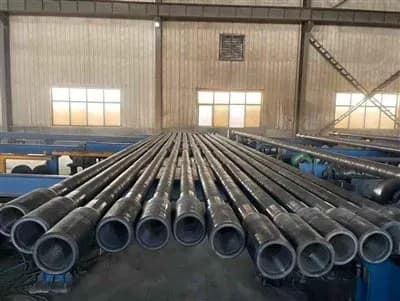
Power plant pipe and boiler tube should not be selected from one generic grade list. Boiler heat-transfer tubes, main steam pipe, feedwater lines and auxiliary piping have different product forms and design duties. Start with the system boundary and governing code, then state the grade, dimensions, delivery condition, testing and documentation required by the project.
Separate the System Before Selecting Material
| System item | Product form to identify | Questions that control the order |
|---|---|---|
| Waterwall, economizer or superheater | Boiler or heat-exchanger tube ordered by outside diameter and minimum wall | Tube specification, grade, design temperature and pressure, corrosion allowance, heat treatment and examination |
| Main steam or hot-reheat line | Pressure pipe ordered by NPS and schedule or by OD and specified wall | Piping code, allowable stress at design temperature, creep assessment, joining method and required delivery condition |
| Feedwater and auxiliary service | Pipe or tube as defined by the system drawing | Fluid, transients, minimum design temperature, water chemistry, erosion or corrosion allowance and inspection class |
| Condenser or heat exchanger | Tube matched to the exchanger standard and tubesheet design | OD, minimum wall, temper or solution treatment, tube length, test method and expansion or welding procedure |
Boiler Tube Is Not Main Steam Pipe
The dimensional convention is the first practical difference. Our verified carbon steel boiler tube page covers ASTM A192, ASTM A210 and ASTM A178 forms and requires outside diameter plus minimum wall; it specifically warns against buying these tubes by pipe schedule alone. Main steam pipe, by contrast, is normally coordinated with a piping drawing that names NPS, schedule or specified wall, fittings, weld details and the applicable piping code.
Keeping the forms separate also prevents an inspection mismatch. Tube orders may require expansion, flattening, eddy-current or other product-specific checks, while a pressure-pipe order may focus on wall, end preparation, heat treatment, weld procedure and system-level examination. The project specification and current standard edition decide the actual acceptance plan.
Use Delivery Condition as an Ordering Field
A grade name does not fully describe the supplied condition. For example, the verified ASTM A335 P11 seamless pipe record lists normalized and tempered as the usual delivery condition and cites a minimum tempering temperature of 650 °C for that route. That value is a product-specific reference, not a universal power-plant heat-treatment setting; the order edition and project specification still govern.
Stainless exchanger tube uses a different route. The ASTM A213 TP304 and TP316L heat-exchanger tube record identifies solution annealing at 1040 °C minimum. These two examples show why a buyer must not transfer a heat-treatment condition from one alloy, form or standard to another.
Design Data Must Come Before Grade Advice
- Identify the system, fluid and whether the component is inside or outside the boiler boundary.
- State design and operating temperature and pressure, startup and shutdown cycles, and any minimum-temperature case.
- Name the governing construction code, material specification and current edition used by the project.
- Provide corrosion allowance, erosion concern, water-chemistry limits and any steam-oxidation or creep assessment requirement.
- State whether dimensions are OD by minimum wall, or NPS by schedule or specified wall.
Welding, Examination and Records
Preheat, interpass control, filler metal and post-weld heat treatment belong to a qualified welding procedure, not to a general blog table. The same is true for nondestructive examination coverage and acceptance criteria. State the weld procedure qualification, examination method and extent, hydrostatic or nondestructive electric test, hardness or impact requirement, and any hold point in the inspection and test plan.
For traceability, request the material certificate, heat-treatment record when applicable, test reports named by the order, and identification that links each lot or piece to those records. Do not treat a generic supplier certificate list as proof that every power-plant order receives the same tests.
What to Confirm with Your Inquiry
Send the system line list or datasheet, governing code, material specification and edition, grade, product form, design conditions, dimensions, quantity, delivery condition, end preparation, welding restrictions, examination plan, impact or hardness limits and document package. Add the required delivery date only after these technical inputs are frozen, then use the inquiry page to submit the package.
Frequently Asked Questions
Why does power piping use alloy grades?
High temperature and pressure require creep strength and allowable stress beyond ordinary carbon steel.
Are boiler tubes the same as main steam pipe?
No. They use different sizes, standards and design conditions and must be specified separately.



