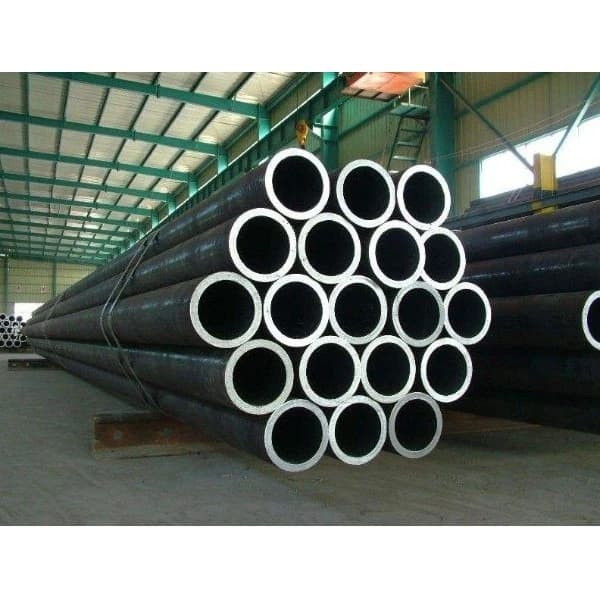
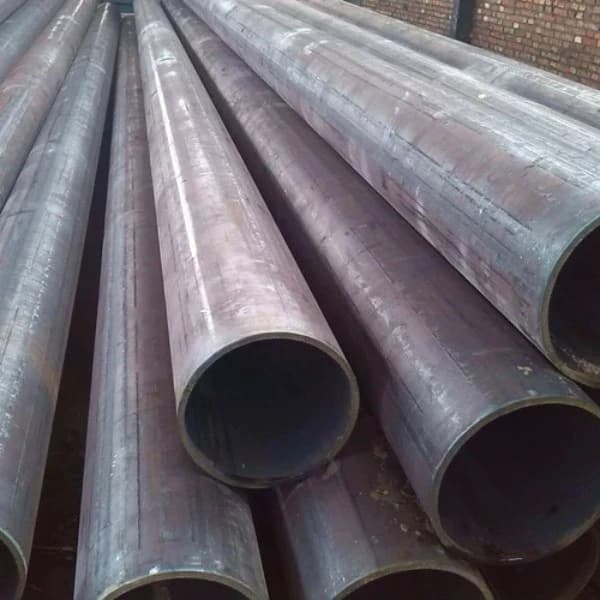
What Is Steel Pipe?
Steel pipe is a hollow, long, cylindrical product used extensively across industries for fluid transport, structural support, machinery manufacturing, and countless other applications. According to the American Iron and Steel Institute (AISI), steel pipe is defined by its hollow cross-section, which distinguishes it from solid bar stock. Steel pipes are manufactured in two fundamental forms: seamless and welded, each with distinct manufacturing processes, performance characteristics, and cost profiles.
Seamless pipe is produced by piercing a solid steel billet and then rolling or drawing it into a hollow tube without any welded seam. This process yields a pipe with uniform wall thickness and no weak points along its length, making it ideal for high-pressure and high-temperature applications. Welded pipe, by contrast, is formed by bending a steel plate or coil into a cylindrical shape and welding the longitudinal seam. Modern welding techniques such as ERW (Electric Resistance Welding), LSAW (Longitudinal Submerged Arc Welding), and SSAW (Spiral Submerged Arc Welding) produce welded pipes that are reliable and cost-effective for many applications.
The applications of steel pipe span virtually every industrial sector. In oil and gas, pipes transport crude oil, natural gas, and refined products across continents. The chemical industry relies on corrosion-resistant pipes for processing aggressive media. Construction uses structural steel pipe for building frames, piling, and scaffolding. Power generation plants require specialized high-temperature pipes for steam systems. Shipbuilding, food processing, and automotive industries all depend on different grades and specifications of steel pipe to meet their unique operational requirements.
Steel Pipe Types by Material
Carbon Steel Pipe
Carbon steel pipe is the most widely used category, accounting for approximately 80% of all steel pipe consumption globally. It is classified by carbon content into low carbon (up to 0.30% C), medium carbon (0.30-0.60% C), and high carbon (0.60-1.00% C). The most common specifications include ASTM A106 (seamless for high-temperature service), API 5L (line pipe for oil and gas transmission), and ASTM A53 (general-purpose welded and seamless). A106 Grade B is the dominant grade for high-temperature industrial piping, offering a good balance of strength, weldability, and cost. API 5L grades from Grade B through X80 provide increasing strength levels for pipeline applications. For a detailed breakdown of carbon steel grades, see our Complete Guide to Carbon Steel Pipe Grades.
Alloy Steel Pipe
Alloy steel pipe contains intentional additions of chromium, molybdenum, nickel, vanadium, or other alloying elements to enhance specific properties. Chromium improves oxidation and corrosion resistance; molybdenum increases high-temperature strength; and vanadium refines grain structure. The ASTM A335 standard covers seamless ferritic alloy steel pipe for high-temperature service, with grades including P5 (5Cr-0.5Mo), P9 (9Cr-1Mo), P11 (1.25Cr-0.5Mo), P22 (2.25Cr-1Mo), P91 (9Cr-1Mo-V), and P92 (9Cr-0.5Mo-W-V). These chrome-moly pipes are essential in power plants, petrochemical facilities, and refineries where temperatures exceed 400°C. Explore our Alloy Steel Pipe Guide for detailed comparisons.
Stainless Steel Pipe
Stainless steel pipe contains at least 10.5% chromium, which forms a passive oxide layer that provides corrosion resistance. Common austenitic grades include 304 (general purpose), 316 (enhanced corrosion resistance with molybdenum), 321 (stabilized for high-temperature service), and 347 (stabilized with niobium). Duplex stainless steels like 2205 and 2507 offer double the yield strength of austenitic grades with superior stress corrosion cracking resistance. Stainless steel pipe is governed by ASTM A312 (seamless and welded), A269 (general service), and A270 (sanitary service) standards.
Steel Pipe Dimensions & Schedules
Nominal Bore and Size Conversion
Pipe sizing uses Nominal Bore (NB) measured in inches, Diameter Nominal (DN) measured in millimeters, and actual Outside Diameter (OD). Critically, the NB does not equal the actual OD. For example, a 4-inch pipe (DN100) has an actual OD of 114.3 mm (4.5 inches), not 100 mm or 4 inches. The DN to NB conversion follows DN = 25 x NB (inches). Our Pipe Size Chart provides complete conversion tables from 1/2" (DN15) through 48" (DN1200).
Pipe Schedule Explained
Pipe Schedule (SCH) is the standardized wall thickness designation defined by ASME B36.10 for carbon steel and ASME B36.19 for stainless steel. The schedule number increases with wall thickness: SCH 5S (thinnest) through SCH XXS (thickest). The relationship is approximately Sch = 1000 x P/S, where P is design pressure and S is allowable stress. Common schedules include SCH 40 (standard wall for general industrial use), SCH 80 (extra strong for high-pressure), SCH 160, and XXS (double extra strong). See our Complete Pipe Schedule Guide and
Pipe Wall Thickness Chart for comprehensive data.
Wall Thickness and Pressure Rating
The relationship between wall thickness and pressure rating is governed by Barlow's Formula: P = 2St/D, where P is internal pressure, S is allowable stress, t is wall thickness, and D is outside diameter. For example, a 4-inch SCH 40 A106 Gr.B pipe (OD 114.3 mm, wall 6.02 mm) has a working pressure of approximately 14.5 MPa at ambient temperature. Our Pipe Pressure Rating Guide includes detailed calculation examples and pressure rating tables for all common materials and schedules.
Steel Pipe Standards Overview
Steel pipe standards are established by international organizations to ensure interchangeability, quality, and safety. ASTM (American Society for Testing and Materials) standards are the most widely referenced globally. Key ASTM standards include A106 (seamless carbon steel for high-temperature), A53 (welded and seamless carbon steel), A333 (low-temperature carbon steel), A335 (alloy steel), A179 (heat exchanger tubes), and A312 (stainless steel). API (American Petroleum Institute) standards govern oil and gas industry pipes, most notably API 5L for line pipe and API 5CT for casing and tubing. EN standards (EN 10216, EN 10217) are used in Europe, JIS standards (G3454, G3456, G3458, G3459) in Japan, and GB standards (GB/T 8163, GB/T 5310, GB/T 9711) in China. Our comprehensive ASTM vs EN vs JIS vs GB Standards Comparison provides full cross-reference tables.
Pipe Processing & Treatment
Cutting and Beveling
Pipe end preparation is critical for weld quality. Cutting methods include oxy-fuel (economical for carbon steel), plasma (high-speed for various materials), band saw (cold cutting with good surface finish), and laser (high precision for thin-wall). Standard bevel types include V-bevel (30-37.5°, most common), compound J-bevel (for thick-wall), U-bevel (for extra thick and alloy steel), and square butt for thin-wall. The standard bevel angle per ASME B16.25 is 37.5 degrees with a 1.6 mm root face. Our Pipe Cutting and Beveling Guide covers all methods in detail.
Heat Treatment
Heat treatment alters the microstructure of steel pipe to achieve desired mechanical properties. Normalizing (heating to Ac3+30-50°C, air cooling) refines grain structure and improves toughness. Quenching (rapid cooling in water, oil, or polymer) produces martensite for maximum hardness. Tempering (reheating below Ac1) relieves stresses and adjusts hardness. Annealing (furnace cooling) softens the material. Alloy steel grades like P91 require precise normalizing and tempering cycles. See our Pipe Heat Treatment Process Guide for complete process parameters.
Anti-Corrosion Coating
Pipe coatings protect against corrosion and extend service life. Fusion Bonded Epoxy (FBE) provides excellent adhesion for temperatures from -40°C to 120°C. Three-Layer Polyethylene (3LPE) adds mechanical protection for buried pipelines. Three-Layer Polypropylene (3LPP) extends temperature resistance to 140°C for offshore and desert applications. Cement mortar lining is used for drinking water pipes. Our Pipe Coating Guide helps select the right coating system.
Steel Pipe Quality Testing
Quality assurance involves multiple testing methods to verify pipe integrity. Non-Destructive Testing (NDT) includes Ultrasonic Testing (UT) for internal defects, Radiographic Testing (RT) for volumetric flaws, Magnetic Particle Testing (MT) for surface cracks in ferromagnetic materials, and Dye Penetrant Testing (PT) for surface defects. Hydrostatic testing pressurizes each pipe to 1.5x working pressure to verify strength and leak-tightness. Mechanical tests include tensile, hardness, and impact (Charpy V-notch) testing. Our NDT Guide and
Hydrostatic Test Guide provide comprehensive coverage.
Pipe Selection by Industry
| Industry | Key Requirements | Primary Materials | Guide |
|---|---|---|---|
| Chemical Processing | Corrosion resistance, high-temperature, toxic media containment | 316/316L SS, Duplex 2205, Alloy 20 | P16 |
| Food & Beverage | Sanitary surface finish, FDA compliance, CIP/SIP compatibility | 304L, 316L SS, Ra ≤ 0.8μm | P17 |
| Shipbuilding | Classification society approval, seawater corrosion resistance | 316L SS, Cu-Ni 90/10, galvanized CS | P18 |
| Power Generation | Creep strength, oxidation resistance, high-temperature | P91, P92, T22, A106 Gr.B | P19 |
Specialty Steel Pipe
Heat exchanger tubes (ASTM A179, A213, A249) require precise dimensional control and exceptional surface quality for efficient heat transfer. Precision pipe (cold-drawn to ±0.1mm tolerance) serves hydraulic cylinders and precision machinery, while standard pipe meets general fluid transport needs. Low-temperature pipe (A333 Gr.6) maintains impact toughness at -45°C for LNG and arctic service. High-temperature pipe (P91, P92) operates above 600°C in ultra-supercritical power plants. See our Heat Exchanger Tubes Guide and
Precision vs Standard Pipe Comparison for detailed information.
Sourcing Steel Pipe from China
China is the world's largest steel pipe producer, exporting to over 200 countries. Key advantages include competitive pricing due to integrated steel mills and efficient manufacturing, consistent quality meeting international standards (ASTM, API, EN, JIS, GB), and flexible lead times with large production capacity. When sourcing from Chinese suppliers, conduct factory audits to verify capabilities, require third-party inspection (SGS, BV, Intertek) for quality assurance, and ensure complete Mill Test Certificates (MTC) with traceable heat numbers. ManufacturerPipe provides full documentation and transparent supply chain management for every order.
FAQ
Q: What is the difference between SCH 40 and SCH 80?
A: SCH 80 has a thicker wall than SCH 40 for the same nominal size, providing higher pressure capacity. For example, a 4-inch SCH 40 pipe has a 6.02 mm wall thickness while SCH 80 has 8.56 mm. SCH 80 is used for higher pressure applications or where additional corrosion allowance is needed.
Q: Can A106 Gr.B and API 5L Gr.B be used interchangeably?
A: While chemically similar, they are not fully interchangeable. A106 Gr.B is designed for high-temperature service with explicit allowable stress values per ASME Section II. API 5L Gr.B includes additional fracture toughness requirements for pipeline service. Substitution requires engineering review per the applicable design code.
Q: Which is better: seamless or welded pipe?
A: Neither is universally better. Seamless pipe has no weld seam, making it preferred for high-pressure and high-temperature service. Welded pipe is more economical and can be manufactured in larger diameters. The choice depends on operating conditions, cost constraints, and applicable code requirements.
Q: How to choose the correct Pipe Schedule?
A: Determine working pressure and temperature, select the pipe material, calculate minimum required wall thickness using Barlow's formula, apply corrosion allowance and safety factors, then select the Schedule that provides at least the calculated wall thickness.
Need Steel Pipe for Your Project?
Contact our engineering team for expert guidance and competitive pricing on carbon steel, alloy steel, and stainless steel pipe.
Product Categories