
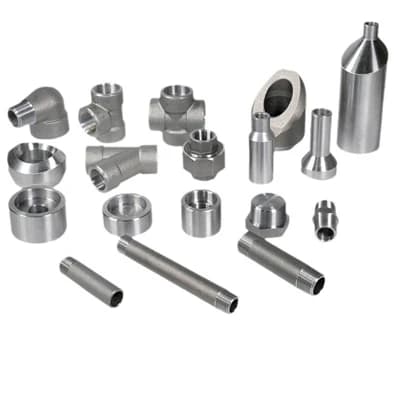
An oil and gas fitting is defined by the governing standard, the material grade, the size, the pressure rating, the end connection and the traceability the project requires. A pressure number taken from one service is not the rating of the fitting. A double-ferrule compression joint is not a butt-weld or forged threaded fitting.
Pick one fitting family before picking a grade
Butt-welding fittings, forged threaded or socket-welding fittings, and compression fittings solve different joints. ASME B16.9 applies to factory-made wrought butt-welding fittings. ASME B16.11 applies to forged socket-welding and threaded fittings. A ferrule fitting that bites the tube is a manufacturer's compression system and has to be ordered to that system, not described as a cold weld that replaces a code fitting.
Flanged joints are a further family. Wellhead and Christmas-tree equipment can fall under API 6A, whose product specification also carries the ISO 10423 designation. That document does not apply to an ordinary process-pipe elbow just because the project is upstream. Use the standard named on the piping class.
Let the service select the material
Carbon steel, austenitic stainless steel, duplex stainless steel and nickel alloys are alternative material families. Type 316 or 316L is often considered where chloride or a more aggressive wet environment is expected. It is not automatically resistant to every sour, CO2 or produced-water condition. Hastelloy and duplex grades are also specified only when the corrosion review names them.
ASTM A106 is a seamless carbon-steel pipe standard, not a universal fitting grade. Do not write "A106 fittings" unless the fitting material standard named by the design uses that identity. Forged fittings need their own material standard and class.
Sour service is a specification, not a sentence. If the project requires sulfide-stress-cracking control, name the applicable NACE MR0175 or ISO 15156 requirement and the hardness or other limits it imposes. A catalogue line that says "NACE" without that limit is not compliance.
Ratings and seals have to be the specified ones
The fitting rating comes from its standard, its class or wall, its material and the design temperature. An example range such as 1,000 to 6,000 psi, or a temperature span copied from a brochure, is not the allowable range of a fitting you have not identified. Offshore service does not create a rating by itself.
Gasket and seal materials are a separate line on the inquiry. Hydrocarbon, inhibitor and acid exposure can rule out an elastomer that is acceptable in water. PTFE and other polymers have their own temperature and chemical limits. Specify the seal when the joint uses one. Do not inherit it from the metal grade.
Traceability is the dossier, not a logo
A material test report should identify the heat number, the chemical analysis, the mechanical results and the tests the standard requires, such as hydrostatic testing when that standard or specification requires it. The heat number is what lets the installed fitting be tied back to those records.
ISO 9001, API Q1 and PED 2014/68/EU are quality or regulatory schemes with their own scopes. A supplier can hold one of them and still not be qualified for the fitting you are buying. Ask for the certificate that matches the purchase specification, and check that the product form is covered.
Installation practice belongs to the fitting manufacturer and the project specification. Torque on a ferrule joint, and ultrasonic or radiographic examination of a welded joint, are required only when that joint type and specification call for them. A polymer inhibitor is a corrosion-control decision, not a property of the fitting.
Do not turn the order into a technology brochure
Embedded sensors, graphene coatings and other development topics are not part of a fitting order unless a named product specification requires them. They do not change the grade, the rating or the certificate. Buying from a certified supplier reduces paperwork risk only when the certificate, the heat number and the dimensions match the line item.
Inquiry fields to lock
- Service, design pressure, design temperature and corrosion conditions.
- Fitting family and governing standard, with the required edition.
- Grade, size, end connection, rating or schedule, and quantity.
- Sour-service standard and test limits, if the service needs them.
- Heat-number traceability, certificate type, seal material and inspection.
Published pages that can take a defined inquiry include API 5L grade pipe fittings, forged pipe fittings, ASTM A234 WPB long-radius elbows and 316L stainless steel butt-weld elbows. Match the link to the fitting family. Do not use a butt-weld page to order a compression fitting.



