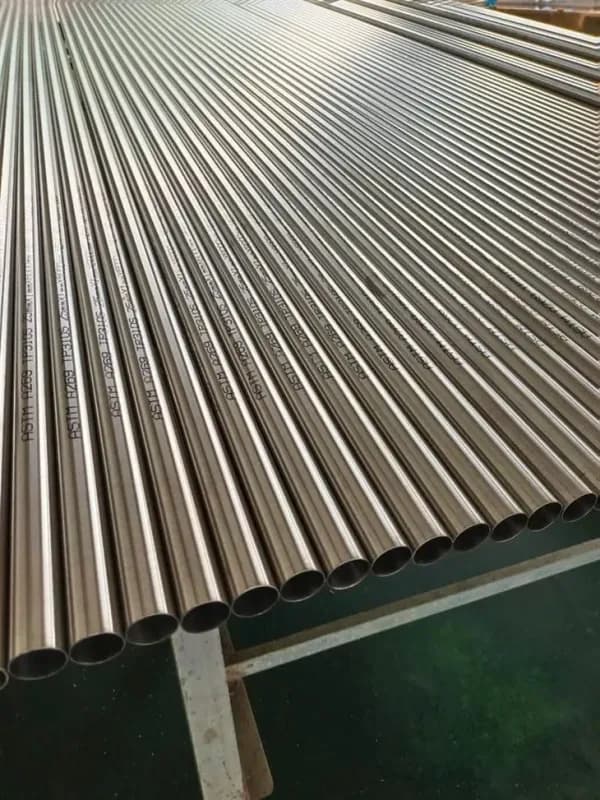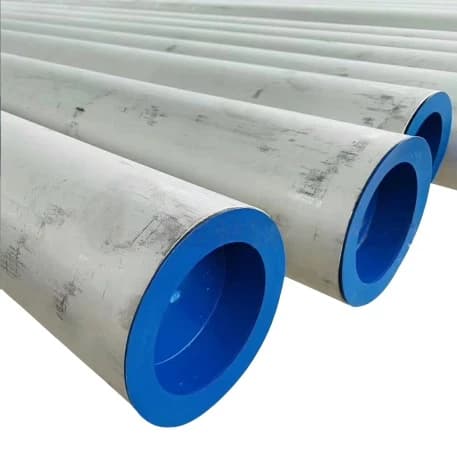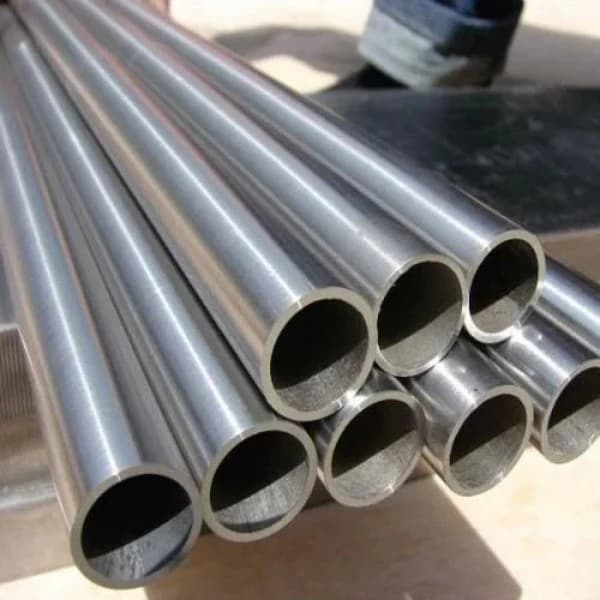
Choose stainless steel pipe by writing the specification first, then looking for a supplier that can meet it. Most sourcing problems on stainless pipe come from an order that states a grade and an outside diameter, but not the standard, the schedule, the condition or the certificate type.
Step 1: Name the Governing Standard and Grade
The standard defines what you are buying; the grade only defines the chemistry. State both, with the edition or year. For austenitic stainless pipe the common references are ASTM A312 for seamless, welded and heavily cold worked pipe, and ASTM A358 or A778 for welded pipe in other service ranges.
Grade choice should follow the service, not habit. TP304 and TP304L cover general corrosion resistance; TP316 and TP316L add molybdenum for chloride exposure; stabilised and duplex grades are chosen for specific corrosion or strength requirements. If the service involves welding and later exposure to a corrosive medium, the low-carbon or stabilised variant is the one to specify, and the intergranular corrosion test should be named on the order.
Examples of how the two decisions appear on a real line item: 304 stainless steel seamless pipe and 316L stainless steel pipe.
Step 2: Set the Size with NPS, OD and Schedule
Pipe size is not a single number. State nominal pipe size (NPS), the schedule, and confirm the resulting outside diameter against the dimensional standard. Outside diameter is set by NPS and does not change with wall thickness or schedule.
| NPS | Outside diameter (mm) | Common stainless schedules |
|---|---|---|
| 1/2 | 21.3 | 10S, 40S, 80S |
| 1 | 33.4 | 10S, 40S, 80S |
| 2 | 60.3 | 10S, 40S, 80S |
| 3 | 88.9 | 10S, 40S, 80S |
| 4 | 114.3 | 10S, 40S, 80S |
| 6 | 168.3 | 10S, 40S, 80S |
| 8 | 219.1 | 10S, 40S, 80S |
Stainless pipe dimensions are covered by ASME B36.19M; the outside diameters in the table above are the same values as those listed in ASME B36.10M for the same NPS. Wall thickness comes from the schedule, and the schedule you pick must be checked against the design pressure and the corrosion allowance.
Step 3: Choose the Manufacturing Route
Seamless pipe is produced by piercing and elongating a solid billet, so it has no longitudinal seam. Welded pipe is formed from strip or plate and welded along the seam, which generally gives better dimensional consistency and shorter lead time at lower cost. Both routes can be supplied to the same specification, and the route must be stated on the order because it affects testing and the applicable rating.
A side-by-side comparison is available on the stainless steel seamless and welded pipe page.
Step 4: State the Condition, Finish and Length
Pipe is normally supplied annealed and pickled, or solution annealed, and the condition is part of the specification because it controls the mechanical properties. State the finish if the surface matters, the length (random or fixed, with the tolerance), and the end finish (plain end, bevelled end, or threaded and coupled).
Step 5: Specify the Testing and the Certificate
Testing is where two quotations that look identical stop being identical. Ask for the following, in writing:
- Chemical analysis reported per heat, tied to the heat number on each pipe
- Tensile and hardness results, and impact testing if the service requires it
- Hydrostatic testing, or the nondestructive electric test permitted by the specification, applied to each length
- Intergranular corrosion testing to ASTM A262 where sensitization is a risk
- Pitting corrosion testing to ASTM G48 for molybdenum-bearing grades in chloride service
- Dimensional and visual inspection results, and the certificate type: EN 10204 3.1, or 3.2 where independent verification is needed
Positive material identification (PMI) at receipt is a reasonable additional check when the service is critical. Treat it as verification of the certificate, not as a replacement for it.
Common Specification Gaps
- Stating the grade but not the standard, so the mill can supply a different product form to a different specification
- Stating the NPS but not the schedule, so wall thickness is left to the supplier
- Omitting the condition, so cold-worked pipe arrives when annealed properties were assumed
- Omitting the certificate type, so an EN 10204 3.1 certificate is supplied where 3.2 was required
- Comparing prices before the testing scope, packing and marking are aligned
What to Confirm with Your Inquiry
- Standard and edition, grade, and manufacturing route (seamless or welded)
- NPS, schedule, outside diameter and wall thickness, length and end finish
- Condition and surface finish required
- Testing scope: hydrostatic or NDT, intergranular corrosion, pitting, impact, PMI
- Certificate type (EN 10204 3.1 or 3.2) and any third-party inspection
- Quantity, packing, marking and required delivery schedule
Send these fields with your enquiry and the quotation you get back will be directly comparable across suppliers.