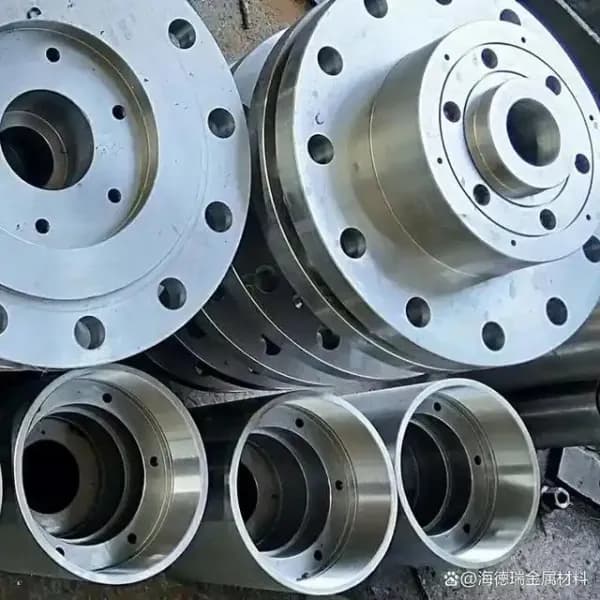
Product Description
This page is an ASME B16.5 Class 150 raised-face flange in Monel 400 (UNS N04400, Werkstoff 2.4360). The raised face is the sealing land, not a pressure rating. Class 150 is a B16.5 designation, and the allowable pressure still depends on the material group and the design temperature in the edition named on the order.
Monel 400 is a nickel-copper solid-solution alloy. It is the usual choice where seawater, brackish water, or a reducing process stream would attack ordinary stainless steel. It is not a stainless grade, and it is not Monel K-500.
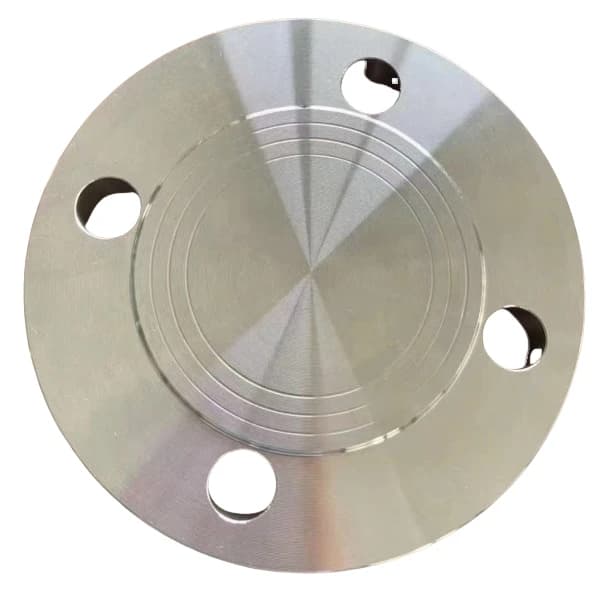
Raised Face, and Why It Is Not a Flat Face
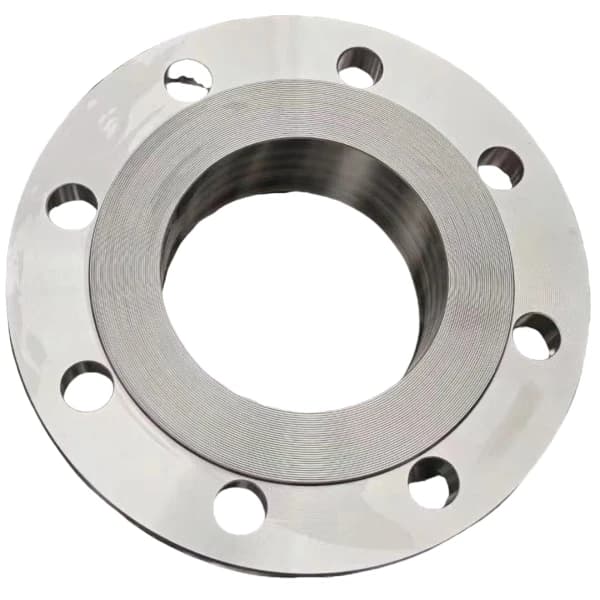
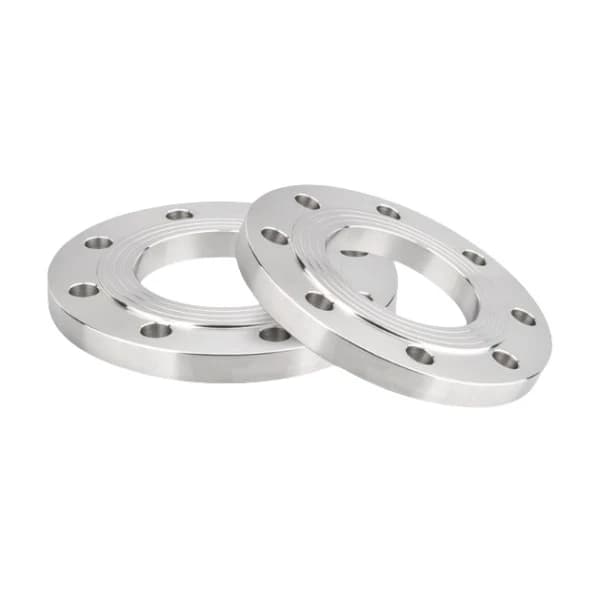
A raised face stands above the plane of the bolt circle. The gasket sits on that smaller land, so the bolt load is concentrated where the seal is made. On ASME B16.5, the Class 150 and Class 300 raised face is 1.6 mm (1/16 in) high. Classes above 300 use a 6.4 mm (1/4 in) face. The stock serrated finish commonly specified for B16.5 and B16.47 is 125–250 RMS; a smoother or concentric finish has to be written on the order.
A flat face is machined in the same plane as the bolt circle and takes a full-face gasket. It is the usual mate for a cast-iron flange, because the full contact stops the bolt load from bending the casting. Do not bolt this raised-face flange against a flat-face cast flange. The raised land can crack the casting. A ring-type joint is a different facing again: a metal ring sits in a groove, and that facing is not supplied unless the order says RTJ.
What ASME B16.5 Actually Covers
ASME B16.5-2025 covers pipe flanges and flanged fittings from NPS 1/2 through NPS 24 (DN 15 through DN 600). It sets pressure-temperature ratings, materials, dimensions, tolerances, marking, and testing. It does not cover NPS 26 through NPS 60; those sizes belong to ASME B16.47 when the order calls for them.
The previous version of this page listed 1/2–48 in and DN10–DN4000 as one range. Both ends of that range are wrong for this standard. NPS 1/2 is DN 15, not DN 10, and NPS 24 is DN 600. NPS 48 is DN 1200, not DN 4000, and it is outside B16.5. DIN, EN, JIS, and BS flanges are not interchangeable with a B16.5 Class 150 flange just because the nominal size looks similar. Quote those only when the drawing names that standard.
Class 150 is not “150 psi.” The old “150# PSI” wording mixed a rating class with a pressure unit. No single pound or megapascal rating is published here. Read the B16.5 pressure-temperature table for the nickel-alloy group at the design temperature.
Material Characteristics
The forging specification for this flange is ASTM B564, Standard Specification for Nickel Alloy Forgings. B564-25 is the active edition (last updated 11 November 2025). The public abstract confirms the title and that grades are classified by chemical composition. It does not publish the heat-analysis limits or the forging tensile minima, so those numbers are not repeated here. Acceptance is the material test report against the B564 edition named on the purchase order.
The producer’s limiting composition for Monel alloy 400, which is a material reference and not a B564 heat analysis, is nickel plus cobalt 63.0% minimum, copper 28.0–34.0%, carbon 0.30% maximum, manganese 2.0% maximum, iron 2.5% maximum, sulfur 0.024% maximum, and silicon 0.50% maximum. Density is 8.80 g/cm³. The melting range is 1300–1350 °C (2370–2460 °F). The old line “melting point 1350 °C” kept only the top of that range.
Published typical values for alloy 400 are 550 MPa tensile and 240 MPa yield. They are typical values, not a B564 forging minimum, and they change with product form and temper. The certificate follows the B564 edition named on the order. Cold work is the only way to raise the strength of alloy 400; this is not an age-hardening grade. K-500 is a separate alloy and is not a substitute on this page.
Weld-neck bores are prepared to ASME B16.25 when the order gives the pipe schedule. Schedule, including the stainless-series 40S and 80S, sets the bore and the weld prep. It does not change the Class 150 rating.
Applications
Buyers specify Monel 400 flanges on seawater cooling, offshore and marine piping, brackish-water service, and chemical lines where a nickel-copper alloy is already on the material list. A raised face is the ordinary facing for steel and nickel-alloy piping in oil, gas, and process plants. It is a poor choice against a flat-face cast-iron valve or pump. Name the mating flange facing before the order is cut.
This page does not claim a service life, a salt-spray ranking, or a maximum temperature. Corrosion and allowable pressure both depend on the fluid, the temperature, and the B16.5 group.
Ordering Information
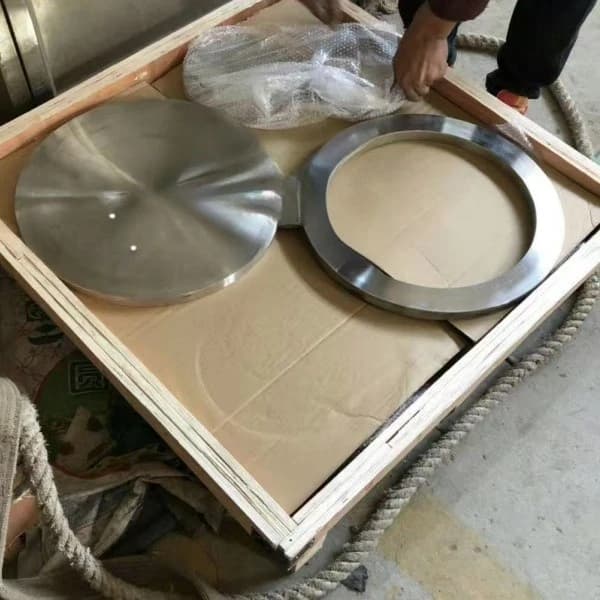
A quotation needs the flange type, not only the facing. Weld neck, slip-on, blind, socket weld, threaded, and lap joint are different B16.5 shapes, and this page does not assume one of them. Also send NPS, Class 150, raised face, the B564 edition, bore or schedule, quantity, and any facing finish other than the 125–250 RMS stock serration. If the mating flange is flat face or cast iron, say so. That joint needs a different facing.
The same alloy in coil and strip is a different product form: Monel 400 Alloy Coil and Strip. For the B16.5 pattern in stainless steel, see ASME B16.5 Stainless Steel Flanges. A Class 150 raised-face joint uses a ring gasket inside the bolts. ASME B16.20 covers that gasket when the drawing calls for it. The insulating-kit page on this site does not currently resolve to a product title, so it is not linked. An oval ring joint is a different groove and a different gasket: ASME B16.20 Nickel-Based Alloy 825 Oval Ring Joint Gasket.
Purchasing Questions
Is the old 1/2–48 in, DN10–DN4000 range a B16.5 size?
No. ASME B16.5-2025 stops at NPS 24, which is DN 600. NPS 1/2 is DN 15, not DN 10. NPS 48 is DN 1200 and belongs to B16.47 only when that standard is named. DN 4000 is not an NPS 48 equivalent.
Can this raised-face flange bolt up to a flat-face flange?
Not to a flat-face cast-iron flange. The 1.6 mm raised land concentrates the bolt load and can bend or crack the casting. Match raised face to raised face, or order a flat face when the mate is cast iron.
Does Class 150 mean 150 psi?
No. Class 150 is a dimensionless B16.5 rating. Allowable pressure comes from the pressure-temperature table for the material group. The old “150# PSI” wording is withdrawn.
Are 550 MPa tensile and 240 MPa yield the certificate minimums?
No. 550 MPa tensile and 240 MPa yield are published typical values, not a B564 forging minimum. The certificate follows the B564 edition on the order.
Is Monel K-500 the same flange?
No. K-500 is a different, age-hardenable nickel-copper grade. This page is alloy 400 only, UNS N04400.