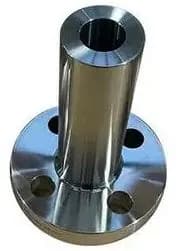
Product Description
The ASME B16.5 long weld neck flange in UNS N08020 (Alloy 20, 20Cb-3, DIN 2.4660) is a forged, integrally reinforced nozzle flange: a heavy-wall barrel joined to a disc-shaped flange whose bolt circle, facing and thickness follow the standard B16.5 weld neck dimensions of the same size and class. This page covers the high-pressure lane of that style, Classes 900, 1500 and 2500, the ranges most often specified for pressure vessel and column nozzles in severe chemical service.
Alloy 20 is a niobium-stabilized nickel-iron-chromium alloy developed for sulfuric acid service, with useful resistance to environments containing chlorides, phosphoric acid and nitric acid. Flanges are forged and supplied to ASTM B462 / ASME SB462, the standard for forged or rolled nickel alloy pipe flanges, forged fittings and valves for corrosive high-temperature service, which covers UNS N08020.
Why a Long Weld Neck Instead of a Standard Weld Neck
The difference is the neck, and it changes how the flange is installed on the vessel.
- Direct nozzle attachment. A standard weld neck ends in a taper with a bevel for butt-welding to matching pipe. A long weld neck acts as a boring extension of the vessel wall: the neck is normally square-cut, so the flange attaches directly to the shell or tank without a pipe nipple and without a separate pipe-to-flange weld seam.
- Bore convention. Because the square-cut end replaces the pipe, a regular long weld neck has no schedule bore. The bore is machined to the nominal size named on the order; it is not the outside diameter of that NPS. Custom bores and wall thicknesses are machined to drawing, and heavy barrel types differ from this convention.
- Barrel variants. Common variants are the standard LWN, the LWN heavy barrel (HB) with a thicker wall for reinforced nozzles, and the equal barrel (E) type.
- Neck length. ASME B16.5 defines a default length through hub of 9 in for NPS 4 and smaller and 12 in above NPS 4. There is no universal standard overall length: longer or shorter barrels are routine, and the finished length is fixed by the purchaser's drawing.
Chemical Composition and Mechanical Properties
The composition below is the published UNS N08020 range compiled from independent datasheets for wrought Alloy 20. It is a reference, not a ladle analysis; the certified chemistry for your order follows the material standard and the heat in question.
| Element | Range or Limit (% by weight) |
|---|---|
| Nickel, Ni | 32.0 – 38.0 |
| Chromium, Cr | 19.0 – 21.0 |
| Copper, Cu | 3.0 – 4.0 |
| Molybdenum, Mo | 2.0 – 3.0 |
| Columbium + Tantalum, Cb+Ta (Nb) | 8 × C to 1.00 |
| Carbon, C | 0.07 max |
| Manganese, Mn | 2.00 max |
| Silicon, Si | 1.00 max |
| Phosphorus, P | 0.045 max |
| Sulfur, S | 0.035 max |
| Iron, Fe | Balance |
For mechanical strength, the published minimums for annealed UNS N08020 forgings are 551 MPa (80 ksi) tensile, 241 MPa (35 ksi) yield at 0.2% offset, and 30% minimum elongation in 50 mm; The mill test certificate for the heat is the acceptance document.
| Property (annealed) | Published minimum |
|---|---|
| Tensile strength | 551 MPa (80 ksi) min |
| Yield strength, 0.2% offset | 241 MPa (35 ksi) min |
| Elongation in 50 mm | 30% min |
| Density | 8.05 g/cm³, for estimation, not an acceptance value |
Size Ranges, Pressure Classes and Neck Length
The table below states the ASME B16.5 boundaries for this page's lane. Size and class are fixed by the standard, not by supplier catalog habits: anything larger than NPS 24 belongs to ASME B16.47 Series A or B, which is a different document with a different class range and is not covered by this page.
| Item | Value under ASME B16.5 |
|---|---|
| Size range, Class 900 and Class 1500 | NPS 1/2 to NPS 24 (DN 15 to DN 600) |
| Size range, Class 2500 | NPS 1/2 to NPS 12 (DN 15 to DN 300) |
| Pressure classes on this page | Class 900, Class 1500, Class 2500 |
| Facing types | Raised face (RF), flat face (FF), ring joint (RTJ) |
| Default length through hub | 9 in for NPS 4 and smaller; 12 in above NPS 4 |
| Overall length / barrel | Per purchaser drawing; standard, heavy barrel (HB) or equal (E) |
Two cautions when cross-quoting: pressure ratings are not a single number. The allowable pressure of a Class 900 flange depends on the B16.5 material group and the design temperature, so quote from the standard's rating tables rather than from a psi figure found on a catalog page. And where a quotation quotes sizes above NPS 24 for a B16.5 flange, ask which standard the drawing actually follows.
Ordering Information
Because long weld necks are drawing-driven parts, a usable quotation needs the nozzle context, not just the flange size. Please confirm:
- NPS and pressure class (900 / 1500 / 2500) and facing (RF, FF or RTJ)
- Overall length through hub, or the drawing; barrel type: standard, heavy barrel (HB) or equal (E)
- Bore and wall thickness, especially for heavy barrel nozzles
- Material standard: ASTM B462 / ASME SB462 for UNS N08020, with any supplementary testing named on the order
- Documentation: EN 10204 3.1 or 3.2 mill test certificate, and any NACE MR0175 / MR0103 review required by the service
- Quantity, delivery basis and surface protection requirements
Where the service calls for a different nickel alloy, the same B16.5 geometry is available as a Monel 400 raised face flange. For standard (non-extended-neck) B16.5 flanges across the stainless range, see the ASME B16.5 stainless steel flange family, or browse the full stainless steel flange category.
Common Questions about UNS N08020 Long Weld Neck Flanges
The previous listing quoted 26 to 48 in. Are those sizes available under ASME B16.5?
No. ASME B16.5 covers Class 900 and 1500 flanges up to NPS 24 and Class 2500 only up to NPS 12; flanges NPS 26 and larger belong to ASME B16.47 Series A or B, a separate standard for large-diameter flanges with its own class range. The earlier size range on this page conflicted with the very standard named in the title and has been removed. If your drawing shows a nozzle above NPS 24, send it for review against the correct standard.
Which material standard applies: ASTM B462, B472 or B564?
For forged pipe flanges and fittings in UNS N08020, the applicable standard is ASTM B462 / ASME SB462 — not B564. B472 is the general-purpose nickel alloy forging standard that also covers this alloy, and B564 covers other nickel alloy grades. Check which standard is printed on the mill test certificate before substituting one for another, and note that a quotation written against B564 should not be assumed to cover Alloy 20 flanges.
Does the bore of a long weld neck follow pipe schedules?
Not normally. Regular LWN flanges are square-cut at the end to replace a piece of pipe rather than weld to it, so there is no schedule bore. The bore is machined to the nominal size named on the order; it is not the outside diameter of that NPS. Heavy barrel nozzles and any flange that will be welded to pipe are exceptions: specify the bore, wall thickness and bevel on the drawing, and we will machine to it.
Is Alloy 20 a stainless steel or a nickel alloy?
Both descriptions circulate, which causes real quoting errors. Iron is the balance, and a conventional figure for that balance is 35%, so in the shop it behaves like a stainless steel; but at 32.0 to 38.0% nickel with 2.0 to 3.0% molybdenum and 3.0 to 4.0% copper, ASTM classifies it under the nickel alloy standards (B462, B472, B473). The precise term is superaustenitic nickel-iron-chromium alloy, and the correct ordering path for flanges is B462, not the A182 stainless flange standard.