Product Description
Duplex 2205 flanges are forged pipe flanges in the 22% chromium duplex stainless steel sold as 2205. The trade name covers two UNS numbers: S31803, the original composition, and S32205, the tighter window with higher minimum chromium, molybdenum and nitrogen. Both are ordered as ASTM A182/A182M grade F51; grade F60 names the S32205 composition specifically. Ferrite is checked in a 40–60% window only when the order asks for it, which is why the forging grade carries a 450 MPa minimum yield strength and resists chloride stress-corrosion cracking better than the standard austenitic forging grades.
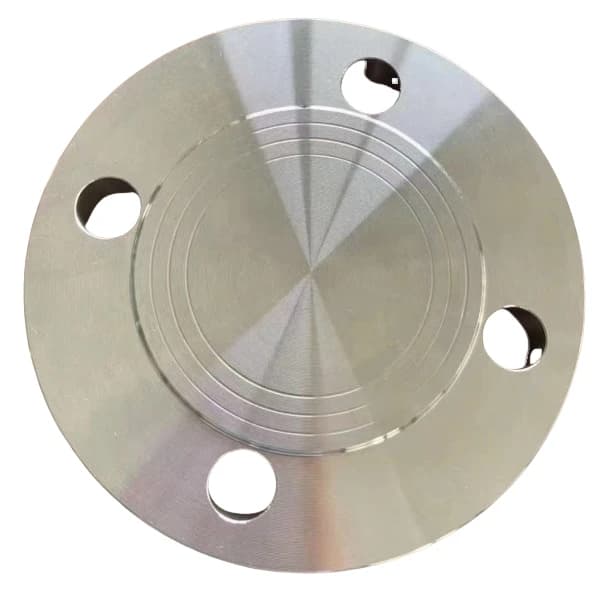
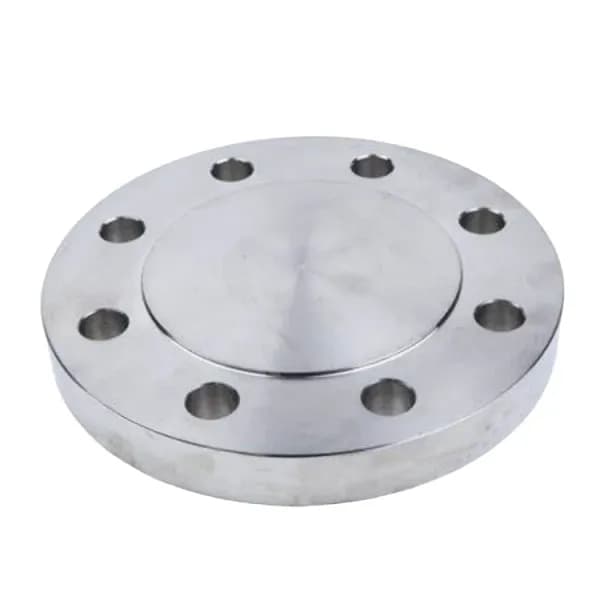
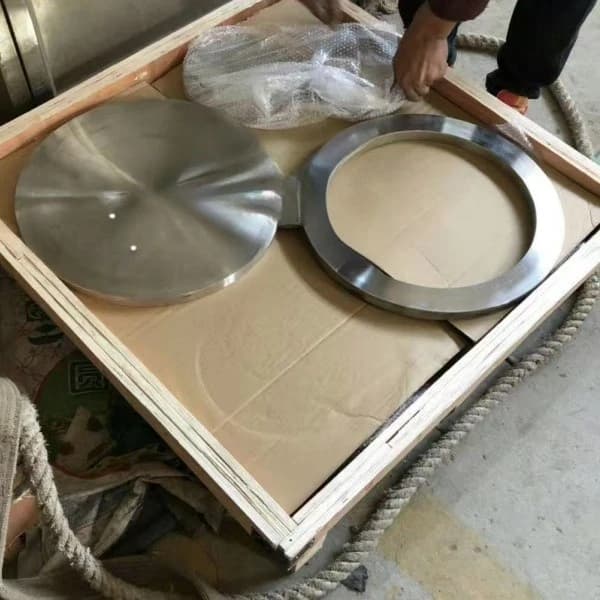
This page is the type range for that grade: weld neck, slip-on, blind, socket weld, threaded and lap joint, with raised face, flat face or ring-type joint. A blind disc with no bore is a separate ordering case and is covered on the S31803 blind flange page. Super duplex grades F53 (S32750) and F55 (S32760) are a different alloy family and are listed under super duplex steel flanges. Lean duplex F52 is not 2205.
S31803 and S32205 Are Not the Same Certificate
A buyer who writes only "2205" can receive either window. S32205 was written because mills already ran 2205 at the top of the original range; the tighter floors turn that practice into a guaranteed minimum. The three elements that move are the three that drive pitting resistance. PREN is a calculated index, not a test result: PREN = %Cr + 3.3 × %Mo + 16 × %N. At each grade's own specified minimum it is 30.53 for S31803 and 34.14 for S32205. The European designation for either window is EN 1.4462 (X2CrNiMoN22-5-3). If a PREN figure is part of the specification, name S32205 or F60 on the order and ask for the figure against the heat analysis.
| Element (%) | UNS S31803 (F51) | UNS S32205 (F51 or F60) |
|---|---|---|
| Carbon | 0.030 max | 0.030 max |
| Manganese | 2.00 max | 2.00 max |
| Phosphorus | 0.030 max | 0.030 max |
| Sulfur | 0.020 max | 0.020 max |
| Silicon | 1.00 max | 1.00 max |
| Chromium | 21.0–23.0 | 22.0–23.0 |
| Nickel | 4.5–6.5 | 4.5–6.5 |
| Molybdenum | 2.5–3.5 | 3.0–3.5 |
| Nitrogen | 0.08–0.20 | 0.14–0.20 |
| PREN at the specified minimum | 30.53 | 34.14 |
These ranges are the published UNS windows used to identify the grade. Acceptance of a forging is the edition of ASTM A182/A182M named on the order and the heat analysis on the certificate, not a single typical analysis. ASTM A182/A182M-26a is the current Active edition (updated 25 June 2026); its store page does not publish the chemistry table, so the figures above are identification ranges, not a copy of that edition's melt limits.
Flange Types, Facing and Bore
The type decides how the flange joins the pipe. The facing decides the gasket. Neither is implied by the class number. A raised face will not seal against a ring-joint groove, and a socket-weld flange is not a substitute for a weld neck on a line that needs a full-penetration butt weld.
| Type | How it joins the pipe | Typical use |
|---|---|---|
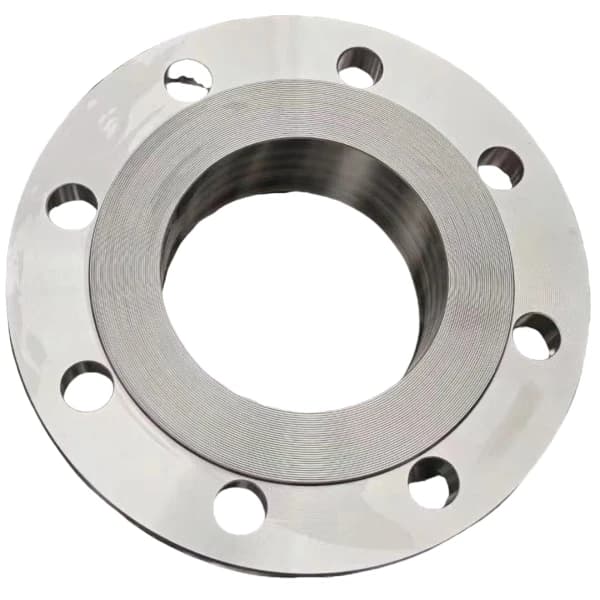
| Weld neck | Butt weld to a matching pipe end; hub bore follows the pipe schedule | Pressure lines where the weld is inspected as a butt joint |
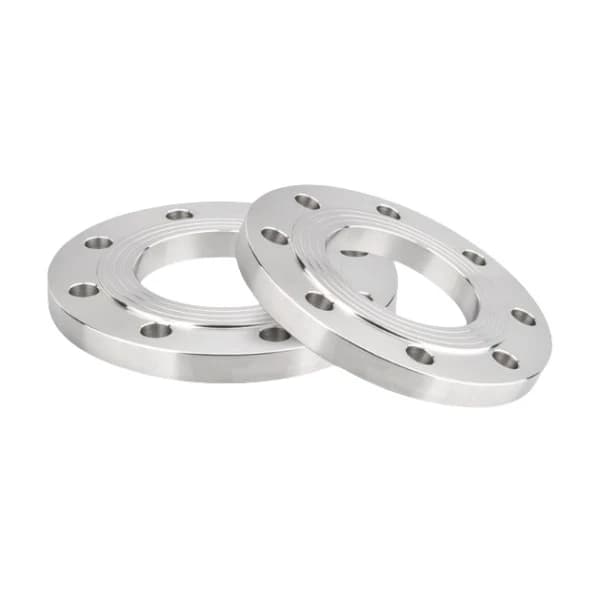
| Slip-on | Pipe passes into the bore and is fillet welded | Lower pressure classes where a fillet weld is acceptable |
| Blind | No bore; bolted closure only | Line ends, nozzles, tie-in points. See the blind-flange page |
| Socket weld | Pipe sits in a socket and is fillet welded | Small-bore lines; not a butt-weld substitute |
| Threaded | Taper thread, no weld | Small-bore lines that must be broken without welding |
| Lap joint | Loose ring over a stub end | Where the stub end carries the corrosion duty and the ring only the bolts |
Facing is ordered separately. Raised face (RF) is the process-piping default and seats a spiral-wound or sheet gasket on the raised ring. Flat face (FF) uses a full-face gasket and is the facing to mate with cast iron, lined or GRP flanges that must not see a raised ring. Ring-type joint (RTJ) machines a groove to ASME B16.20 and seals on a metal ring; it will not mate with a raised face. On Class 150 and Class 300 the raised face is 1.6 mm (1/16 in) high; on Class 400 and above it is 6.4 mm (1/4 in). For a weld neck, the bore and the welding end follow the pipe schedule under ASME B16.25, including the stainless schedules that carry an S (40S, 80S). Class and schedule are not the same number.
Standards, Size and Class
Dimensions come from the flange standard. The material grade changes the pressure-temperature rating through the material group, not the outside diameter or the bolt circle. The ranges below are the scopes of those standards. They are not a stock list, and a catalogue line that reads "1/2 in to 48 in, Class 150 to 2500" is not the scope of any one of them.
| Standard | What it covers | Size | Rating |
|---|---|---|---|
| ASTM A182/A182M | Forged stainless pipe flanges. F51 covers S31803 and S32205; F60 names S32205 | The forging, not the dimension table | Not a pressure rating |
| ASME B16.5 (2025) | Pipe flanges and flanged fittings | NPS 1/2–24 (DN 15–600) | Class 150 to 2500; Class 2500 is dimensioned only to NPS 12 |
| ASME B16.47 | Large-diameter flanges. Series A and Series B do not share a bolt circle | NPS 26–60 (DN 650–1500) | Class 150 to 900; Series B also has Class 75 |
| EN 1092-1 | PN flanges, when the project is written in PN rather than Class | Confirm DN and PN on the order | Not interchangeable with an ASME class of a similar number |
| ASME B16.20 | Ring-joint groove and the metal ring | Per NPS and class | Not a flange rating |
ASME B16.5 stops at NPS 24. From NPS 26 the flange is a B16.47 item, and the series letter has to come from the project specification because Series A and Series B will not bolt together. Class 2500 above NPS 12 is not a B16.5 flange. EN 1092-1 is a separate dimension system: a PN 16 flange is not a Class 150 flange with a different stamp.
Material Characteristics
For an F51 forging the acceptance minima in the solution-annealed condition are 620 MPa (90 ksi) tensile strength, 450 MPa (65 ksi) yield strength at 0.2% offset, 25% elongation and 45% reduction of area, with hardness not above 293 HBW. That yield strength is a little more than twice the minimum specified for the common austenitic forging grades, which is why a duplex flange can be the lighter choice on a chloride line. It is a minimum for the ordered grade, not a tested value of every heat, and it is not a plate or bar value copied onto a forging.
The delivered condition is a solution anneal and a rapid quench. After forging, the part is cooled and then heated above 1020 °C and quenched. A slow cool or a stress relief in place of that anneal can leave the chemistry correct and the toughness and corrosion resistance wrong, because intermetallic phases form on cooling. A mill certificate that does not state the heat treatment is not a complete certificate for this grade. Where the order asks for it, ferrite is checked in a 40–60% window, and intermetallic phases are checked by ASTM A923 or a corrosion test such as ASTM G48. Those tests are supplementary requirements, not a default on every flange.
Duplex 2205 is the right material in chlorides and the wrong material in heat. ASME B16.5 places the grade in material group 2.8 and carries a note that the steel is not to be used over 600 °F (315 °C). Above that, the ferrite can embrittle and sigma phase can form. Treat 315 °C as the standard's ceiling, not as a design temperature. Working pressure is read from the group 2.8 table at the design temperature in the edition named on the order. Class is a designation, not a pressure in psi, and the same class does not carry the same working pressure as a 304 or 316 flange. Where the order requires sour service, NACE MR0175 / ISO 15156 is a separate requirement and caps hardness (28 HRC where the order names NACE MR0175 / ISO 15156); it is not implied by the A182 grade.
Applications
Duplex 2205 flanges are specified where the line already runs in 2205 and the flange has to match it, and where warm chlorides have already ruled out 316:
- Seawater cooling, firewater and produced-water piping offshore
- Desalination and brine systems
- Chemical lines that carry chlorides but stay below the 315 °C ceiling
- Sour-service piping when the order names NACE MR0175 / ISO 15156
- Pulp and paper and coastal marine piping in the same temperature band
They are not a substitute for super duplex when the PREN requirement is above 40, and they are not a high-temperature flange. Plate, coil and pipe in 2205 are different product forms with different standards; a coil specification does not describe a forging.
Ordering Information
A quotation follows the configuration, not the trade name. Send:
- Grade: ASTM A182 F51 with the UNS number (S31803 or S32205), or F60 when the tighter composition is required
- Type: weld neck, slip-on, blind, socket weld, threaded or lap joint
- NPS or DN, and the pipe schedule for a weld neck
- Class, or PN if the drawing is EN 1092-1
- Facing: raised face, flat face or ring-type joint
- Dimension standard and edition, and the series letter for any size above NPS 24
- Design temperature and the medium, so the rating is read from the correct row
- Certificate and any supplementary test: ferrite, ASTM A923, ASTM G48, or NACE MR0175 / ISO 15156
- Quantity and marking
Sizes and classes outside the tables above are quoted to drawing. Nothing on this page is a stock promise or a lead time.
Common Questions about Duplex 2205 Flanges
Is duplex 2205 the same as S31803?
2205 is the trade name. S31803 is the original UNS window and S32205 is the tighter one. Both can be supplied as ASTM A182 F51. F60 names S32205. If the specification needs the higher chromium, molybdenum and nitrogen floors, write S32205 or F60 on the order. Ordering "2205" alone leaves the window to the mill.
What size and class can a duplex 2205 flange be?
ASME B16.5 covers NPS 1/2 through NPS 24, Class 150 through 2500, and Class 2500 only through NPS 12. From NPS 26 the flange is ASME B16.47, Series A or Series B, and the two series do not bolt together. An older range of 1/2 in to 80 in, or Class 150 to 2500 on every size, is not the scope of either standard and is not offered on that basis.
Can a 2205 flange replace a 316 flange?
Only when the line is within the duplex temperature ceiling and the facing, class and bore match the mating flange. The yield strength is higher and chloride stress-corrosion resistance is better, but ASME B16.5 group 2.8 is not to be used over 315 °C, and the pressure-temperature rating is the group 2.8 table, not the 316 table. Super duplex is the step up when 2205's PREN is not enough; it is not the same forging.
Does the flange come with a pressure rating in MPa?
No single pressure describes the product. Class is a designation. Working pressure is read from ASME B16.5 material group 2.8 at the design temperature, in the edition named on the order. A previous page that stated one pressure for Class 150 through 2500 has been withdrawn for that reason.
What should the certificate show?
The heat analysis against the ordered UNS number, the mechanical results against the F51 or F60 minima, the solution-anneal and quench, and any supplementary test the order named. A certificate that lists chemistry only, or that lists a plate standard in place of A182, does not accept a forging.