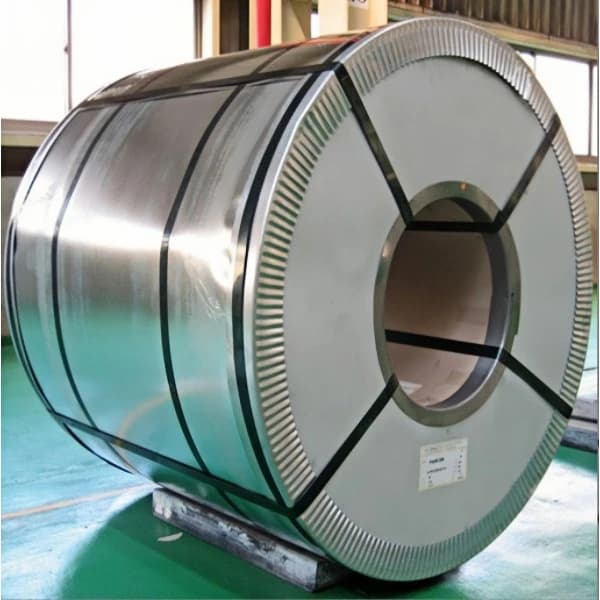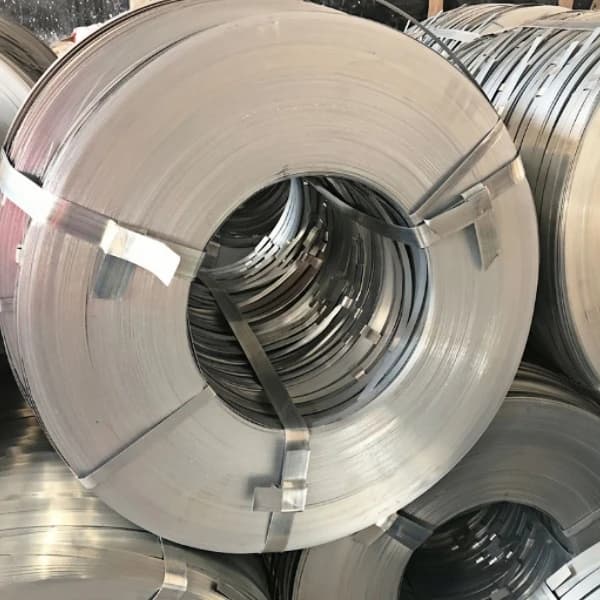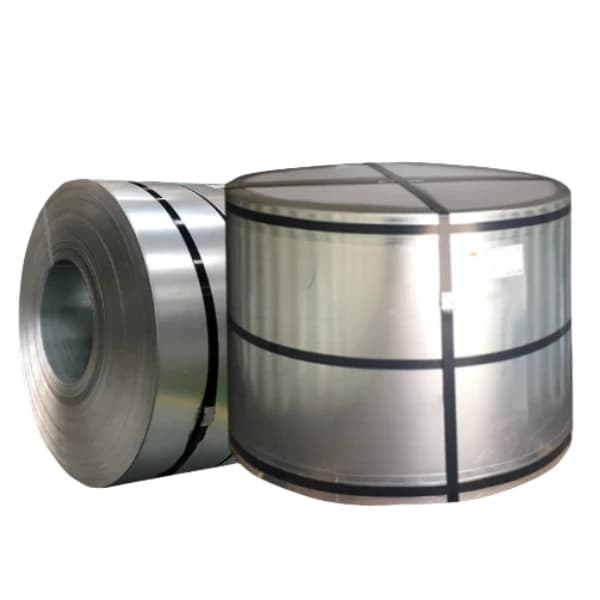
Product Description
Monel 400 coil and strip are nickel-copper alloy products supplied to UNS N04400 (W.Nr. 2.4360) for industrial service that needs a combination of corrosion resistance, strength and fabrication performance. The alloy contains roughly 63% nickel and 28-34% copper, and it is a common choice for marine engineering, chemical processing, saltwater equipment and selected oil-and-gas applications.
Monel 400 resists flowing seawater, neutral and alkaline solutions and many reducing environments, and it shows good resistance to chloride stress corrosion cracking and pitting in fresh water. Its resistance to hydrochloric and hydrofluoric acid is best in de-aerated conditions. Performance depends on the medium, concentration, temperature, flow rate and fabrication condition, so the service conditions should be reviewed before the material is approved.
Specifications
Chemical composition, wt% (ASTM B127 reference limits)
| Element | Reference limit |
|---|---|
| Nickel (Ni) | 63.0 min |
| Copper (Cu) | 28.0-34.0 |
| Iron (Fe) | 2.50 max |
| Manganese (Mn) | 2.00 max |
| Carbon (C) | 0.30 max |
| Silicon (Si) | 0.50 max |
| Sulfur (S) | 0.024 max |
Carbon is 0.30% maximum to ASTM B127; any tighter cap is stated on the order.
Typical mechanical properties (reference values; confirm against the mill certificate)
| Condition (temper) | Tensile strength | Hardness, Rockwell B |
|---|---|---|
| Annealed / soft | 70-85 ksi (approx. 480-585 MPa) | 68 max |
| Skin-hard | Cold worked | 68-73 |
| Quarter-hard | Cold worked | 73-83 |
| Half-hard | Cold worked | 82-90 |
| Three-quarter-hard | Cold worked | 89-94 |
| Hard | 100-120 ksi (approx. 690-825 MPa) | - |
| Spring temper | approx. 120 ksi (approx. 825 MPa) | 98 min |
The cold-worked tempers are controlled mainly by hardness rather than by a single tensile figure, so tensile strength rises from approximately 480-585 MPa in the annealed condition to approximately 825 MPa or more in spring temper. Spring temper is a minimum-hardness designation, and the properties of a specific lot should be confirmed on the mill certificate.
Reference physical properties
| Property | Reference value |
|---|---|
| Density | 0.318 lb/in³ (8.8 g/cm³) |
| Melting range | 2370-2460 °F (1300-1350 °C) |
| Modulus of elasticity | 26.0 × 10³ ksi (approx. 179 GPa) |
| Thermal conductivity | approx. 21.8 W/(m·K) at room temperature |
| Electrical resistivity | approx. 51 µΩ·cm at room temperature |
| Coefficient of thermal expansion | approx. 15.7 µm/(m·°C), 20-300 °C |
Values are typical for the alloy and are given for reference; actual values vary with temper, product form and test temperature and should be confirmed on the certified material test report. Service temperature limits depend on the product form, temper, medium and applicable design code and should be confirmed for each project.
Product form and ordering details
| Item | Details |
|---|---|
| Grade | Monel 400 (UNS N04400); W.Nr. 2.4360 (2.4361 is the low-carbon variant) |
| Grade equivalents | EN NiCu30Fe; AFNOR NU-30M; JIS NW 4400; BS NA 13 |
| Product forms | Coil and precision-rolled strip. Plate and sheet are separate product forms. |
| Coil thickness | 4.5-10 mm |
| Strip thickness | Up to 3.0 mm; the minimum available thickness depends on width and temper and is confirmed for each order |
| Width | Precision-rolled strip 5-600 mm. Coil slit width 50-1500 mm; the minimum width after slitting is 50 mm. |
| Delivery state | Soft/annealed, skin-hard, quarter-hard, half-hard, three-quarter-hard, hard or spring temper |
| Surface finish | Mill, bright, TR, annealed or polished, subject to confirmation |
| Standards | ASTM B127; ASME SB 127; AMS 4544; QQ-N-281; BS 3072 NA13; BS 3073 NA13; DIN 17750 - confirm the applicable edition |
| Tolerances | To be confirmed for the ordered thickness, width, edge condition and temper |
| Order details | Grade, product form, thickness, width, coil or cut length, temper, finish, quantity and service conditions |
Material Characteristics
Monel 400 is a solid-solution strengthened nickel-copper alloy, so it cannot be precipitation hardened; strength and hardness are raised by cold working, and the selected temper sets the balance between formability and strength. In the annealed condition the coil and strip are ductile, remain tough at low temperatures and can be cold formed, drawn, blanked and welded by conventional methods. Typical annealing is carried out at approximately 870-980 °C (1600-1800 °F) followed by rapid cooling. The harder tempers are stiffer and spring back more, and are normally chosen for springs, seals and other parts that need higher strength or wear resistance. The alloy is machined and welded with conventional procedures, and the delivery condition should be selected from the required balance of formability, strength and flatness.
Applications
Monel 400 coil and strip are selected where seawater, salt, caustic or reducing-acid service has to be combined with good fabrication properties. Typical uses include marine components, seawater piping and splash-zone sheathing, propeller shafts and shafting, pumps, valves, seals and springs; heat exchangers, brine heaters, HF reboilers, MEA reboilers and packed columns in chemical and petrochemical plants; salt-production equipment; process and storage vessels; and oil-and-gas items such as oil-well recovery pumps, crude-oil distillation towers, gasoline and fresh-water tanks, boiler feed-water heaters, and chlorinated-solvent and ethyl-chloride purification equipment. Final suitability depends on the medium, temperature, concentration and aeration, so the service conditions should be confirmed for each project.
Ordering Information
To request a quotation, provide the grade, product form (coil or strip), thickness, width, coil or cut length, quantity, temper, surface finish, applicable standard and the service conditions. Where dimensional tolerances, edge condition, mechanical property ranges or inspection documents are critical, attach a drawing or technical specification. The quotation should confirm the delivery state, inspection documents, packaging and delivery requirements. Monel K500 is a different, precipitation-hardenable grade and must not be substituted for Monel 400 unless it is separately approved. For matching flanged connections in the same grade, see the Monel 400 raised face flange.