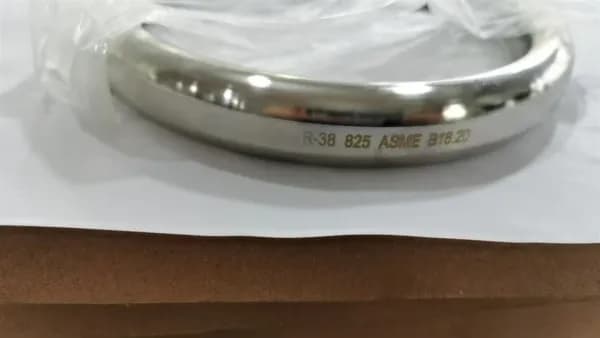
Product Description
An Alloy 825 oval ring joint gasket is a solid metal ring machined to the oval section of an ASME B16.20 Type R ring-joint. The alloy is UNS N08825 (W.Nr. 2.4858), a nickel-iron-chromium grade with molybdenum, copper and titanium. It is not a spiral-wound gasket, not a sheet gasket, and not an octagonal ring. The octagonal Type R ring uses the same R number and the same groove on a current flat-bottom flange, but it is a different cross-section and should be ordered as its own line.
The oval ring seals by plastic flow into the sides of the flange groove. Contact is a narrow line, so the ring has to be softer than the groove it seats in. ASME B16.20 sets the maximum hardness by gasket material; the value for this nickel alloy is read from the edition named on the order, not from a single hardness printed here. Alloy 825 is chosen when the flange and the process fluid call for it, typically where sulfuric acid, phosphoric acid, sour gas or seawater is the reason a carbon-steel or stainless ring is not used. That selection is a materials decision. It is not a pressure rating and not a temperature rating for the joint.
Oval and Octagonal Rings
Type R is the ring style covered by ASME B16.20 for standard ring-joint flanges. Both the oval and the octagonal section carry an R number, and both will enter the flat-bottom groove used on current flanges. They are not the same part. The comparison below is the ordering distinction, not a hardness or pressure table.
| Point | Oval Type R | Octagonal Type R |
|---|---|---|
| Section | Oval. Seats on a narrow line. | Octagon with a 23-degree face. Seats on a band. |
| Groove | Fits the current flat-bottom groove and older round-bottom grooves. | Fits the current flat-bottom groove. It does not fit an old round-bottom groove. |
| Marking | Same R number as the octagonal ring of that size. The section must be stated on the order. | Same R number. Do not assume the section from the number alone. |
| This page | This product. | Not this product. Order it separately. |
RX and BX rings are also outside this page. RX is a pressure-energized oval section for API 6B grooves. BX is the section used with API 6BX flanges. Neither shares dimensions with a Type R oval of the same nominal size.
Dimensions and Standards
The ring number fixes the section and the pitch diameter. NPS and pressure class only tell you which R number the flange groove calls for. ASME B16.20 gives dimensions, tolerances and marking for ring-joint gaskets that fit the flanges in ASME B16.5, ASME B16.47, API 6A and ISO 10423. It does not assign a pressure-temperature rating to the gasket. The joint rating stays with the flange standard and the flange material group.
ASME B16.5 covers flanges from NPS 1/2 through NPS 24. Class 2500 in that standard stops at NPS 12. Larger flanges are an ASME B16.47 question, and only where that standard actually provides a ring-joint facing. A single line of “1/2 in to 48 in, Class 150 to 2500” is not a supply range and is not used on this page. API 6A is a separate flange and ring system; do not copy a B16.5 R number onto a 6A flange without checking the ring table.
| Item | How it is fixed |
|---|---|
| Standard | ASME B16.20, edition named on the order. The 2023 edition is the current issue (published 2024). |
| Style | Type R, oval section. Octagonal, RX and BX are not this item. |
| Size | R number from the flange facing. NPS and class are the way to find that number, not a substitute for it. |
| Flange fit | B16.5 ring-joint facing through NPS 24. Above that, confirm B16.47 or API 6A before quoting. |
| Marking | Manufacturer, ring number, material and the B16.20 reference, as the ordered edition requires. |
| Hardness | At or below the B16.20 maximum for the gasket material, and below the flange groove. Confirm both before machining. |
Alloy 825 Identification
The limits below are the published limiting composition of INCOLOY alloy 825, in weight percent (Special Metals, Table 1). They identify the alloy. They are not a heat analysis, and they are not the acceptance limit for a finished ring. Acceptance is the material certificate for the bar the ring is cut from, checked against the revision named on the order.
| Element | Limit |
|---|---|
| Nickel | 38.0–46.0 |
| Iron | 22.0 minimum |
| Chromium | 19.5–23.5 |
| Molybdenum | 2.5–3.5 |
| Copper | 1.5–3.0 |
| Titanium | 0.6–1.2 |
| Carbon | 0.05 maximum |
| Manganese | 1.0 maximum |
| Silicon | 0.5 maximum |
| Sulfur | 0.03 maximum |
Density is 8.14 g/cm³ and the melting range is 1370–1400 °C. Both are physical constants of the alloy, not service limits of a bolted joint. Room-temperature tensile figures in the same bulletin are typical values for tubing and bar, and they change with cold work. They are not a minimum for a finished ring, so they are not listed as a gasket guarantee. The Special Metals bulletin notes that exposure above 540 °C can form phases that reduce ductility, and that the alloy is not normally used where creep-rupture controls the design. That note is the producer bulletin, not a gasket temperature rating.
The old page on this product said the ring was rated for 2500 psi, for −40 °C to 550 °C, and for a tensile strength of at least 550 MPa. None of those figures is a property of this gasket. Class 2500 is a flange class, not 2500 psi. The 550 MPa figure does not appear in the Alloy 825 bulletin as a ring-gasket minimum. Those three claims are withdrawn.
Applications
Use this ring where the flange is already a ring-joint facing and the material specification calls for Alloy 825. Typical duties are sour-gas and oil-well piping, sulfuric and phosphoric acid lines, and seawater service where a soft-iron or stainless ring would be the wrong metal. The flange, the bolting and the groove condition still decide whether the joint is suitable. A harder ring than the groove will mark the groove; a reused oval ring rarely returns to the same contact line.
This page does not cover spiral-wound gaskets, kammprofile gaskets, or the insulation kit used on the same flange class. Those are different products. For the flange itself, start from the forged stainless steel flange page and match the facing before you match the ring.
Ordering Information
A quotation needs the R number, the oval section (not octagonal), NPS, flange class, and the flange standard (ASME B16.5, ASME B16.47 or API 6A). Add the flange material and its hardness, or ask for the ring hardness to be set from the B16.20 table against that flange. State the B16.20 edition, the quantity, whether the ring is marked with the heat number, and which documents you want with the shipment: material certificate, hardness reading, and dimensional report. Do not send only “Alloy 825 RTJ, Class 600.” That sentence fits more than one ring.
Frequently Asked Questions
Will an oval Alloy 825 ring fit a flange cut for an octagonal ring?
On a current flat-bottom Type R groove, the oval and the octagonal ring of the same R number both enter the groove. They do not seal on the same geometry. The oval makes a line contact; the octagonal makes a band on its 23-degree face. Order the section the specification names. An octagonal ring will not enter an old round-bottom groove.
What does the R number mean, and why is NPS not enough?
The R number is the size of the ring: pitch diameter and section. One NPS has a different R number at Class 150 than it has at Class 600 or Class 1500. Send the R number stamped for that facing. If you only know NPS and class, say which flange standard the facing was machined to, because B16.5, B16.47 and API 6A do not share one ring table.
Is this gasket rated to Class 2500 or to 2500 psi?
No. ASME B16.20 sizes the ring so it can be used in the grooves of the flanges listed in B16.5, B16.47 and API 6A. The pressure-temperature rating belongs to the flange and its material group. Class 2500 is not the same statement as 2500 psi, and this page does not publish either number as a gasket rating.
How hard should the Alloy 825 ring be?
Softer than the flange groove, and no harder than the maximum ASME B16.20 lists for the gasket material in the edition you order. Tell us the flange alloy, or the groove hardness, when you enquire. A ring that is harder than the groove can damage the facing, and an oval ring is not intended to be reused after it has been seated.
Do you publish a chemical analysis or a tensile minimum for the finished ring?
The table on this page is the alloy’s published limiting composition, for identification. The certificate for the bar is the document that accepts a given ring. Typical tensile numbers for annealed bar or tubing are not a minimum for a machined gasket, so they are not offered as one.