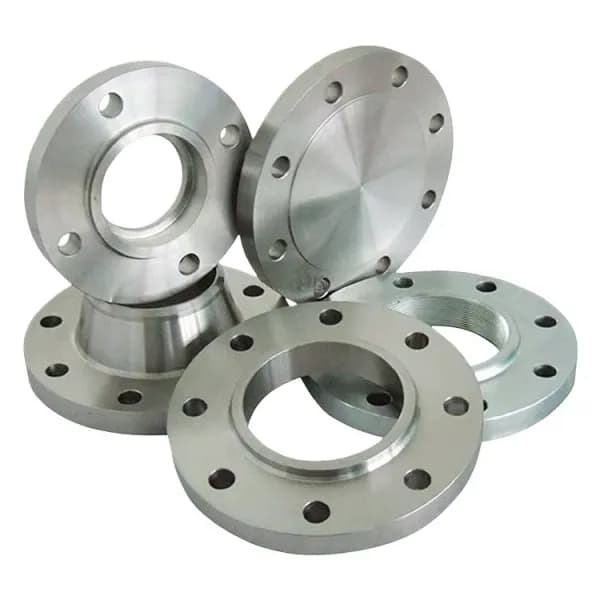
Product Description
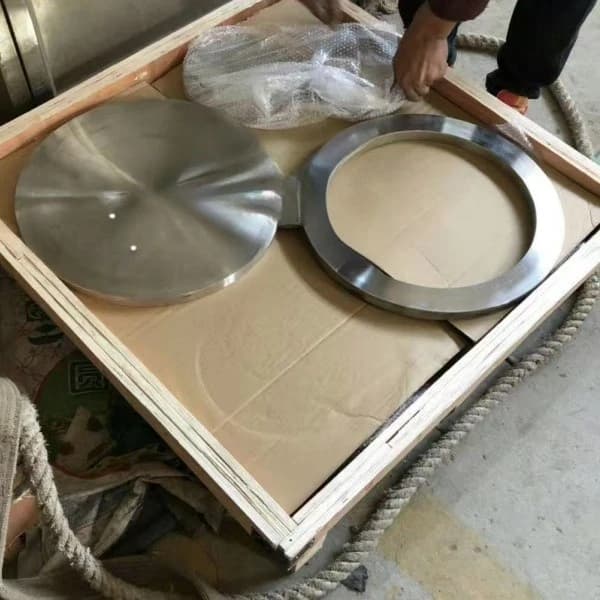
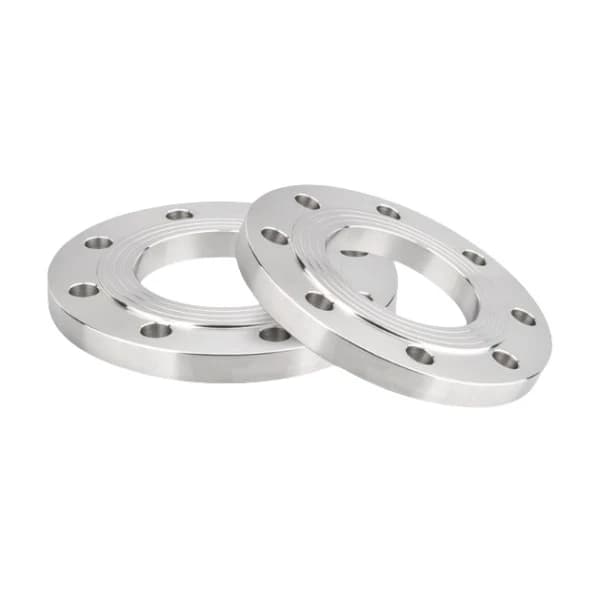
ASME B16.5 stainless steel flanges are forged pipe flanges manufactured to the dimensions, pressure-temperature ratings, materials, tolerances, testing and marking requirements of ASME B16.5, covering NPS 1/2 through NPS 24 (DN 15 through DN 600) in pressure Classes 150 through 2500. Supply covers the common austenitic grades in ASTM A182 - F304, F304L, F316, F316L and the stabilized F321/F321H - in weld neck, slip-on, socket weld, threaded, lap joint and blind types, with raised face, flat face or ring joint facings.
Two points settle most specification questions before a purchase order is written. First, a Class number is a pressure-temperature rating designation, not a fixed pressure value: the allowable working pressure depends on the material group and the operating temperature. Second, the B16.5 size range ends at NPS 24, so larger diameters belong to ASME B16.47. Both points are set out below, together with the material grouping that drives the ratings, within the wider stainless steel flange range.
Flange Types and Facings in ASME B16.5
ASME B16.5 standardizes six flange types (plus reducing flanges), and each type carries its own thickness column in the standard's dimension tables - a Class 150 weld neck flange is not dimensionally interchangeable with a Class 150 threaded flange of the same size. The table below summarizes how each type joins the pipe and where it is normally selected.
| Type | Joint to pipe | Typical selection points |
|---|---|---|
| Weld neck (WN) | Butt weld through a tapered hub | Full-penetration weld; preferred for high-pressure, cyclic and critical lines |
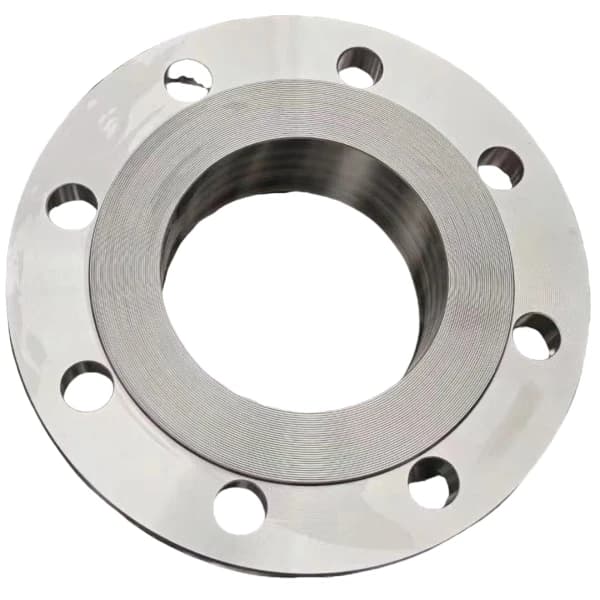
| Slip-on (SO) | Pipe slipped through the bore, two fillet welds | Economical and easy to align in general service |
| Socket weld (SW) | Pipe inserted into a recess, one outside fillet weld | Small-bore piping, typically NPS 1-1/2 and below |
| Threaded (TH) | Screwed onto threaded pipe, no welding | Low-pressure, ambient-temperature service, or locations where welding is impractical; internal NPT thread per ASME B1.20.1 (BSPT to ISO 7-1 on request) |
| Lap joint (LJ) | Used with a stub end; the flange is a loose ring | Bolt-hole alignment freedom and frequent dismantling; lets the rotating ring be a cheaper material than the stub end |
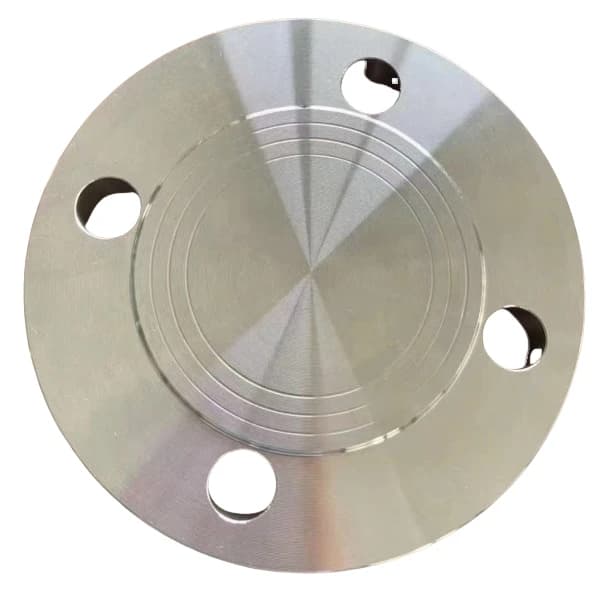
| Blind (BL) | Solid disc, no bore | Closes a line end or an opening on a vessel or valve; also the only form for which B16.5 lists plate materials (see below) |
Facings follow the same standard: raised face (RF) is the workhorse for most process piping, flat face (FF) is selected where the mating surface is brittle, and ring joint (RTJ) with oval or octagonal metal rings is used in high-pressure, high-temperature service. ASME B16.5's rating tables apply directly to ring joint and tongue-and-groove facings, so an RTJ flange in the same size, class and material group carries the tabulated rating without derating for the facing. For a worked example of a single grade and size, see the 317 stainless steel weld neck flange, NPS 6 Sch 40S, Class 300; if your route is forging-based supply, the forged stainless steel flange page covers the A182 F304/F316 forging route in detail.
Pressure Classes Are Rating Designations, Not Pressure Values
ASME B16.5 uses seven pressure classes - 150, 300, 400, 600, 900, 1500 and 2500. As the class number rises, the flange ring gets thicker and the bolt pattern grows, so a Class 600 flange is heavier and stronger than a Class 150 flange on the same pipe size. What the class number does not do is state a pressure. A Class 150 flange made from A182 F304 is rated 275 psig at 100 °F, and that value falls as the temperature rises; a Class 150 flange made from A182 F304L is rated 230 psig at the same temperature. Two further range rules matter when ordering: Class 2500 is dimensionally tabulated only through NPS 12, and Class 150 flanges are not rated above 1000 °F. Where a joint operates above ambient temperature, always read the rating from the pressure-temperature table of the current edition rather than assuming from the class number.
Pressure-Temperature Ratings by Material Group
ASME B16.5 groups materials with matching allowable-stress behavior and gives each group its own rating columns. The grades on this page fall into four groups: Group 2.1 (A182 F304/F304H), Group 2.2 (A182 F316/F316H), Group 2.3 (A182 F304L/F316L) and Group 2.4 (A182 F321/F321H). The anchor values below are reproduced at the standard's base temperature range from the ASME B16.5 rating tables (ANSI-authorized reprint) and cross-checked against an independent compilation; ratings may be interpolated between the tabulated temperatures of the current edition.
| Material group (grade) | Class 150, psig at -20 to 100 °F | Class 300, psig at -20 to 100 °F |
|---|---|---|
| Group 2.1 - A182 F304/F304H | 275 | 720 |
| Group 2.2 - A182 F316/F316H | 275 | 720 |
| Group 2.3 - A182 F304L/F316L | 230 | 600 |
| Group 2.4 - A182 F321/F321H | 275 | 720 |
Above the base range the ratings fall with temperature. As an indication of the slope, a Class 150 Group 2.1 flange is tabulated at 20 psig at 1000 °F; the same slope is why L-grade flanges lose their advantage in hot service. The standard's own footnotes cap the low-carbon group further: A182 F304L ratings are not to be used above 800 °F and A182 F316L not above 850 °F. Ratings also assume gaskets within the limiting dimensions of MSS SP-47 and no greater bolt load or flange moment than the facings the tables were established for. An earlier version of this page described 321 as performing reliably in high-temperature conditions up to 650 °C; that wording was not a standard rating and has been removed - 321 is rated in its own Group 2.4 columns, and its allowable pressure at any temperature must be read from the B16.5 tables for the specified grade and class.
Material Grades and How They Are Grouped
All flanges on this page are supplied as ASTM A182 forgings. The standard austenitic set is F304 and F304L for general corrosion resistance, F316 and F316L where molybdenum improves pitting resistance in chloride-bearing or chemical service, and F321 or F321H where titanium stabilization is specified to resist carbide precipitation and intergranular attack across the sensitization range (roughly 425-850 °C). The niobium-stabilized alternative is F347, covered on the ASTM A182 F347 flange page; niobium and titanium stabilization address the same sensitization mechanism with different metallurgy, and the two are not freely interchangeable against a project specification. One boundary from the standard is easy to miss: B16.5 lists plate materials only for use as blind flanges, so a "plate flange" in another type is not a B16.5 part and must be ordered against the applicable plate-flange standard instead.
Class 150 Weld Neck Dimensions
The table below reproduces dimensions in inches (with millimetre equivalents for the outside diameter) for Class 150 weld neck flanges, NPS 1/2 through NPS 12. Thickness values are specific to the weld neck type - the standard's threaded and slip-on thickness columns are thinner - and all manufacturing tolerances are those of ASME B16.5. These figures are reproduced from ASME B16.5; the current edition governs.
| NPS | Flange OD, in (mm) | Thickness, in | Bolt circle, in | Bolts | Bolt dia, in |
|---|---|---|---|---|---|
| 1/2 | 3.50 (88.9) | 0.44 | 2.38 | 4 | 0.50 |
| 3/4 | 3.88 (98.6) | 0.50 | 2.75 | 4 | 0.50 |
| 1 | 4.25 (108.0) | 0.56 | 3.12 | 4 | 0.50 |
| 1-1/4 | 4.62 (117.3) | 0.62 | 3.50 | 4 | 0.50 |
| 1-1/2 | 5.00 (127.0) | 0.69 | 3.88 | 4 | 0.50 |
| 2 | 6.00 (152.4) | 0.75 | 4.75 | 4 | 0.62 |
| 3 | 7.50 (190.5) | 0.94 | 6.00 | 4 | 0.62 |
| 4 | 9.00 (228.6) | 0.94 | 7.50 | 8 | 0.62 |
| 6 | 11.00 (279.4) | 1.00 | 9.50 | 8 | 0.75 |
| 8 | 13.50 (342.9) | 1.12 | 11.75 | 8 | 0.75 |
| 12 | 19.00 (482.6) | 1.25 | 17.00 | 12 | 0.88 |
Applications
ASME B16.5 stainless steel flanges serve wherever flanged connections need corrosion resistance and standardized bolt-up geometry: chemical and petrochemical process lines, refinery and utility piping, water and wastewater treatment, food, beverage and pharmaceutical processing on 304/316L systems, and marine or coastal installations where the molybdenum-bearing grades are specified. Stabilized F321/F321H flanges are selected where the piping specification calls for resistance to intergranular corrosion after thermal cycling in the sensitization range. The standard's interchangeability - identical bolt patterns for a given size and class across compliant makers - is what allows mixing valves, fittings and flanges from different sources on one line, so the correct class and material group, not just the nominal size, must travel with the purchase order.
Ordering Information
To price and produce ASME B16.5 stainless steel flanges, send the grade (F304, F304L, F316, F316L, F321 or F321H), the flange type, NPS and pressure class, the facing (RF, FF or RTJ), and for weld neck, slip-on or socket weld flanges the mating schedule or wall thickness so the bore and weld preparation match the pipe. Add quantity, any facing-finish or serration requirement, and documentation needs such as material test reports or PMI. Sizes above NPS 24 are outside B16.5: blind and weld neck flanges from NPS 26 to NPS 60 are standardized in ASME B16.47, Series A (formerly MSS SP-44) and Series B (formerly API 605) - the two series share pressure class names but differ in dimensions and bolting, so state the series as well as the size.
Common Questions about ASME B16.5 Stainless Steel Flanges
Is there a difference between ANSI B16.5 and ASME B16.5 flanges?
No. "ANSI flange" is legacy trade naming from the years when the standard was accredited under ANSI; the document has long been published by ASME as B16.5. Dimensions and ratings of an "ANSI B16.5" flange are the same as the current ASME B16.5 part, and purchase orders are best written with the ASME designation.
Does Class 150 mean the flange holds 150 psi?
No. The class is a rating designation. A Class 150 A182 F304 flange is rated 275 psig at -20 to 100 °F, an A182 F304L flange in the same class is rated 230 psig, and both fall with temperature. Read the pressure-temperature table for the material group before fixing a class.
Why is a 316L flange rated lower than a 316 flange?
The lower carbon content that helps 316L resist weld-zone sensitization also reduces its high-temperature strength, so ASME B16.5 places it in Group 2.3 with lower rating columns than Group 2.2 (F316). The gap exists already at ambient temperature (230 vs 275 psig in Class 150) and widens in hot service, where the standard also caps 304L at 800 °F and 316L at 850 °F.
What standard applies to flanges above NPS 24?
ASME B16.5 ends at NPS 24. Large-diameter blind and weld neck flanges from NPS 26 to NPS 60 are covered by ASME B16.47 in Series A and Series B, which are not dimensionally interchangeable, so the series must be specified with the size and class.
Does ASME B16.5 specify bolt torque?
No. The standard contains no mandatory torque tables. Tightening is engineered per assembly, typically following ASME PCC-1, because the required torque depends on the gasket, the bolt material and size, and the lubrication factor.