Product Description
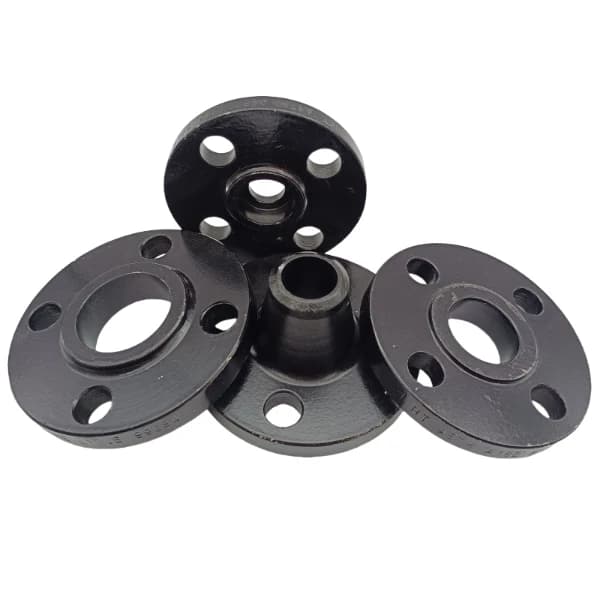
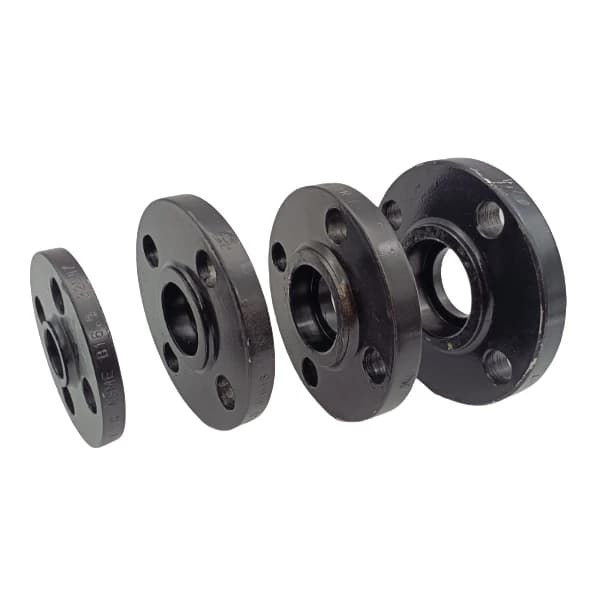
A carbon steel threaded flange is a forged pipe flange with a female pipe thread in the bore. The male thread on the pipe screws into that bore, so the joint does not need a butt weld. This page covers that connection only, in forged carbon steel, normally ASTM A105, with dimensions to ASME B16.5 and the thread to ASME B1.20.1 when the order calls for NPT.
The flange still bolts to the mating flange through a gasket. The thread only joins the flange to the pipe. A raised face is the usual facing. A flat face is a different joint, used when the mating flange is flat, and a ring-type joint is a groove plus a metal ring. Name one facing on the order. Do not treat the three as interchangeable finishes of the same flange.
Carbon steel is not a corrosion-resistant alloy. Bare A105 rusts in wet service and in storage. Black oil, paint, phosphate or galvanizing is a surface choice on the order, not a corrosion rating, and none of those coatings is assumed. Low-temperature service is a different forging grade, ASTM A350 LF2, on its own page. High-yield line-pipe flanges in ASTM A694 are a different grade again.
What to Confirm Before Ordering
The rows below are the order fields for this flange. They are not a stock list and not a measured certificate for one heat. Outside diameter, bolt circle, thickness and thread length come from the ASME B16.5 table for the ordered NPS and class. They are not reprinted here as a second set of numbers.
| Item | How this flange is specified |
|---|---|
| Product form | Forged threaded flange, female thread in the bore. Not a weld neck, slip-on, socket weld, lap joint or blind flange. |
| Material | ASTM A105/A105M carbon steel forging, unless the order names another grade. A105N means the same chemistry with a normalizing heat treatment called out on the order. |
| Thread | ASME B1.20.1 NPT unless the order says otherwise. BSPT (ISO 7-1 / EN 10226) is a different thread and must be named. NPT and BSPT do not interchange. |
| Dimensions | ASME B16.5. Flanges in Class 150, 300, 400, 600, 900 and 1500 run from NPS 1/2 through NPS 24, except that Class 900 and 1500 have no NPS 22. Class 2500 stops at NPS 12. Above NPS 24 there is no standard threaded flange. ASME B16.47 covers NPS 26–60 but lists weld neck and blind flanges only, so a larger threaded flange is a special item, specified separately. |
| Facing | Raised face, flat face, or ring-type joint. One facing per order. RTJ rings follow ASME B16.20 and are not part of this flange. |
| Pressure | Class is a designation, not a pressure in psi or bar. Read the allowable pressure from the ASME B16.5 table for the material group and the design temperature, in the edition named on the order. The connected pipe rating also limits the joint. |
ASTM A105/A105M-26 is the active forging specification as of the 10 March 2026 store listing. Its scope is forged carbon steel piping components, including flanges, for ambient and higher-temperature pressure service, with a maximum forging weight of 10,000 lb (4540 kg). The store listing does not print the melt analysis or the tensile minimums, so those numbers are not repeated on this page. Acceptance is the material test report against the edition named on the order.
Material and Joint Limits
A105 is a carbon steel forging grade for flanges, fittings and similar parts. It is not ASTM A36 structural plate, and it is not Q235B. Those grades do not accept an A105 flange. Plate flanges, where B16.5 allows plate for certain blind and reducing flanges, are a different product and are listed separately.
The thread is the weak point of this joint, not the bolt circle. B16.5 threaded flanges are used where welding is impractical. They are a poor choice for severe cyclic service, severe thermal shock, or lines where crevice corrosion at the thread would be a problem. A sealant may be required to make the thread tight. The sealant is selected for the fluid and the temperature. It is not supplied with the flange, and it is not a substitute for the gasket on the raised face.
Do not read a single temperature or a single pressure off a catalogue line and treat it as the rating of every size. A Class 150 number is not 150 psi. A supplier temperature window belongs to that supplier's reading of one pressure-temperature table. The figure that governs is the B16.5 rating for the ordered material group, class and temperature, capped by whatever the pipe itself is rated for.
Applications
Use a carbon steel threaded flange on low-alloy carbon steel piping where the pipe end is already threaded and a weld is not wanted: utility air, fuel oil, low-pressure steam and similar non-corrosive services, small bore branch connections, and lines that have to come apart for maintenance. The facing, class and thread still have to match the mating flange and the pipe.
It is the wrong flange where the specification calls for a butt weld, where the size is above NPS 24, or where the material must be stainless, duplex or a low-temperature forging. Weld neck, slip-on, plate and lap-joint carbon steel flanges are listed as their own items. ASTM A350 LF2 covers the low-temperature forging grade.
- A105 carbon steel flanges for the grade across other flange types.
- Carbon steel plate flanges where the order allows a plate flange.
- Carbon steel lap joint flanges where the stub end is the wetted part.
- ASTM A350 LF2 flanges for low-temperature service.
Ordering Information
Send NPS, pressure class, facing, thread standard (NPT or a named alternative), material grade and whether normalizing (A105N) is required, quantity, and any coating or certificate the order requires. Outside diameter and drilling follow the B16.5 table for that NPS and class. A material test report is issued against the edition on the order. EN 10204 3.1 is available when the order asks for it. It is not included unless it is asked for.
Questions Buyers Ask
Is a carbon steel threaded flange the same as an NPT flange?
Only when the order says NPT. NPT is the ASME B1.20.1 tapered pipe thread. BSPT is a different taper thread. The two do not screw together. If the pipe is BSPT, write BSPT on the order. A parallel thread (BSPP) is a third form and is not assumed.
What size range applies?
ASME B16.5 covers this flange from NPS 1/2 through NPS 24 in Classes 150, 300, 400, 600, 900 and 1500. Class 2500 stops at NPS 12. NPS 1/2 is DN 15, not DN 10. NPS 24 is DN 600. Sizes above NPS 24 are not this item, and they are not B16.47 items either: B16.47 lists weld neck and blind flanges only.
Why is there no tensile strength on this page?
The active ASTM listing, A105/A105M-26, confirms the product scope and the 10,000 lb forging limit. It does not print the chemical limits or the tensile, yield, elongation and hardness minima. Those values move with the edition. The certificate for the heat is the record, checked against the edition named on the purchase order. A catalogue range such as 485–655 MPa, or a tightened carbon window, is not the specification.
Can this flange be used on a corrosive or low-temperature line?
Not by default. Carbon steel needs a corrosion allowance or a coating decision, and a coating is not a corrosion rating. Service at low temperature belongs on ASTM A350 LF2, which is a different forging specification with its own impact requirements. Sour-service restrictions, where they apply, have to be named on the order. They are not implied by A105.
What should the enquiry include?
NPS, class, facing, thread (NPT or the named alternative), A105 or A105N, quantity, and any coating or EN 10204 certificate. Class is not a pressure. The allowable pressure is read from ASME B16.5 for the material group at the design temperature, and it cannot exceed the rating of the pipe on the thread.