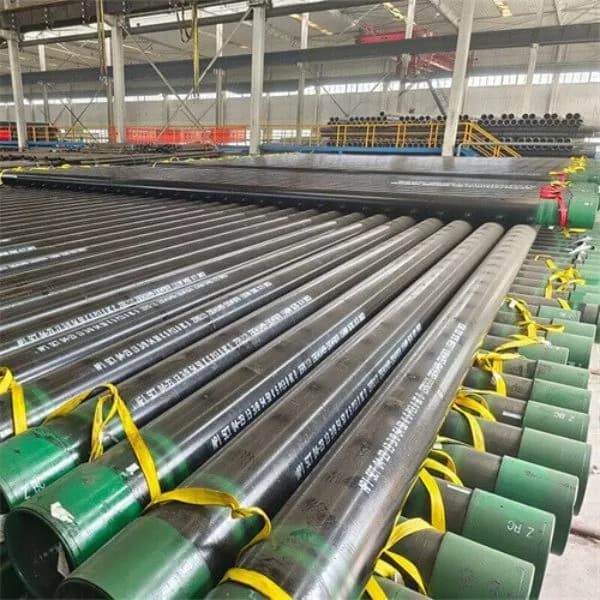
Product Description
Oil and gas casing pipe is the large-diameter steel tubular that is lowered into a drilled well and cemented in place to line and stabilise the borehole. As the structural backbone of the well, casing keeps the hole open, isolates the different geological formations from one another, protects shallow freshwater zones, and provides the sealed pressure environment that lets drilling and production proceed safely. It is one of the three Oil Country Tubular Goods (OCTG) product families, alongside tubing (the smaller string run inside the casing to carry produced oil and gas to surface) and drill pipe.
Casing is supplied to API 5CT (Specification for Casing and Tubing), the API standard that sets the grade designations, dimensional ranges, threading and marking requirements for well casing and tubing, pup joints and couplings. The international equivalent of API 5CT is ISO 11960. Steel grades are designated by a letter and a number that gives the minimum yield strength in ksi, and fall into four API groups that correspond to increasingly demanding well conditions. The right grade, wall and connection are chosen from the well depth, formation pressure, temperature and whether the produced fluid is sour (hydrogen-sulphide-bearing), so every string is specified against a specific well rather than picked from a stock list.
Specifications
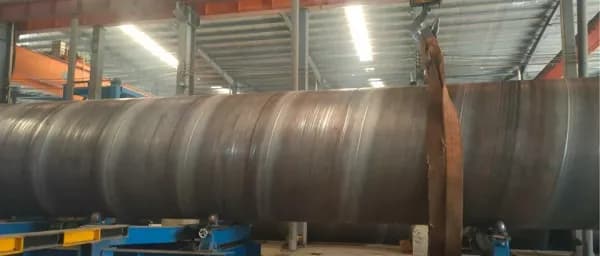
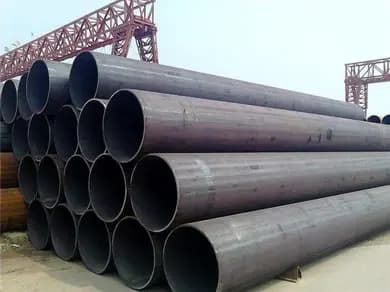
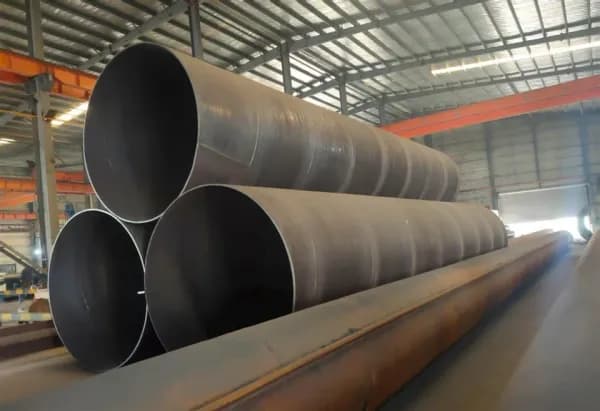
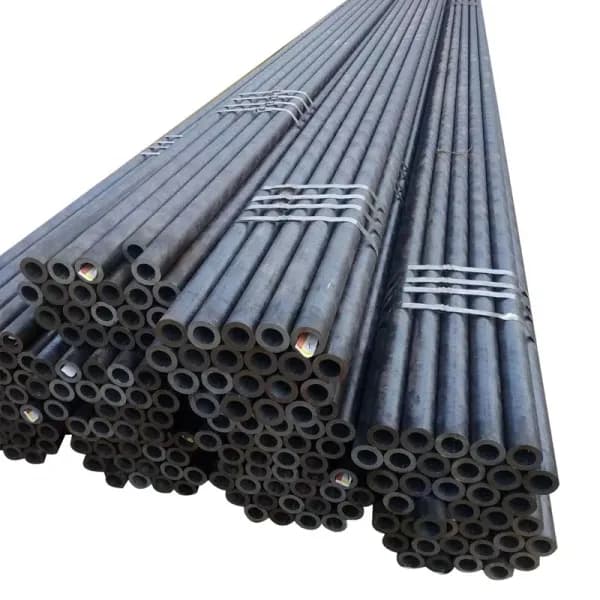
Outside diameter is 4-1/2 in to 20 in (114.3 mm to 508 mm), and conductor casing above 20 in is made to the ordered outside diameter. Wall thickness is 6 mm to 25 mm. Grade, length range, and connection follow the well design and are stated on the order.
| Parameter | Value |
|---|---|
| Product form | Well casing (OCTG), seamless (S) or electric-welded (E) process; run and cemented in place, not reusable |
| Standard | API 5CT, with ISO 11960 as the international equivalent when the order names it |
| Grades | Group 1: H40, J55, K55, N80, R95 · Group 2: M65, L80 (Type 1 / 9Cr / 13Cr), C90, T95, C110 · Group 3: P110 · Group 4: Q125 |
| Outside diameter | 4-1/2 in to 20 in (114.3 mm to 508 mm). Conductor casing above 20 in is made to the ordered outside diameter. |
| Wall thickness | 6 mm to 25 mm |
| Length | Range 1 / Range 2 / Range 3 (R1 / R2 / R3) per API 5CT, to be confirmed per order |
| Connections | STC (short thread & coupled), LTC (long thread & coupled), BTC (buttress thread & coupled); premium proprietary connections on request |
| End finish | Threaded per the connection selected; thread protectors fitted for transport |
| Sour service | L80, C90, T95 and CRA grades for hydrogen-sulphide (H₂S) service, per the applicable edition of the standard |
| Documentation | Material test certificate level and any supplementary testing specified on the order |
Material Characteristics
Casing strength is graded primarily by minimum yield strength, which rises with the grade designation across the four API groups. The lower grades — H40, J55 and K55 — are general-purpose carbon-steel grades for shallow, low-pressure wells, while N80 and R95 move into deeper sweet-service wells. Group 2 grades are the restricted-yield and sour-service grades: L80 (available as Type 1, 9Cr and 13Cr), C90 and T95 are produced with a controlled chemistry and additional sulphide-stress-cracking testing so they can resist hydrogen-sulphide cracking in sour environments. P110 (Group 3) and Q125 (Group 4) are the high-strength grades selected for deep and high-pressure wells.
Two properties are stated side by side for each grade because they are often confused: the yield strength (a range, in MPa) and the minimum tensile strength. The values below are the API 5CT yield and minimum tensile strengths for these grades.
| Grade | Yield strength (MPa) | Min tensile strength (MPa) | Typical use |
|---|---|---|---|
| H40 | 276 – 552 | 414 | Shallow, low-pressure casing; rarely used |
| J55 | 379 – 552 | 517 | Shallow, low-pressure wells |
| K55 | 379 – 552 | 655 | Like J55 with higher tensile strength |
| N80 | 552 – 758 | 689 | Sweet oil and gas wells |
| R95 | 655 – 758 | 724 | Intermediate-strength sweet service |
| L80 | 552 – 655 | 655 | Sour service; corrosion-resistant variants |
| C90 | 621 – 724 | 689 | Sour service, higher strength |
| T95 | 655 – 758 | 724 | Sour service, higher strength |
| C110 | 758 – 828 | 793 | High-strength sour service |
| P110 | 758 – 965 | 862 | Deep, high-pressure wells |
| Q125 | 862 – 1034 | 931 | Extreme high-pressure wells |
Casing is produced either seamless (designated by the process letter S) or electric-welded (E). Seamless casing is the default for critical, high-pressure strings because there is no longitudinal weld to act as a weak point; electric-welded casing remains the economical route for shallower, non-critical applications. Heat treatment — normalising, normalising and tempering, or quench-and-temper depending on the grade — is part of the grade specification, not an optional extra.
Applications
Casing is run in a sequence of strings, each with a distinct job, and a single well typically uses several of them.
- Conductor casing — the first, shallow string that isolates unconsolidated surface formations and supports the wellhead and, offshore, the platform structure.
- Surface casing — protects freshwater aquifers, prevents collapse in weak shallow formations and anchors the blowout preventer.
- Intermediate casing — isolates unstable or abnormally pressured zones (mobile salts, caving shale, lost-circulation zones) so drilling can continue safely.
- Production casing — the final full string that isolates the producing zones and houses the production tubing.
- Liner — a shorter string hung from the previous casing to line a specific section at lower cost than a full string.
Casing is specified for oil and gas wells, including deep, horizontal and shale wells, high-pressure/high-temperature (HPHT) and sour-service wells, and geothermal wells where the grade must also tolerate hot brine. The grade and wall are always matched to the specific well's depth, pressure and fluid chemistry rather than a universal rating.
Ordering Information
Because casing is engineered to a specific well, a complete enquiry should state the items below so the right grade, wall and connection can be confirmed without a clarification round.
- Outside diameter, wall thickness (or weight per unit length) and length range (R1 / R2 / R3)
- Steel grade (for example J55, L80, P110) and whether the well is sour (H₂S) service
- Process: seamless or electric-welded
- Connection type: STC, LTC, BTC, or a premium connection
- End finish and thread protectors
- Quantity, delivery destination and certificate / testing requirements
For the pressure-containment pipe that carries oil and gas along a surface or buried route rather than down the well, see the Carbon Steel Line Pipe range, which is supplied to API 5L rather than API 5CT. Both families sit within the wider carbon steel pipe category on this site.
What is the difference between casing and tubing?
Casing is the large-diameter string cemented to the borehole that gives the well its structural integrity and isolates formations; tubing is the smaller-diameter string run inside the casing that carries the produced oil and gas to the surface. The two are separate OCTG families supplied to the same API 5CT standard but for different functions, so they are ordered and sized independently.
Which API 5CT grade should I choose for my well?
The grade follows well depth, pressure and fluid chemistry. J55 and K55 suit shallow, low-pressure wells; N80 and R95 suit deeper sweet-service wells; L80, C90 and T95 are the sour-service (hydrogen-sulphide) grades; and P110 or Q125 are chosen for deep or high-pressure strings. Send the well depth, expected pressure and whether the fluid is sour, and the grade and wall can be matched to the application.
What is the difference between seamless and electric-welded casing?
Seamless casing (process S) is formed without a longitudinal weld and is preferred for critical, high-pressure strings. Electric-welded casing (process E) is the economical alternative for shallow, non-critical applications. Both are produced to API 5CT; the choice is driven by the pressure rating and the well's criticality, not by a universal "seamless is always better" rule.
Is casing pipe reusable?
No. Casing is cemented in place and cannot be dismantled once a well is abandoned, so it is a single-use product. Tubing and drill pipe, by contrast, can be pulled and reused, which is one reason they are ordered and tracked separately.
What details do you need to quote oil and gas casing pipe?
Provide the outside diameter, wall thickness or weight, length range (R1/R2/R3), the steel grade, whether the service is sour, the process (seamless or welded), the connection type and the quantity. With those items the correct grade, wall and connection can be confirmed and the enquiry quoted without a follow-up round.