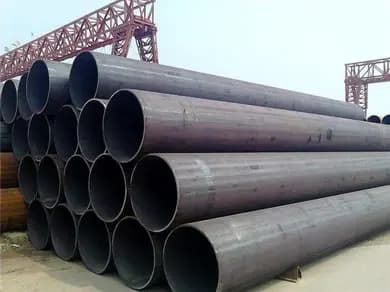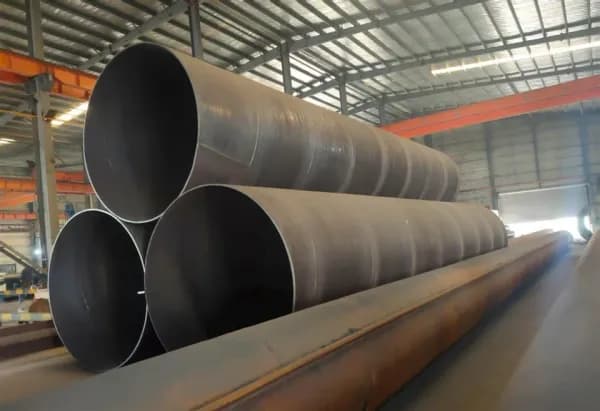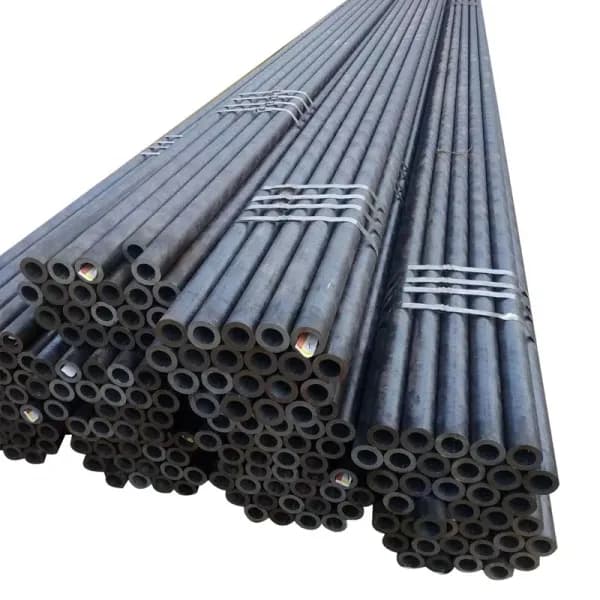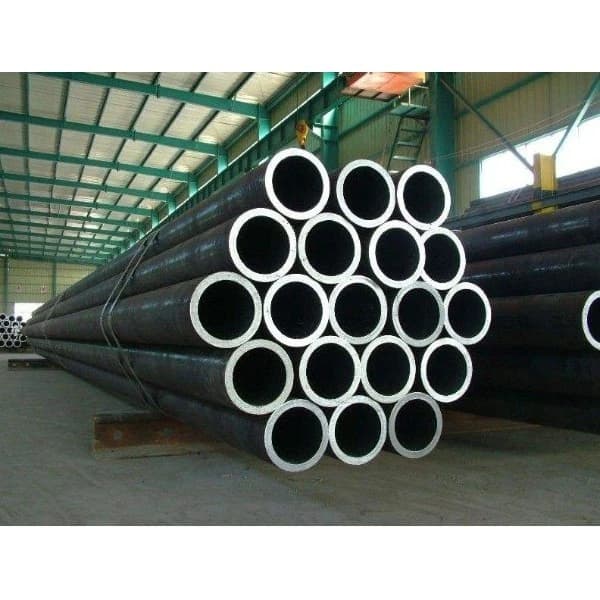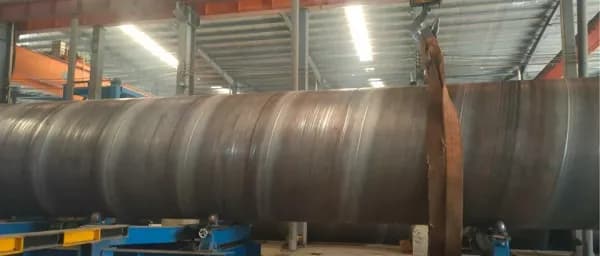
Spiral welded steel pipe (SSAW / SAWH) is made from hot-rolled coil formed at a helix angle and joined by double-sided submerged arc welding, which is why one forming line can cover a wide outside-diameter range from a small number of coil widths. This page covers the three standards spiral pipe is most often ordered against - ASTM A252 for pipe piles, ASTM A139 for conveying liquid, gas or vapour, and API 5L for line pipe - so the standard, grade and inspection level can be matched to the service before a quotation is requested.
Which Standard Fits the Service: A252, A139 or API 5L
The three standards are not interchangeable: A252 is a structural piling specification, A139 is a conveying pipe specification, and API 5L is a pipeline transportation specification with the tightest weld inspection. The table below summarises what each one controls.
| Standard | Intended service | What the standard controls | Notes for buyers |
|---|---|---|---|
| ASTM A252 | Steel pipe piles: the cylinder acts as a permanent load-carrying member or as a shell for cast-in-place concrete piles | Three strength grades (1/2/3); chemistry limited to P max 0.050%; no routine hydrostatic test - it is ordered as a supplementary requirement | Welded seams may be longitudinal, helical-butt or helical-lap, so spiral (SSAW) pipe is within scope |
| ASTM A139 | Conveying liquid, gas or vapour in NPS 4 and larger pipe, nominal wall 1.0 in. [25.4 mm] and less | Five grades A-E; chemical limits; hydrostatic test of every length; production weld tension and bend tests on a lot basis | Covers straight-seam and helical (spiral) seam; for high-temperature service the standard points to ASTM A691 instead |
| API 5L | Pipeline transportation systems for oil, gas and water (line pipe) | PSL1 / PSL2 requirement levels, grades, full-length (100%) NDT of welded seams for OD 60.3 mm and larger, hydrostatic test of every pipe | See the dedicated API 5L spiral steel pipe page for grades and PSL details, and carbon steel line pipe for the general line pipe range |
| AWWA C200 | Steel water pipe 6 in. (150 mm) and larger for transmission and distribution of potable, raw and reclaimed water or wastewater | Manufacture, welding qualification, hydrostatic testing, specials and fittings for water works | References ASTM pipe specifications including A139; commonly the controlling document on municipal water projects |
ASTM A139 Grades and Mechanical Requirements
The values below are quoted from the tensile and chemical tables of ASTM A139/A139M, which defines pipe-mill grades whose properties differ from standard plate grades. Several widely copied supplier summaries print different values for Grades C-E (for example 70 ksi / 40 ksi for Grade C); the values here follow the standard's own table, and the edition called up by the contract should always govern.
| Grade | Tensile strength, min | Yield strength, min | Elongation in 2 in. or 50 mm, basic min % (walls 5/16 in. [7.9 mm] and over) |
|---|---|---|---|
| A139 Grade A | 48 ksi [330 MPa] | 30 ksi [205 MPa] | 35 |
| A139 Grade B | 60 ksi [415 MPa] | 35 ksi [240 MPa] | 30 |
| A139 Grade C | 60 ksi [415 MPa] | 42 ksi [290 MPa] | 25 |
| A139 Grade D | 60 ksi [415 MPa] | 46 ksi [315 MPa] | 23 |
| A139 Grade E | 66 ksi [455 MPa] | 52 ksi [360 MPa] | 22 |
Chemical composition is limited by the same table - for thinner walls the standard deducts from the basic elongation, and the 8 in. elongation values are computed from the tensile strength. The composition limits are:
| Grade | C, max % | Mn, max % | P, max % | S, max % |
|---|---|---|---|---|
| A | 0.25 | 1.00 | 0.035 | 0.035 |
| B | 0.26 | 1.00 | 0.035 | 0.035 |
| C | 0.28 | 1.20 | 0.035 | 0.035 |
| D | 0.30 | 1.30 | 0.035 | 0.035 |
| E | 0.30 | 1.40 | 0.035 | 0.035 |
ASTM A252 Grades for Pipe Piles
A252 grades the steel by strength rather than by a full chemical recipe - the standard limits only phosphorus (0.050% max) and lets the mill set the rest of the chemistry to reach the mechanical requirements. The grade table is:
| Grade | Yield strength, min | Tensile strength, min | Elongation in 2 in. or 50 mm, basic min % (walls 5/16 in. [7.9 mm] and over) |
|---|---|---|---|
| A252 Grade 1 | 30 ksi [205 MPa] | 50 ksi [345 MPa] | 30 |
| A252 Grade 2 | 35 ksi [240 MPa] | 60 ksi [415 MPa] | 25 |
| A252 Grade 3 | 45 ksi [310 MPa] | 66 ksi [455 MPa] | 20 |
Because piles are driven rather than pressurised, A252 does not require a hydrostatic test as standard practice; it can be specified as a supplementary requirement. Grade 2 is the common general-purpose choice for building foundations and retaining structures, while Grade 3 is specified for heavier loads in poor soils, marine works and large infrastructure. Wall thickness, diameter and length are chosen by the purchaser, which is why large-diameter piling is frequently ordered as spiral welded pipe.
How Spiral Pipe Is Made and What Is Actually Inspected
The production route is coil feeding and levelling, edge milling, helical forming at an angle to the pipe axis, inside and outside submerged arc welding of the continuous seam, cutting to length and end preparation. Because the seam is helical, the stress resolved normal to the weld under internal pressure is lower than the full hoop stress (it scales with the square of the cosine of the helix angle) - but the seam is also longer than a longitudinal seam, so inspection coverage of the weld matters more, not less. Claims that spiral pipe is inherently "more durable because stress is spread evenly" are marketing shorthand; weld quality and its inspection decide performance.
What each standard actually requires is frequently overstated. Under ASTM A139 every length of pipe is hydrostatically tested to P = 2St/D, with the fiber stress S between 0.60 and 0.85 times the specified minimum yield strength and the pressure capped at 2,800 psi [19.3 MPa], held for at least 5 seconds - plus one reduced-section production weld tension test per 3,000 ft (914 m) lot. A139 does not require 100% seam NDT; the earlier claim on this page that every pipe receives "100% ultrasonic testing plus a hydrostatic test" described the API 5L regime, not A139. Under API 5L, welded pipe in grades L210/B and above with OD 60.3 mm and larger must have the weld seam non-destructively inspected full length (100%), with ultrasonic as the required method for submerged arc welds and radiography only by agreement, and every pipe is hydrostatically tested. If a project needs 100% seam UT on A139 or A252 pipe, it should be written into the order as an additional requirement.
Dimensions: Order by Outside Diameter and Wall Thickness
Spiral pipe is dimensioned as OD x nominal wall thickness, not by schedule number alone. The previous size line on this page ("SCH 10-SCH 160", "NPS 8 to NPS 100 mm") mixed two unit systems: NPS is a dimensionless designator, and the heavier schedule walls exceed the A139 scope cap of 25.4 mm nominal wall at larger diameters. The dimensional rules that do apply under A139 are:
| Item | ASTM A139 requirement |
|---|---|
| Wall thickness | Minimum at any point not more than 12.5% under the nominal wall specified |
| Outside diameter | Not more than +/-1% from the specified nominal outside diameter |
| Ovality | Within 1% of the specified diameter measured within 4 in. [100 mm] of the ends |
| Mass | Individual length +10% / -5.5% of specified mass (wall over 0.188 in. [4.78 mm]); -5% for thinner walls |
| Straightness | Commercially straight; tighter straightness by agreement |
| Random lengths | Averaging 29 ft [8.9 m] or over, minimum length 20 ft [6.1 m], no more than 5% under 25 ft [7.6 m] |
| Specific lengths | As ordered, tolerance +/-1/2 in. [12.7 mm] |
| Ends | Plain right-angle cut or bevelled; field-weld bevel 35 deg with a +/-2.5 deg tolerance and 1/16 +/- 1/32 in. [1.6 +/- 0.8 mm] root face |
Mills commonly quote spiral pipe from 219.1 mm (NPS 8, 8.625 in.) to 3,500 mm (138 in.) outside diameter. The 25.4 mm (1.0 in.) nominal-wall cap belongs to ASTM A139 only; API 5L and ASTM A252 do not use it. The diameter and wall combination is confirmed with the quotation rather than assumed from a catalogue.
Coating, Lining and End Preparation
Spiral welded pipe is supplied bare or with external coatings and internal linings to the project specification - typical systems include fusion-bonded epoxy, three-layer polyethylene, liquid epoxy and cement-mortar lining, each with its own surface preparation, thickness and holiday-testing requirements. Any lining or coating in contact with potable water must meet the drinking-water approval required by the project (for example NSF/ANSI 61 on North American water works). Galvanizing, where actually required, should be specified per order together with the coating-weight standard. End finish - plain right-angle cut or bevelled for field butt welding - is part of the order, and A139 defines the field-weld bevel geometry.
Typical Applications
Spiral welded steel pipe is specified for: pipe piling (bearing piles, casings for drilled shafts, bridge and marine foundations, retaining structures) to ASTM A252; municipal water transmission and distribution mains, sewer force mains, penstocks and irrigation lines to AWWA C200 / ASTM A139; low-pressure industrial fluid lines; structural columns and caissons; and oil or gas gathering and transmission lines when ordered to API 5L. One clarification that prevents mis-sourced enquiries: this is pressure-bearing and structural steel pipe, not the thin-wall galvanized spiral duct used for HVAC ventilation - for that product see the galvanized steel spiral duct page. For very large diameters in plate-based production, compare large diameter straight seam welded pipe (LSAW), which is often specified where longitudinal seams or heavier walls are required.
Ordering Information
To price spiral welded pipe accurately, please send: quantity; the standard and edition (ASTM A252, ASTM A139, API 5L or AWWA C200); the grade (A139 Gr. A-E, A252 Gr. 1-3, or the API 5L grade and PSL level); outside diameter and nominal wall thickness in mm or inches; lengths (specific, random or uniform); end finish; any hydrostatic or NDT requirements beyond the standard; the coating or lining system including any potable-water approval; and the documentation or third-party inspection required. Mill test certificates with heat traceability accompany the order, and repairs, retests and marking follow the requirements of the ordered standard.
Common Questions about Spiral Welded Pipe
Which standard should I order spiral welded pipe to - ASTM A252, ASTM A139 or API 5L?
It depends on the duty. A252 is for pipe piles where the cylinder carries structural load and hydrostatic testing is not routine; A139 is for conveying liquid, gas or vapour in NPS 4 and larger pipe with nominal wall up to 25.4 mm; API 5L is for oil, gas and water pipelines and carries the strictest seam inspection regime. Water-works projects often call up AWWA C200, which references ASTM pipe specifications including A139. Send the service conditions and project specification for confirmation.
Can spiral (helical) seam pipe be supplied to ASTM A252 for piling?
Yes. A252 permits welded pipe piles with longitudinal, helical-butt or helical-lap seams, so spiral (SSAW) pipe is within scope. The standard limits chemistry to a phosphorus maximum of 0.050% and grades the steel by strength (Grade 1/2/3); a hydrostatic test can be added as a supplementary requirement when the project calls for one.
Why is a schedule number alone not a good wall specification here?
Spiral pipe is ordered as OD x nominal wall thickness. The A139 scope caps nominal wall at 1.0 in. [25.4 mm], so at larger diameters the heavier schedule walls fall outside the standard; a schedule number may be quoted in addition, but the OD x wall pair is what the mill needs to confirm availability.
Is every spiral pipe weld seam ultrasonically tested?
Not automatically. API 5L requires full-length (100%) NDT of the weld seam for welded pipe in grades L210/B and above with OD 60.3 mm and larger, using ultrasonic for submerged arc welds with radiography only by agreement. ASTM A139 requires a hydrostatic test of every length plus lot-based production weld tests, and 100% seam UT is an additional requirement that must be stated in the order.
What is the difference between spiral welded pipe and spiral duct?
Spiral welded pipe is a pressure-bearing or structural steel product made to ASTM A252, A139, API 5L or AWWA C200 and joined by submerged arc welding. Spiral duct is thin-wall lockseam ventilation material for HVAC. They share the word "spiral" and nothing else - sizing, standards, joints and applications are all different.