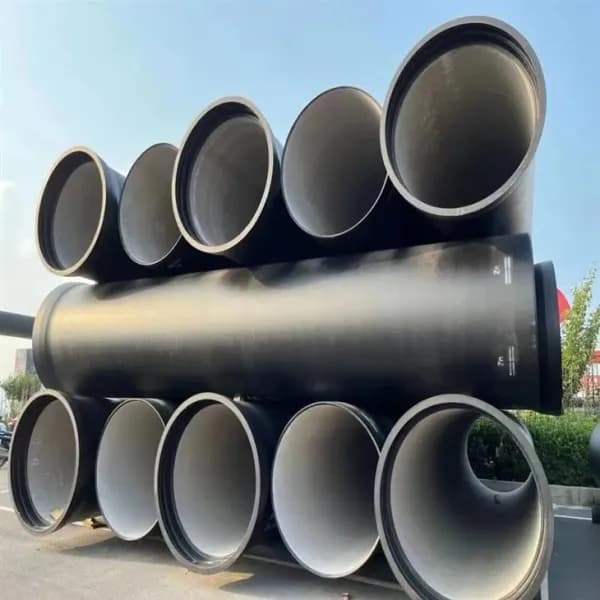
Product Description
Ductile iron pipe is a pressure pipe for water transmission, distribution and sewer force mains, made from ductile cast iron. The name refers to the material: molten iron is treated so that its graphite solidifies as spheroidal nodules rather than flakes, which is what gives the pipe greater strength, ductility and impact resistance than the grey cast iron it replaced. The result is a pipe that carries working pressure and absorbs ground movement and external load without the brittleness of earlier cast iron pipe.
Every ductile iron pipe is a protected system rather than a bare metal tube. The internal cement-mortar lining isolates the iron from the conveyed water and gives a smooth bore that holds flow capacity, while the external zinc coating with a bitumen overlay - or, in aggressive soils, a heavier zinc-aluminium coating or polyethylene encasement - guards the outside surface. Like all ferrous materials, ductile iron will corrode if left unprotected, so the lining and coating are part of the specification, not an optional extra.
Specifications
The table below summarises the catalogue parameters. Wall thickness, coating and pressure rating are confirmed against the individual order and the standard edition it is called up to:
| Item | Reference |
|---|---|
| Material | Ductile cast iron (spheroidal graphite cast iron) |
| Standards | ISO 2531, EN 545, GB/T 13295 (water and gas); EN 598 and GB/T 26081 (sewerage); AWWA C151 for North American water projects |
| Wall-thickness class | K7, K8, K9 (ISO 2531 / EN 545) |
| Pressure class | C25, C30, C40 to EN 545:2010. Allowable operating pressure changes with diameter; C40 is not available on every DN. |
| Nominal diameter | To the ordered standard: DN 40 to DN 2600 for ISO 2531, DN 40 to DN 2000 for EN 545 |
| Effective length | 6 m for bulk. Other lengths, including a container length, are agreed at order. |
| Internal lining | Portland cement-mortar lining to ISO 4179 (other linings on request) |
| External coating | Zinc to at least 130 g/m2 (ISO 8179) with bitumen overlay; Zn-Al alloy or polyethylene encasement for aggressive soils |
| Joint types | Push-on (Tyton) joint, K-type, self-restrained joint; gaskets to ISO 4633 |
| Documentation | Mill test certificate; third-party inspection where the purchase order specifies it |
Mechanical Properties
Minimum room-temperature values for the pipe body to ISO 2531 / EN 545. The certified test report for the supplied batch governs, and actual results are recorded per heat:
| Property | Minimum / reference |
|---|---|
| Tensile strength (Rm) | 420 MPa minimum |
| Yield strength (Rp0.2) | 300 MPa minimum |
| Elongation (A) | 10 % minimum for DN 80-1000; 7 % minimum for DN 1200-2200 |
| Brinell hardness | 230 HB maximum for centrifugally cast pipe, from ISO 2531:1998 |
Wall thickness in ISO 2531 is related to the nominal diameter through a class constant - for K9 the nominal wall thickness is e = 9 x (0.5 + 0.001 x DN) mm - so a higher class number denotes a thicker wall and a higher pressure rating. K9 is the most widely specified class for municipal water mains, C40 is the EN 545:2010 pressure class whose number is the maximum allowable operating pressure in bar, and that class is not offered on every diameter. The class for a project follows the hydraulic design rather than a default.
Material Characteristics
Ductile iron is made by adding magnesium to molten iron, which causes the carbon to crystallise as discrete graphite nodules instead of continuous flakes. The nodular graphite interrupts the iron matrix far less than flakes do, and that is what gives the pipe its combination of strength, ductility and impact resistance.
- Strength and toughness. Ductile iron carries both internal pressure and external earth load, and its ductility lets it tolerate soil movement and trench settlement that would crack a brittle pipe.
- Jointing. The push-on (Tyton) joint assembles quickly and accommodates a few degrees of angular deflection at each joint, which simplifies laying around slight curves and reduces the number of special fittings.
- Flow capacity. The large nominal bore and the smooth cement-mortar lining keep the Hazen-Williams flow coefficient high over the service life, which lowers pumping energy compared with a rougher or smaller-bore alternative.
- Corrosion behaviour. Ductile iron corrodes at roughly the same rate as cast iron or steel, so internal and external protection are mandatory. The standard protection is a cement-mortar lining inside and zinc plus bitumen outside; aggressive soils call for a zinc-aluminium coating or polyethylene encasement, selected from the soil corrosivity.
- Service life. With correct lining and coating, ductile iron water mains are expected to serve well beyond 100 years. Life in any specific soil or water depends on the protection system specified and the service conditions.
Applications
Ductile iron pipe is used wherever a buried pressure pipe must combine strength, impact resistance and a long service life. Typical applications include:
- Municipal drinking water - transmission and distribution mains, where the cement-mortar lining protects water quality and the pipe carries working pressure plus surge.
- Sewer force mains and wastewater - pressurised sewage lines where toughness and resistance to external load matter.
- Raw water and irrigation - large-diameter transfer lines for water supply and agricultural distribution.
- Trenchless installation - the pipe is pulled or pushed through the ground in horizontal directional drilling and pipe bursting, where its toughness and restrained joints suit the loads involved.
- Industrial and process water - cooling and service water lines where a robust, protected pressure pipe is required.
Suitability for a specific project depends on the pressure class, soil corrosivity and the chosen lining and coating; those are confirmed at specification stage rather than assumed.
Ordering Information
To quote ductile iron pipe, an enquiry should carry:
- Standard and edition - ISO 2531, EN 545 or GB/T 13295 for water, EN 598 or GB/T 26081 for sewerage, or AWWA C151 for North America - exactly as written in the project specification.
- Nominal diameter (DN) and the pressure or wall-thickness class (K7-K9 or C25-C40).
- Length required - 6 m, container length, or cut-to-length - and the total quantity.
- Joint type - push-on, K-type or self-restrained - and the gasket material where specified.
- Lining and coating, including any requirement for aggressive-soil protection such as zinc-aluminium alloy or polyethylene encasement.
- Documentation and inspection - mill test certificate, third-party or witnessed inspection, or specific test requirements.
- Destination, delivery schedule and any installation or soil-corrosivity information available.
Related pressure pipe items: carbon steel line pipe, large diameter straight seam welded pipe, spiral steel pipe and 304 stainless steel seamless pipe. Ductile iron pipe is a cast, lined-and-coated product and is quoted separately from welded or seamless steel pipe.
Frequently Asked Questions
What does the K9 class mean for ductile iron pipe?
K9 is a wall-thickness class in ISO 2531 and EN 545. The K number sets the nominal wall thickness for a given diameter through the relationship e = K x (0.5 + 0.001 x DN) mm, so K9 has a thicker wall - and a higher pressure rating - than K7 or K8. K9 is the most common class for municipal water mains; the correct class for a project is set by the hydraulic design, not by a default.
What is the difference between the K class and the C class?
The K classes (K7, K8, K9) are wall-thickness classes, while the C classes (C25, C30, C40) are EN 545:2010 pressure classes, and the number is the maximum allowable operating pressure in bar for that class. C40 is not available on every diameter. Both appear in EN 545 and ISO 2531. When ordering, state the class your specification calls for, since the same diameter can be supplied in several wall thicknesses.
Why does ductile iron pipe need a lining and a coating?
Ductile iron is a ferrous material and corrodes at a rate similar to cast iron and steel, so both surfaces must be protected. The internal cement-mortar lining isolates the iron from the water and preserves the smooth bore, while the external zinc coating - with a bitumen overlay, or a zinc-aluminium coating or polyethylene encasement in aggressive soils - protects the buried surface. The lining and coating are part of the specification and determine the service life in a given soil and water.
What diameter and pressure classes are available?
Ductile iron pipe is supplied in the K7-K9 wall-thickness classes and C25-C40 pressure classes. Diameter follows the ordered standard: DN 40 to DN 2600 for ISO 2531, and DN 40 to DN 2000 for EN 545. The bulk length is 6 m, and any other length is agreed at order. The class and diameter available for a project are confirmed against the standard edition and the hydraulic design.
What information do you need to quote ductile iron pipe?
Standard and edition, nominal diameter, class (K or C), length and quantity, joint type and gasket, lining and coating requirements, documentation and inspection, and the destination. Where the pipe will be buried in aggressive or high-corrosivity soil, describe the soil so that the external protection can be confirmed with the offer.