Product Description
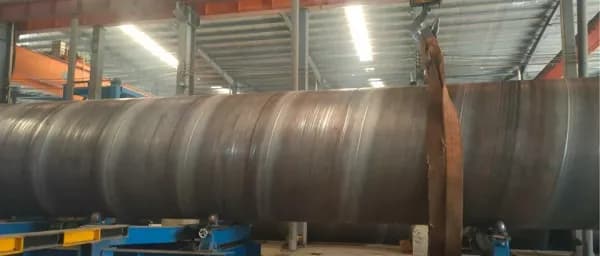
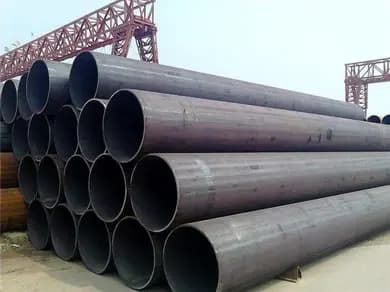
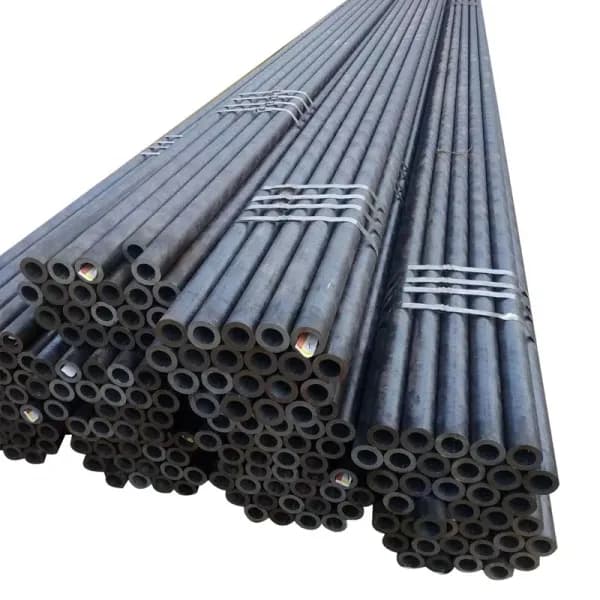
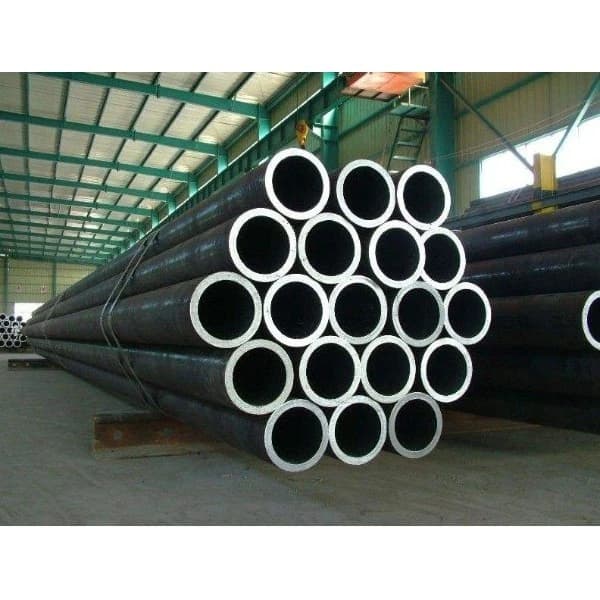
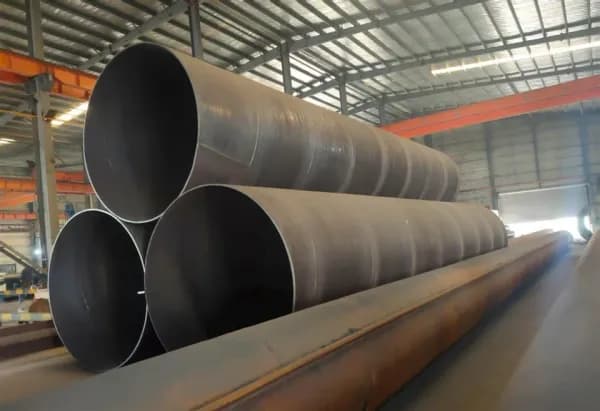
API 5L spiral steel pipe is a large-diameter line pipe made from steel coil that is formed helically and welded along a spiral seam. In API 5L and its ISO 3183 counterpart the process is designated SAWH – submerged-arc welding, helical seam – and the same product is bought and sold as SSAW pipe, HSAW pipe or spiral welded pipe. It conveys gas, water and oil in the petroleum and natural gas industries, and it is quoted against the grade and the product specification level (PSL1 or PSL2) named on the order.
Spiral forming is what makes this pipe available in large diameters without a plate press: the coil is uncoiled, edge-trimmed and fed at an angle into the forming head, so one strip width covers a whole family of diameters. The seam is welded from both the inside and the outside, after which the pipe is cut to length, end-finished, hydrostatically tested and examined. Because the seam runs at an angle to the pipe axis, it is longer per metre of pipe than a longitudinal seam, which is why the weld quality – not a single pressure figure – is what has to be fixed on the enquiry.
Carbon steel line pipe is not corrosion-resistant by itself; coating is part of the supply specification rather than a property of the steel. Neither is “spiral” a pressure rating. Design pressure is calculated under the governing pipeline or piping code (ASME B31.4 or B31.8 for pipelines, ASME B31.3 for process piping) from the grade, the outside diameter, the wall thickness and the weld joint quality factor agreed for the seam, and the calculation is repeated for every line size.
Specifications and Size Range
The table separates what the standard fixes from what is settled at order. The sizes below are the supply range carried by this product listing; every dimensional item is re-confirmed for the ordered route, because wall availability is tied to the strip width (API 5L requires the strip width used for helical seam pipe to be between 0.8 and 3.0 times the outside diameter) and to the ordered grade.
| Item | Reference value | How it is fixed |
|---|---|---|
| Product form | Helical (spiral) seam submerged-arc welded pipe, SAWH / SSAW, welded inside and outside | This page. Not LSAW, not ERW and not seamless pipe. |
| Standard | API 5L, 46th edition, with its ISO 3183 counterpart | The edition and any annex or supplemental requirement are named on the order. |
| Quality level | PSL1 or PSL2 | PSL2 where the design code, the operator specification or the service conditions require it. |
| Grade | B and X42 to X70 (ISO 3183 names L245 to L485) | Per order. Grade A and grades above X70 are not offered on this page. |
| Outside diameter | 219 mm (8 in.) and above | Confirmed per order against strip width and wall. This page starts at 219 mm. API 5L permits helical seam pipe from 114.3 mm, and that smaller range is not offered here. |
| Wall thickness | 3 mm to 22 mm | Confirmed per order against diameter, grade and strip width. |
| Length | 1 m to 30 m, random or fixed lengths | Cut from a continuous helical weld, so long lengths are possible; the ordered length is confirmed per order. |
| Ends | Plain (square cut) or beveled | Confirmed per order. API 5L limits threaded-end pipe to seamless and longitudinal-seam welded pipe with a diameter of 508 mm or less, so threaded and coupled ends are not offered on a helical seam pipe. |
| Coating | Bare, varnished or shop-primed; FBE, 3LPE / 3LPP and coal tar epoxy systems available | Coating system, dry-film thickness and the applicable coating standard are confirmed per order. |
| Inspection | Hydrostatic test and weld examination to the ordered level; third-party inspection can be arranged | The test plan and the extent of examination are agreed before production. |
How Spiral Pipe Is Made and Tested
Coil is uncoiled, leveled and edge-milled to the strip width needed for the ordered diameter, then fed into the forming head at the helix angle that matches that diameter. The strip closes into a spiral and the seam is welded with submerged arc welding in two passes, one from the inside and one from the outside (the reason the trade also calls this DSAW or double-side spiral welded pipe). The pipe is then sized, cut to the ordered length, and the ends are square-cut or beveled.
Quality control follows the ordered product specification level rather than the process. For PSL1 the standard sets the minimum strength, the chemical limits and a hydrostatic test, with substitution options; for PSL2 the pipe is also tested for impact toughness, the weld is examined non-destructively on every pipe, and strength is bounded at both the minimum and the maximum. Weld examination of this type of pipe is normally by ultrasonic testing of the seam and by radiographic testing on an agreed sampling or full-coverage basis, and the mill test certificate is issued for the pipe that is actually shipped.
Two process limits are worth knowing before the size is fixed. A helical seam needs enough strip to wrap around the pipe, which is why the standard sets the strip-width band and why thin walls at very large diameters must be checked against coil availability. The helical angle also becomes very shallow as the diameter falls, so small diameters are the territory of ERW and seamless pipe instead. That boundary, not a preference, is what decides the route for a given line size.
Chemical Composition of Spiral Pipe (PSL1, Reference)
The values below are the API 5L PSL1 limits for wall thickness up to 25 mm, reproduced for reference from the 46th edition. Spiral pipe is a welded product, so the welded column applies here: carbon is capped at 0.26 % for grades above A. Most tables found online print 0.28 % for the same grades, because that is the seamless-pipe limit from the same table; the two figures are not interchangeable and the welded value is the one that governs this product.
| Grade | ISO 3183 name | C max (%) welded seam pipe | Mn max (%) | P max (%) | S max (%) |
|---|---|---|---|---|---|
| A | L210 | 0.22 | 0.90 | 0.030 | 0.030 |
| B | L245 | 0.26 | 1.20 | 0.030 | 0.030 |
| X42 | L290 | 0.26 | 1.30 | 0.030 | 0.030 |
| X46 | L320 | 0.26 | 1.40 | 0.030 | 0.030 |
| X52 | L360 | 0.26 | 1.40 | 0.030 | 0.030 |
| X56 | L390 | 0.26 | 1.40 | 0.030 | 0.030 |
| X60 | L415 | 0.26 | 1.40 | 0.030 | 0.030 |
| X65 | L450 | 0.26 | 1.45 | 0.030 | 0.030 |
| X70 | L485 | 0.26 | 1.65 | 0.030 | 0.030 |
For each 0.01 % of carbon below the specified maximum, the manganese maximum may rise by 0.05 %, up to 1.65 % for grades B to X52, 1.75 % for grades above X52 and below X70, and 2.00 % for X70. Residual copper, nickel and chromium are limited to 0.50 % each and molybdenum to 0.15 %; deliberate boron addition is not permitted, and the niobium, vanadium and titanium sums apply as stated by the standard unless otherwise agreed. Walls above 25 mm, and any deviation from the values above, are subject to agreement at order, and the governing edition is confirmed on the mill test certificate.
Mechanical Properties of Spiral Pipe (PSL1 Minimums, Reference)
The table lists the PSL1 minimum yield and tensile strength of the pipe body in SI units, with the ISO 3183 names that carry the same number in MPa. These are minimums, not typical mill results, and they apply to the pipe body: the seam of a welded pipe must additionally satisfy the standard’s weld tensile requirements for the same grade.
| Grade | ISO 3183 name | Minimum yield strength (MPa) | Minimum tensile strength (MPa) |
|---|---|---|---|
| A | L210 | 210 | 335 |
| B | L245 | 245 | 415 |
| X42 | L290 | 290 | 415 |
| X46 | L320 | 320 | 435 |
| X52 | L360 | 360 | 460 |
| X56 | L390 | 390 | 490 |
| X60 | L415 | 415 | 520 |
| X65 | L450 | 450 | 535 |
| X70 | L485 | 485 | 570 |
Elongation is not given as a single figure: API 5L calculates the minimum from the grade and the cross-sectional area of the test piece, so it changes with the size and the wall that is ordered. PSL2 keeps these minimums and adds maximum values, a yield-to-tensile ratio limit and toughness requirements; because the per-grade PSL2 upper limits depend on the delivery condition and the edition in force, they are confirmed against the ordered edition at quotation instead of being reproduced here. A tensile figure quoted from another grade or from another standard is not the rating of this pipe.
PSL1 or PSL2 for Spiral Pipe
API 5L defines two product specification levels over the same strength grades. They are not two qualities of the same order of pipe — they are two different test and control regimes, and the table below shows which one has to be named on the enquiry.
| Item | PSL1 | PSL2 |
|---|---|---|
| Chemical limits | Standard limits (P max 0.030 %, S max 0.030 %) | Stricter carbon, phosphorus and sulfur limits (P max 0.025 %, S max 0.015 %) plus carbon equivalent control |
| Strength requirements | Minimum yield and tensile strength only | Minimum and maximum yield and tensile strength, with a maximum yield-to-tensile ratio of 0.93 |
| Impact toughness | Charpy testing not required | Charpy V-notch testing required (0 °C reference for standard sizes) |
| Non-destructive testing | Not required for each pipe | Examination of the weld on each pipe |
| Hydrostatic test | Per the standard, with substitution options | Performed on each pipe; not substituted by non-destructive testing |
| Delivery condition | As-rolled base grades (X52, and so on) | Designated N (normalized), Q (quenched and tempered) or M (thermo-mechanically rolled), for example X52N, X52Q, X52M |
| Typical service | General onshore transmission, water lines and lower-pressure duty | High-pressure long-distance lines, offshore, sour service and low-temperature service |
Sour service is ordered as PSL2 with the S delivery-condition suffix and the HIC and SSC testing required by the applicable annex, with hardness limits taken from NACE MR0175 / ISO 15156 as specified by the operator. Availability is grade-, size- and mill-qualified, so a sour requirement is confirmed against the order rather than assumed from the grade. Where the design code or the operator specification already calls for PSL2, state it on the enquiry together with any annex requirements and the level and the delivery condition suffix are confirmed in one pass.
Applications and Where Spiral Pipe Fits
Typical duties are onshore transmission lines for natural gas, crude oil and refined products, gathering and flowline systems in producing fields, water transmission mains inside petroleum and natural gas industry scope, and lower-pressure utility and plant piping. Grade B and X42 to X52 are the common spiral grades for distribution and medium-pressure transmission; X60 to X70 are reserved for larger, higher-pressure systems where the wall saving pays for the stricter quality regime.
The same helical forming line also produces products that are not line pipe, and it matters which standard governs. Piling under ASTM A252 is a structural product with its own grade system (205, 240 and 310 MPa minimum yield) and a different duty; ASTM A139 covers electric-fusion welded pipe for conveying liquid, gas or vapour at NPS 4 and above; AWWA C200 governs spiral-seam steel water pipe 6 in. and larger; SY/T 5037 and SY/T 5040 are the Chinese low-pressure fluid and piling specifications for spiral pipe; and EN 10217-5 is the submerged-arc welded part of the European pressure-purpose tube series. EN 10219, which is sometimes quoted on spiral pipe pages, is the cold formed structural hollow section standard and is not a line pipe standard at all. If the duty is piling rather than transmission, the right page is spiral steel pipe to ASTM standards; if it is a smaller-diameter or higher-pressure line, compare the large diameter straight seam welded pipe and the full carbon steel line pipe range before fixing the route.
Two further products are often confused with this one. Oil country tubular goods are not line pipe: casing and tubing follow API 5CT with their own grades and connections, and are covered on the oil and gas casing pipe page. Neither is this the thin-gauge spiral duct used for ventilation, which is governed by airtightness classes rather than by API 5L and is supplied as galvanized steel spiral duct.
Ordering Information
To quote API 5L spiral steel pipe against the exact envelope, send the grade and quality level (for example API 5L X60 PSL2), the outside diameter, the wall thickness, the length or random-length requirement, the end finish (plain or beveled), the coating system, any impact test temperature, carbon equivalent limit or supplemental annex requirement, the extent of weld examination you need, and the quantity with destination. Where the pipeline design code, the operating pressure and the medium are stated as well, the wall and the test plan can be proposed against the calculation instead of a generic size quote.
Companion items can be sourced with the pipe: API 5L grade pipe fittings match the line grade, and the whole carbon steel pipe range – seamless, ERW, LSAW and spiral – is listed under the pipe and tube category. If your requirement is a general fluid-service or pressure-purpose welded tube standard rather than a line pipe standard, send the standard number with the enquiry and the correct product family will be confirmed.
Common Questions about API 5L Spiral Steel Pipe
What is API 5L spiral steel pipe, and what is the difference from LSAW pipe?
API 5L spiral steel pipe is welded line pipe whose seam runs around the pipe in a helix instead of straight along it. Coil is fed at an angle into the forming head, so the pipe is built from strip rather than from plate, and the seam is welded inside and outside. LSAW pipe is formed from plate and welded along a longitudinal seam; it does not need a plate press either, but it is not a spiral product, and the two are not interchangeable on a specification. In API 5L terms the spiral process is the SAWH designation, traded as SSAW or HSAW pipe. Both routes serve large-diameter transmission lines; which one applies is decided by the diameter, the wall, the pressure class and the operator specification.
Should I order PSL1 or PSL2?
PSL1 is the standard level: minimum strength, standard chemical limits and a hydrostatic test, which suits general onshore transmission, water lines and lower-pressure duty. PSL2 adds maximum as well as minimum strength, a yield-to-tensile ratio limit of 0.93, mandatory Charpy testing, weld examination on every pipe, tighter phosphorus and sulfur limits with carbon equivalent control and a delivery condition suffix (N, Q or M). If the design code, the operator specification, an offshore route, a low design temperature or a sour medium applies, PSL2 is normally required. State the code and the annex requirements on the enquiry so the level and the delivery condition are confirmed together.
Why do suppliers show two different carbon limits for API 5L PSL1?
Because the standard contains two values and most tables print only one of them. For PSL1 above Grade A the maximum carbon is 0.26 % for welded pipe and 0.28 % for seamless pipe. Spiral pipe is welded, so 0.26 % is the figure that governs this product; a page that shows 0.28 % for a spiral or SSAW pipe has copied the seamless column. The same table also allows the manganese maximum to rise by 0.05 % for each 0.01 % that carbon falls below its maximum, up to a capped ceiling, so a mill certificate can legitimately show a manganese figure above the base maximum in the table.
Can API 5L spiral pipe be supplied with threaded and coupled ends?
No, not under API 5L. In the standard, threaded-end pipe is limited to seamless and longitudinal-seam welded pipe with an outside diameter of 508 mm or less, and helical seam pipe falls outside that provision. Spiral pipe is therefore offered with plain (square cut) or beveled ends, and the joint is made by field welding. If a threaded connection is essential for your application, say so on the enquiry and the requirement has to be met by a different product – a smaller-diameter seamless or ERW pipe within the diameter limit.
How is the design pressure of a spiral line handled, and what sizes can be made?
Design pressure is a calculation, not a catalogue value: the governing code (ASME B31.4 or B31.8 for pipelines, ASME B31.3 for process piping) computes the allowable pressure from the grade, the diameter, the wall thickness and a weld joint quality factor. That factor is assigned by the seam type together with the extent of non-destructive examination – the factor is set by the seam type and the extent of non-destructive examination under the cited code, not by one band for every arc weld. There is no fixed penalty for the spiral process; a pipe examined over its full length can carry a higher factor than the same pipe examined by sampling. On sizes: the listing starts at 219 mm outside diameter and the standard allows helical seam pipe from 114.3 mm upward, while the practical ceiling is set by the strip width and the wall you need. Send the diameter, wall and pressure requirement together and the achievable combination will be quoted.