Product Description
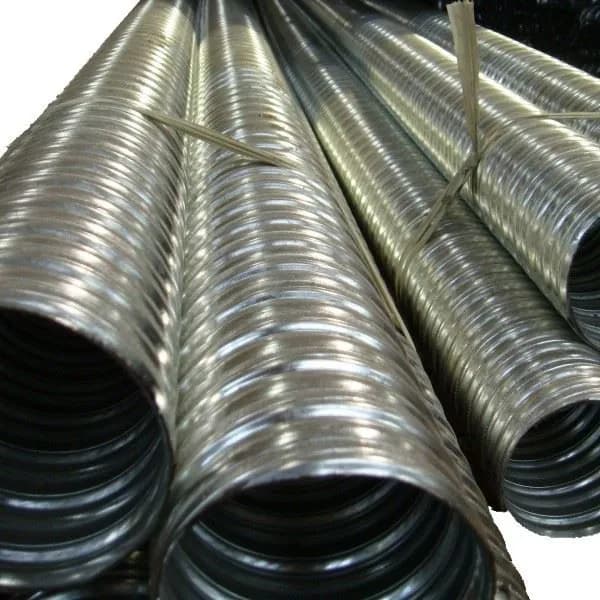
Galvanized steel spiral duct is round ductwork for air distribution. It is formed on a spiral tube former from continuously hot-dip zinc-coated steel strip: the strip is folded into a continuous helical lockseam, and that seam acts as a reinforcing rib along the whole length of the tube. Two consequences follow for a buyer. The duct holds its round section over long runs, so it needs fewer supporting hangers than rectangular ductwork built from the same sheet. And because it is supplied in long lengths joined with slip couplings, it has far fewer transverse joints to seal on site.
This page covers the galvanized steel product, the standard choice for supply, return and exhaust air in commercial and industrial ventilation, including the ventilation systems of vessels and offshore platforms. Where the air stream carries chemicals, or where the environment attacks zinc, projects specify stainless steel spiral duct instead - that is a separate product, not a variant of this one. What decides whether a duct order is right is four definable items: diameter and wall thickness, the zinc coating designation, the airtightness class the ductwork has to meet, and the joint type. Each is set by the project specification, and each is confirmed against the order.
Dimensions and Supply Range
Outside diameter is 80 mm to 1600 mm and wall thickness is 0.4 mm to 3.0 mm. Most installed projects fall in the 80 mm to 710 mm band, which describes use and is not a second supply range. Confirm the diameter and the wall for each line of the enquiry.
| Item | Supply range | To be confirmed per order |
|---|---|---|
| Product form | Round spiral duct, continuous helical lockseam | Single-wall profile: smooth interior (SR) or corrugated and reinforced exterior (SR2C) |
| Material | Continuously hot-dip zinc-coated carbon steel strip | Steel grade and coating type (Z, ZF, ZA, AZ or ZM) to EN 10346 |
| Outside diameter | 80 mm to 1600 mm. Most installed projects fall in the 80 mm to 710 mm band. | Diameter list with quantities |
| Wall thickness | 0.4 mm to 3.0 mm; thickness rises with diameter | Thickness required for each diameter |
| Length | Stated on the order | Cut lengths and cutting tolerance |
| Joints | Slip couplings, flanged joints, or gasketed joints | Joint type and gasket material (for example EPDM) |
| Fittings | Elbows, tees, reducers, Y-branches, end caps | Fitting schedule or drawings |
| Airtightness | EN 12237 air tightness class A to D | Required class and test pressure |
| Documentation | Mill certificate to EN 10204 | Certificate type (3.1 or 3.2), coating mass report, leakage test report |
Zinc Coating: What the Designation Means
Duct is made from sheet that was zinc coated on a continuous line before it was formed, so the coating is specified by mass per unit area to EN 10346 - not by the batch galvanizing standard used for steelwork galvanized after fabrication. The table gives the common zinc (Z) designations and what the number actually means.
| Designation | Minimum total coating mass, both faces (triple spot) | Minimum single spot | Nominal thickness per side |
|---|---|---|---|
| Z100 | 100 g/m2 | 85 g/m2 | 7 µm |
| Z200 | 200 g/m2 | 170 g/m2 | 14 µm |
| Z225 | 225 g/m2 | 195 g/m2 | 16 µm |
| Z275 | 275 g/m2 | 235 g/m2 | 20 µm |
| Z350 | 350 g/m2 | 300 g/m2 | 25 µm |
Z275 is the coating most often written into general construction and ductwork specifications; the US equivalent is ASTM A653 G90, 0.90 oz/ft2, which is the same 275 g/m2 counted over both faces. It is not automatic for every order. State the designation, and state the surface treatment as well - chemical passivated (C), oiled (O) or passivated and oiled (CO) - if the duct will be painted or stored outdoors before installation.
Do not specify this product to EN ISO 1461. EN ISO 1461 covers hot dip galvanized coatings applied by dipping fabricated iron and steel articles in a zinc melt, and its scope explicitly excludes sheet, strip and wire that are continuously hot dip galvanized, and tube galvanized in automatic plants. Duct sheet is ordered to EN 10346. The distinction matters in service: continuously coated sheet carries a thinner coating than batch galvanizing, and cut edges, punched holes and drilled fixing points expose bare steel.
Salt spray testing is a quality-control check on the coating, not a measure of service life. The European general galvanizing association warns that neutral salt spray (NSS) and other accelerated tests are unsuitable for comparing coating types or for predicting real-world performance. If your project requires a corrosion test, name the standard, the duration and the acceptance criterion in the order, and we will confirm what can be supplied rather than quoting an hour figure from a datasheet.
Airtightness: How Leakage Is Specified
Ductwork leakage is not specified as a percentage of airflow. Circular sheet metal ductwork is classified to EN 12237 by air tightness class, and the allowed leakage is calculated from the test pressure. Send us the class and the test pressure from your specification and we will quote against them.
| Air tightness class | Air leakage limit fmax (m3/s per m2 of duct surface) | Negative pressure limit | Positive pressure limit |
|---|---|---|---|
| A | 0.027 × Pt^0.65 / 1000 | 500 Pa | 500 Pa |
| B | 0.009 × Pt^0.65 / 1000 | 750 Pa | 1000 Pa |
| C | 0.003 × Pt^0.65 / 1000 | 750 Pa | 2000 Pa |
| D* | 0.001 × Pt^0.65 / 1000 | 750 Pa | 2000 Pa |
* Class D is reserved for special apparatus. Note the direction of the scale: class A is the lowest class with the largest allowed leakage, and D is the tightest.
If the project follows another system, name it on the order. EN 1507 covers sheet metal ducts of rectangular section, EN 15727 covers the testing and classification of ductwork components, EN 12599 gives the commissioning test method, DW/143 gives the practical pressure classes A, B and C used in the UK, and the SMACNA HVAC Air Duct Leakage Test Manual defines seal classes C, B and A with leakage classes in the US. Published SMACNA leakage class figures differ between secondary sources, so we quote to the class named on your drawings rather than to a number copied from a summary table.
Round Spiral Duct vs Rectangular Duct
Both forms are used in the same buildings. The choice is normally made on the space available and on the balance between material cost and site labour. This is the comparison that matters at specification stage.
| Aspect | Round spiral duct | Rectangular duct |
|---|---|---|
| Cross-section and seam | Round, continuous helical lockseam, self-stiffening | Rectangular, flanged or welded longitudinal joints |
| Airflow | Smooth round section, lower pressure loss for a given airflow | Higher resistance; corners and transitions add loss |
| Joints and sealing | Slip couplings or gasketed joints; fewer joints per metre | More joints, more sealing work on site |
| Supports | Longer spans between hangers | Closer hanger spacing for the same duty |
| Space and appearance | Needs round clearance; often left exposed as a visible finish | Suits shallow ceiling voids and high-volume runs |
| Cost balance | Less labour and less sealing; material cost depends on diameter | Less material in some layouts, more labour and sealing |
| Transport and storage | Ships pre-formed and takes more volume | Can be nested or delivered flat for compact storage |
Spiral Duct Is Not Spiral Welded Pipe
The two products share the word spiral and nothing else. Spiral duct is thin-wall helical lockseam tube, 0.4 mm to 3.0 mm, that moves air at the low pressures used in ventilation, and it is accepted on dimensional checks and an airtightness class. Spiral welded pipe is submerged-arc welded line pipe made to API 5L and ASTM pipe standards, with wall thickness an order of magnitude greater and a pressure design governed by a pipeline code. If your project is a water, oil, gas or piling line, see Spiral Steel Pipe to ASTM and API Standards; it is not interchangeable with ventilation duct.
Applications
Galvanized spiral duct is used wherever large volumes of air have to be moved reliably and economically. Typical duties are listed below; the coating designation, thickness and joint type are matched to the duty when the order is confirmed.
- Vessel and offshore platform ventilation - accommodation and engine room supply and exhaust air, galley and sanitary extract, where a zinc-coated sheet is used against salt-laden air.
- Commercial buildings - offices, retail, malls and hotels, where exposed spiral runs are often left visible as part of the interior finish.
- Industrial ventilation - factories and workshops, dust collection, fume and carbon monoxide exhaust, and material handling such as grain.
- High-humidity and grease-laden extract - kitchens, pools and plant rooms, with the material, sealing and cleaning access specified for that duty.
Kitchen extract, corrosive fume and high-temperature service are the three duties that most often move away from standard galvanized spiral duct, to stainless steel, a heavier coating or a different joint and sealant system. Confirm the duty on the order so the quotation is built for the air actually being moved.
Ordering Information
Send the following and we can price and schedule a spiral duct order without a second round of questions.
- Diameter list with quantities, in mm or inches, and the wall thickness required for each diameter.
- Total length and cut lengths, or the duct schedule taken from the drawings.
- Zinc coating designation (Z275 to EN 10346 is the common one) and the surface treatment, or the ASTM A653 equivalent.
- Airtightness class required - EN 12237 class, or the DW/143 or SMACNA class - with the test pressure.
- Joint type: slip coupling, flanged or gasketed, and the gasket material.
- Fitting schedule: elbows, tees, reducers, Y-branches and end caps.
- Documents: mill certificate type (EN 10204 3.1 or 3.2), coating mass report, and a leakage test report if the specification calls for one.
- Destination, packing (bundled, end-capped or palletised) and delivery terms.
Purchasing Questions
What diameters and wall thicknesses can you supply?
Outside diameter is 80 mm to 1600 mm and wall thickness is 0.4 mm to 3.0 mm. Most projects fall inside the 80 mm to 710 mm band, and the thickness available for a diameter is confirmed per order. Send the duct schedule with quantities and we will confirm it line by line.
What does Z275 mean, and is it the same as hot-dip galvanizing to ISO 1461?
Z275 is an EN 10346 coating designation: a minimum total zinc coating mass of 275 g/m2 counted over both faces of the sheet in the triple-spot test, with a single-spot minimum of 235 g/m2 and a nominal thickness of 20 µm per side. ASTM A653 G90 (0.90 oz/ft2) is the equivalent US designation. It is not the same as EN ISO 1461, whose scope explicitly excludes continuously hot-dip coated sheet and strip; duct sheet is correctly specified to EN 10346.
How do I specify how airtight the ductwork has to be?
By class, not by percentage. EN 12237 defines air tightness classes A to D for circular sheet metal ducts, with the allowed leakage calculated as 0.027 (class A), 0.009 (B), 0.003 (C) or 0.001 (D) times Pt^0.65 divided by 1000, in m3/s per m2 of duct surface, and static pressure limits of 500 Pa negative and 500 Pa positive for class A, 750/1000 Pa for class B and 750/2000 Pa for classes C and D. Class D is reserved for special apparatus. Give us the class and the test pressure and we will quote to them.
Can you guarantee 5,000 hours of salt spray testing with no rust, or a leakage rate below 2%?
No, and we no longer publish either figure. Neutral salt spray testing is a quality-control check on the coating, and the European general galvanizing association warns that accelerated tests of this kind are unsuitable for comparing coating types or predicting service performance - an hour count on a test panel is not a service life. Leakage is not a fixed percentage either: it is a class limit that varies with test pressure and duct surface area. What we will do is supply to the coating designation and airtightness class written into your specification, and provide the test reports the order calls for.
Is spiral duct the same product as spiral welded steel pipe?
No. Spiral duct is thin-wall helical lockseam tube for ventilation air, accepted on dimensional checks and an airtightness class. Spiral welded pipe is submerged-arc welded line pipe to API 5L and ASTM pipe standards, used for water, oil, gas and piling, with far heavier walls and a pressure design governed by a pipeline code. See the separate Spiral Steel Pipe to ASTM and API Standards page for that product.
Related Products
- Spiral Steel Pipe to ASTM and API Standards - submerged-arc welded line pipe, not ventilation duct.
- Galvanized Round Pipe - galvanized steel tube for water, structural and general duties.
- Carbon Steel Pipe - the full carbon steel pipe range in this catalogue.