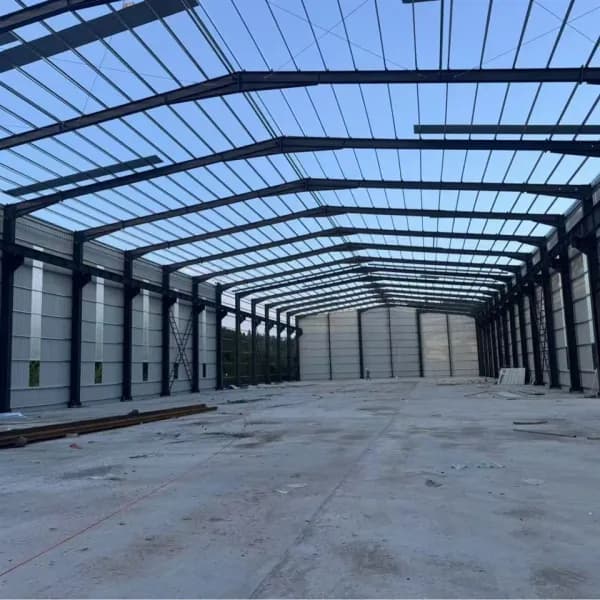
Product Description
Custom steel buildings are engineered and fabricated for one project, not selected from a size list. This page covers single-storey portal frame buildings and multi-storey steel frames supplied in Q235 and Q355 structural steel. Q235 is the designation in GB/T 700. Q345 is the designation in the 2008 edition of GB/T 1591, and Q355 is the designation in the 2018 edition. The reference-band minimum yields are 345 MPa for Q345 and 355 MPa for Q355. Both names appear on drawings, quotations and mill certificates, and the governing edition is confirmed per order.
In a custom steel building every dimension is a design output: span, length, eave height, bay spacing, roof pitch and the section size of each column, rafter, beam and purlin follow from the project loads, the cladding and the design code that governs the site. That is why the first question in any enquiry is not which stock sizes are available, but which code governs the design and what the loads are. The sections below set out the steel grades, the member and connection standards, the surface protection routes and the design-code picture for China, the United States and the UK/EU, so that a quotation can be prepared against real inputs rather than a generic size range.
Steel Grades: Q235B and Q355B (Formerly Q345)
Both grades share one naming rule. "Q" is the yield-strength symbol and the number is the specified minimum yield strength in MPa at the reference thickness band; the letter after the number is the impact-test temperature of that quality grade (A = no impact test, B = +20 °C, C = 0 °C, D = −20 °C, E = −40 °C). Framing members normally use grade B as a minimum, and the required grade letter is a design decision driven by the service temperature of the site, not a commercial option.
The table lists the standard minima for the thickness bands most building sections fall into. Yield strength steps down again for thicker material in both standards, and the two editions cut the bands at slightly different points, so the mill certificate and the ordered thickness band govern acceptance.
| Property | Q235B (GB/T 700-2006) | Q355B (GB/T 1591-2018) |
|---|---|---|
| Minimum yield strength, ≤ 16 mm | 235 MPa | 355 MPa |
| Minimum yield strength, > 16–40 mm | 225 MPa | 345 MPa |
| Minimum yield strength, > 40–60 mm | 215 MPa | 335 MPa (the band is > 40–63 mm in the 2018 edition) |
| Tensile strength, Rm | 370–500 MPa | 470–630 MPa |
Ladle-analysis chemistry limits (maximum %) for the common hot-rolled band are C 0.20, Si 0.35, Mn 1.40, P 0.045 and S 0.045 for Q235B. For Q355B the compilations agree on Si 0.55, Mn 1.60, P 0.035 and S 0.035, while the carbon and residual-element limits in GB/T 1591-2018 vary with the delivery route (as-rolled, normalised or thermomechanically rolled) and the thickness band; those values are read from the standard's own table and confirmed on the material test certificate for the ordered heat.
Quality grades and impact requirements line up across the two standards as follows.
| Quality grade | Impact test temperature | Q235 minimum absorbed energy | Q355 minimum absorbed energy |
|---|---|---|---|
| A | Not required | — | — |
| B | +20 °C | 27 J | 34 J |
| C | 0 °C | 27 J | 34 J |
| D | −20 °C | 27 J | 34 J |
| E | −40 °C | Not covered by GB/T 700 | 34 J |
| F | −60 °C | Not covered by GB/T 700 | 34 J (introduced by the 2018 edition) |
Two procurement points follow from these tables. First, Q345 does not mean 355 MPa: the minimum yield of Q345 is 345 MPa at the reference band, 355 MPa belongs to Q355, and both step down as thickness increases, so a blanket "minimum yield 355 MPa" claim is not a valid specification for a frame that mixes section thicknesses. Second, ordering Q235B or Q355B by number alone is a common shorthand mistake in cold regions: the letter after the number is what carries the low-temperature guarantee, and outdoor winter service usually calls for grade C or D rather than B. Stating both points in the enquiry lets the mill certificate be checked against the design instead of against a marketing figure.
Structural Members, Connections and Standards
A steel building frame is a bill of materials, and each part family has its own product standard. The table lists the member types in this supply scope and the standard each is normally ordered against.
| Member or item | Typical product standard |
|---|---|
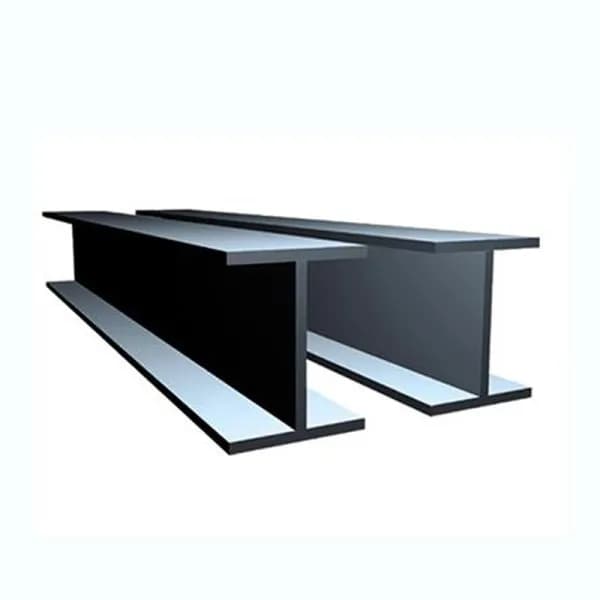
| Hot-rolled H-sections (HW / HM / HN series) | GB/T 11263-2024, Hot rolled H and cut T section steel (current edition, effective May 2025) |
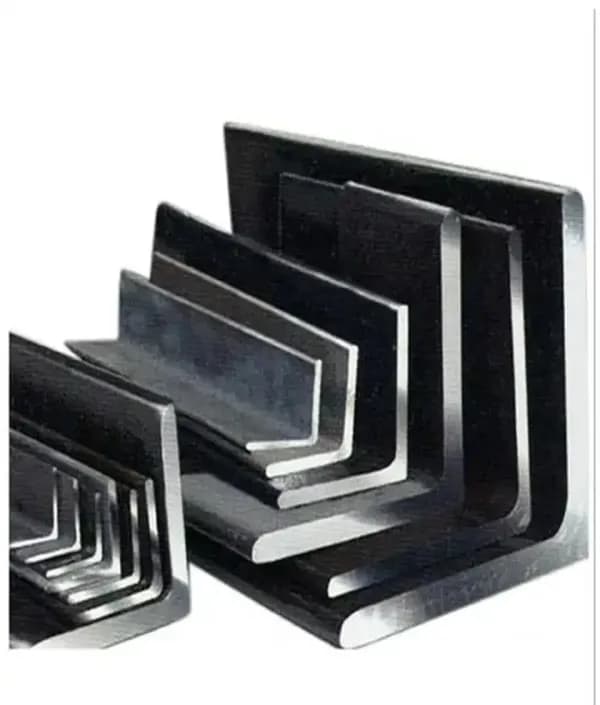
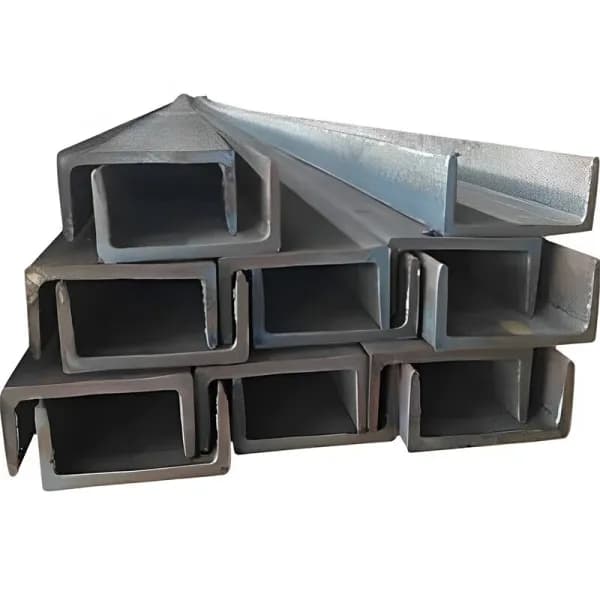
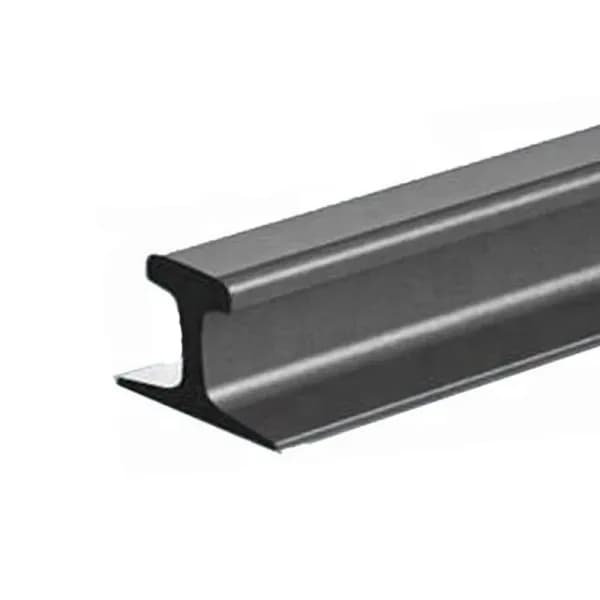
| Hot-rolled I-beams, channels and angles | GB/T 706-2016 |
| Cold-formed C and Z purlins, girts and bracing sections | GB/T 6728-2025 (replaced GB/T 6723-2017 and GB/T 6728-2017 from March 2026) |
| Plates for built-up and welded members | GB/T 700-2006 / GB/T 1591-2018, to the ordered thickness band |
| High-strength bolt sets (large hexagon head) | GB/T 1228 / 1229 / 1230 / 1231 series |
| Torshear-type high-strength bolt sets | GB/T 3632 |
| Structural welding | GB 50661-2011 |
| Fabrication and erection acceptance | GB 50205-2020 |
Primary columns and rafters use hot-rolled H-sections, with wide-flange HW sections the usual choice for columns and HM and HN sections for beams; built-up welded I-sections are used where the design needs a section the rolling programme does not cover. Secondary framing (purlins, girts and bracing) is normally cold-formed from galvanized strip into C and Z profiles, with hot-rolled angles and channels used for bracing, ties and connection details. Connections are a design decision rather than a site improvisation: shop welding is executed to GB 50661, high-strength bolted connections use the GB/T 1228 series or GB/T 3632 torshear assemblies, and completed work is accepted against GB 50205.
The individual sections are described on their own pages: H-shaped steel, steel angle irons and channel steel; plate for built-up members is covered on the Q235 carbon steel plate page.
Surface Protection and Building Envelope
Corrosion protection is part of the specification, not a finish added at the end. Members are blast-cleaned and then either painted with a system selected for the site's corrosivity category or hot-dip galvanized; cladding is supplied as profiled sheet or as insulating sandwich panels.
| Route or component | Standard | What the order states |
|---|---|---|
| Blast cleaning to Sa 2½ | GB/T 8923.1 (ISO 8501-1) | Cleanliness grade before priming |
| Protective paint system | ISO 12944 (Chinese series GB/T 30790) | Corrosivity category for the site and the coating system with its dry-film thicknesses |
| Hot-dip galvanizing of fabricated members | GB/T 13912-2020 | Minimum local and average coating thickness |
| Continuous galvanized strip (purlins, cladding base) | GB/T 2518 | Coating mass of the ordered grade |
| Prepainted (colour-coated) steel strip | GB/T 12754-2019 | Coating type and colour |
| Profiled steel sheet cladding | GB/T 12755-2008 | Profile, thickness and fixing layout |
| Metal-faced insulating sandwich panels | GB/T 23932-2025 | Core type, thickness and fire classification |
Hot-dip galvanizing of fabricated steelwork is covered by GB/T 13912-2020, the Chinese modified adoption of ISO 1461:2009, and its minimum coating thickness depends on the substrate thickness:
| Substrate thickness t | Minimum local thickness | Minimum average thickness |
|---|---|---|
| t ≥ 6 mm | 70 µm | 85 µm |
| 3 mm ≤ t < 6 mm | 55 µm | 70 µm |
| 1.5 mm ≤ t < 3 mm | 45 µm | 55 µm |
| t < 1.5 mm | By agreement | By agreement |
Note the scope: GB/T 13912 applies to fabricated articles, so continuously galvanized sheet, strip and welded mesh, automatically galvanized tube and bar, and products with their own standards (fasteners, for example) fall outside it and are specified against their own product standards. Cladding is quoted as profiled steel sheet to GB/T 12755 or as metal-faced insulating sandwich panels to GB/T 23932, whose 2025 edition replaced the 2009 edition from July 2026; the core's fire classification to GB 8624 is confirmed against the project's fire strategy.
Design Codes: China, the United States and the UK/EU
A steel building cannot be compliant in the abstract. It is designed to a named code, with named loads, for a named site, and the code also decides which members and connections may be simplified. The table summarises the frameworks most export projects fall under and what each requires you to confirm.
| Market | Typical design basis | What to confirm |
|---|---|---|
| China | GB 50017-2017 for general steel design; GB 51022-2015 for single-storey light portal frames (height ≤ 18 m, no crane or up to 20 t bridge crane / 3 t suspension crane); loads to GB 50009-2012; seismic to GB 50011-2010; acceptance to GB 50205-2020 | Whether the building falls inside GB 51022's limits or is designed to GB 50017 |
| United States | IBC with loads to ASCE 7; members to AISC 360 and, where seismic ductility applies, AISC 341; cold-formed members to AISI S100; welding to AWS D1.1 | Grade equivalences and material certificates. Common hot-rolled grades are A36 (minimum yield 250 MPa) and A992 (yield 345–450 MPa with a maximum yield-to-tensile ratio of 0.85) |
| EU / UK | EN 1990, EN 1991 and EN 1993 (Eurocodes); execution to EN 1090-2 with Execution Classes EXC1–EXC4; CE marking (EU) or UKCA marking (Great Britain) to EN 1090-1; preloaded bolt assemblies to EN 14399 | The required Execution Class and the marking route for the destination market |
One UK/EU point deserves its own paragraph. Fabricated structural steelwork is a regulated construction product in Europe: it must be CE marked to EN 1090-1 for the EU market and UKCA marked for the Great Britain market, where CE marking ceased to be valid in 2025. Execution quality is set by an Execution Class from EXC1 to EXC4, determined from EN 1993-1-1 Annex C and the relevant National Annex, with EXC2 the normal requirement for buildings. The class drives the fabricator's certified factory production control, welding management to EN ISO 3834 and the documentation set, so the Execution Class should be stated in the enquiry and any supplier, including us, should be asked to state the class its certificate covers before the order is placed.
Applications
Custom steel frames serve warehouses and distribution centres, production workshops and processing plants, storage buildings, multi-storey frames, mezzanine floors, canopies and plant rooms. The right framing concept differs between them: a single-storey portal frame suits clear-span storage and light manufacturing, while multi-storey work uses a beam-and-column frame with a floor system designed for the actual live loads.
Crane provision is the boundary that most often changes the design basis. Runway beams, brackets and reinforced columns can be designed into the primary frame from the start, and the crane capacity, span and hook height must be known at design time rather than retrofitted later. Under GB 51022-2015 a light portal frame building may not exceed 18 m in height and is limited to a 20 t bridge crane or a 3 t suspension crane; outside those limits the building is designed to GB 50017-2017 instead. Telling the supplier early whether a crane is planned therefore determines both the standard used and the price.
Ordering Information
Because the building is designed rather than picked from a list, a quotation is prepared from the project inputs below. Sending them in the first enquiry removes the round of guesswork that otherwise delays pricing.
- Dimensions and layout: length, width, eave height, span or spans, bay spacing and roof pitch, or the architectural drawings.
- Site data: the governing design code of the project, and wind, snow and seismic data for the site (or the code-based load values from the structural engineer).
- Crane data if any: capacity, span, hook height and duty class.
- Steel grades: Q235B or Q355B, the quality-grade letter (B, C, D or E) for the coldest service temperature, and whether the Q345 designation of the 2008 edition must be kept on the documents.
- Envelope: roof and wall cladding type (profiled sheet or sandwich panel), core and thickness, insulation values, and doors and windows with sizes and positions.
- Surface protection: paint system with the corrosivity category, or hot-dip galvanizing.
- Foundation interface: anchor bolt plan and column base reactions for the foundation designer.
- Documentation: the design code, Execution Class or marking route for the destination market, and the certificates and drawings to be supplied with the shipment.
Quotations are prepared per project from these inputs, and any value that depends on the final design, such as member sizes, steel tonnage or the anchor bolt plan, is confirmed at the design stage rather than assumed in advance.
Common Questions about Custom Steel Buildings
Is Q345 still the correct grade to specify?
Q345 is the designation used by GB/T 1591-2008, which has been superseded by GB/T 1591-2018. The current edition names the equivalent steel Q355, whose reference-band minimum yield is 10 MPa higher (355 MPa against 345 MPa), and it re-cuts the thickness bands and adds a carbon-equivalent control. New Chinese-standard designs are written around Q355, while Q345 remains common in legacy documents and stock lists. The two designations are not automatically interchangeable, so the edition that governs the order is stated on the quotation, and drawings that call for Q345 are checked against the current table before fabrication.
Does Q345 mean every member has a 355 MPa minimum yield?
No, and this is the most common specification error on steel building projects. The minimum yield of Q345 is 345 MPa at the reference band (up to 16 mm); 355 MPa is the Q355 figure at the same band; and the required minimum steps down as thickness increases. For Q355B the minimum is 335 MPa above 40 mm. Q345 values above 16 mm are read from the table of the edition named on the order. The values that govern a specific member are read from the standard's table for that member's thickness band and confirmed on the material test certificate. If a specification quotes a single yield value for the whole frame, ask which thickness band and which edition it refers to.
Can the frame be supplied to ASTM A36 or A992 instead?
Chinese-standard sections are rolled to Q235B and Q355B, whose property levels sit close to, but not identical with, the US grades: A36 specifies a minimum yield of 250 MPa where Q235B specifies 235 MPa, and A992 specifies a yield of 345–450 MPa with a maximum yield-to-tensile ratio of 0.85, a ductility control that Q355 does not carry in the same form. Equivalence is therefore decided per project by the engineer of record, not assumed. Where a design is drawn to US grades, the practical route is to agree in the order which grade, which certificate and which testing basis the fabricator supplies, and to confirm the substitution in writing before the mill order is placed.
What information is needed for a quotation?
The minimum set is: overall dimensions and layout (length, width, eave height, span, bay spacing, roof pitch), the governing design code and the site's wind, snow and seismic data, crane data if a crane is planned, the cladding build-up with door and window sizes and positions, the surface protection required, and the documentation expected with the shipment. Drawings or even a sketch speed matters up; if structural drawings do not exist yet, the enquiry can be priced from the site parameters and the operational brief, and the member design follows at the next stage.
What is EN 1090 or UKCA marking, and does it apply to my project?
If the building is erected in the European Union or Great Britain, yes. Fabricated structural steelwork is a regulated construction product there: components must be CE marked to EN 1090-1 for the EU market and UKCA marked for the Great Britain market, where CE marking ceased to be valid in 2025. The technical requirements for fabrication and erection are in EN 1090-2, and the required Execution Class (EXC1 to EXC4, with EXC2 typical for buildings) is set by the designer from EN 1993-1-1 Annex C. State the Execution Class and the marking route in the enquiry and ask the fabricator to confirm the class covered by its certificate; this single question removes most of the compliance risk in importing steelwork into these markets.