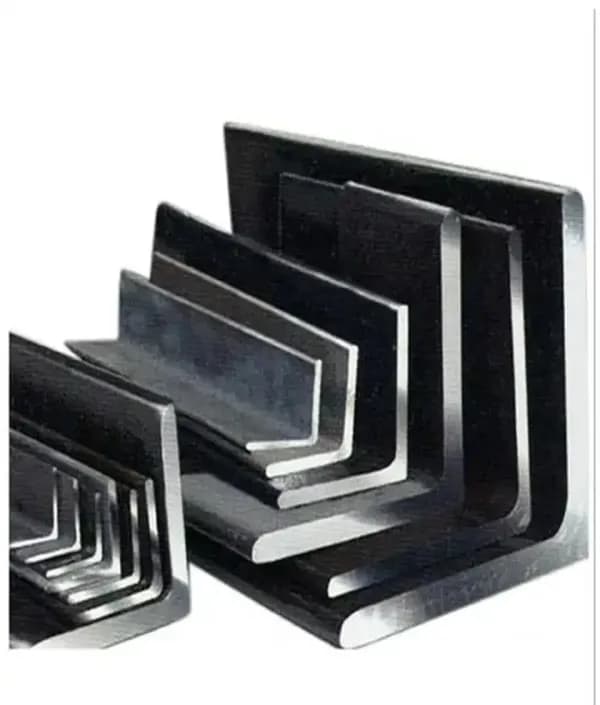
Product Description
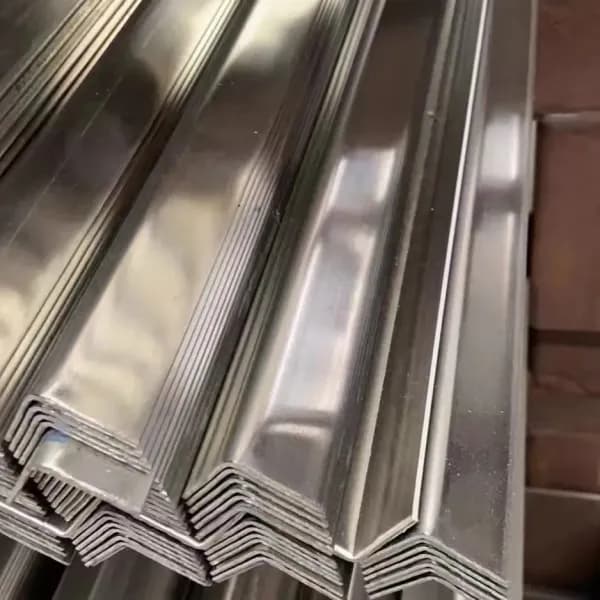
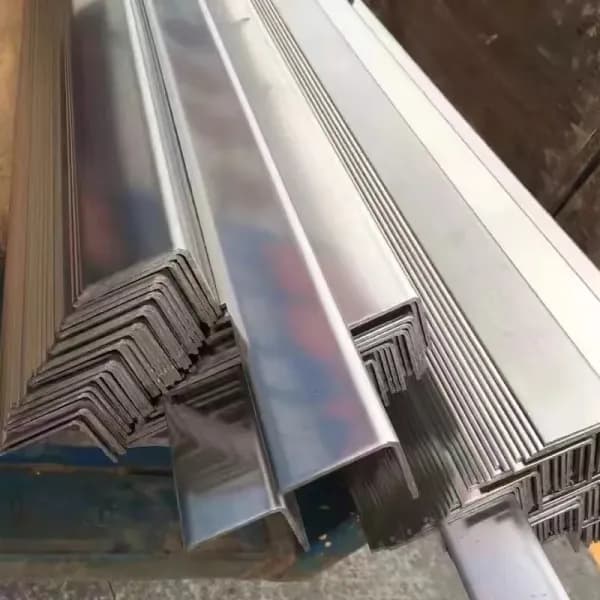
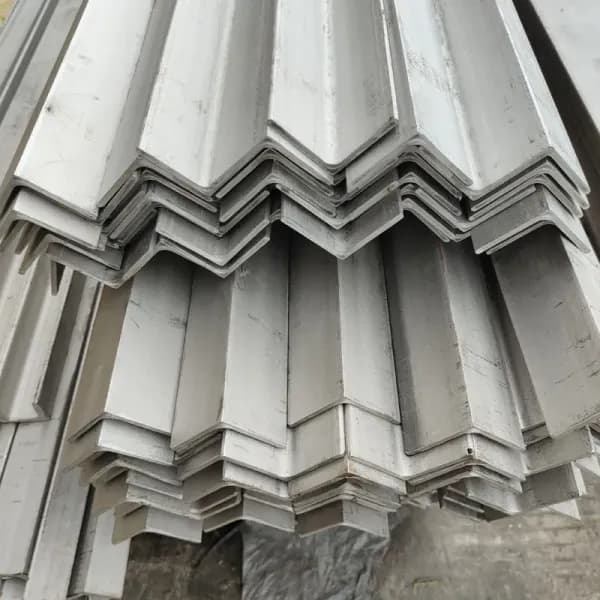
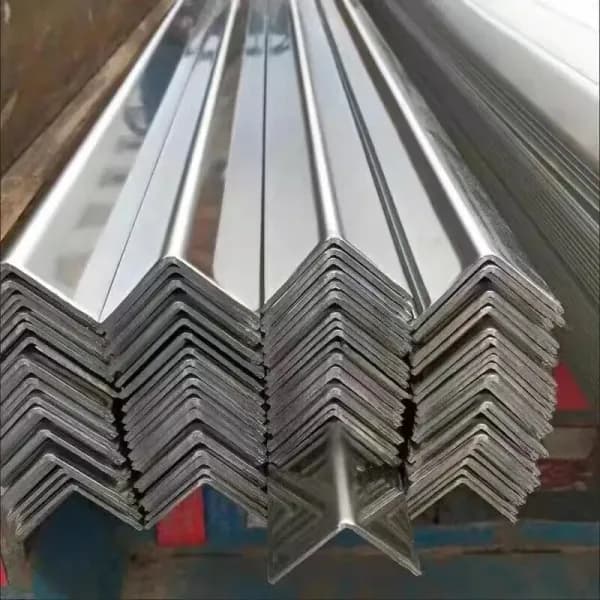
Steel angle iron — also written angle steel, angle bar or L-section, and sold in the US as steel angle — is a hot rolled carbon steel profile with two flat legs set at 90 degrees. This page covers the size range on offer: equal-leg angles from 20 x 20 x 3 mm up to 200 x 200 x 20 mm, supplied black (mill finish) or hot dip galvanized, with the grade, the standard and the inspection document quoted to whatever the drawing names.
Hot rolling is the production route and part of the specification. The section is rolled from a heated billet through a series of grooved passes, which is what produces a continuous rolled surface, a root radius at the inside corner, and mechanical properties that are uniform along the whole length. Angle made by folding or roll-forming steel strip is a different product: it is limited to thin gauges, it takes its properties from the strip rather than from the section, and it is normally supplied pre-galvanized. If a drawing simply says “angle iron”, the route, the grade and the coating still have to be fixed before anything can be priced, and none of the three can be substituted silently.
The L-shape is why the section is used so widely. Two legs at right angles give stiffness in two directions at once from a small amount of steel, plus two flat faces to drill, bolt and weld against. Angle is efficient in both tension and compression and is one of the cheapest sections per metre, but it is not symmetric: a member carrying a compressive load has to be checked for buckling about the weaker axis, and a bolted connection has to be designed for the load path the angle actually has. Size primary structure by calculation to the governing code; choose bracing, cleats, frames and supports from the standard section tables.
Steel Angle Sizes and How They Are Written
Almost every ordering error on an angle starts with the designation. Three numbers define the section and a fourth defines the piece, so the complete call-out is leg A x leg B x thickness x length. On an equal-leg angle the two legs are identical and are written once, which is why L 50 x 50 x 5 means two 50 mm legs at 5 mm thickness — not a 50 mm leg with a 5 mm web.
The two naming systems in common use look alike and are not interchangeable, so the table below puts them side by side.
| System | Equal leg | Unequal leg | Length |
|---|---|---|---|
| Metric (EN 10056-1, GB/T 706, JIS G 3192) | L 50 x 50 x 5 | L 75 x 50 x 6 (long leg first) | 6 m, 9 m, 12 m, cut to length |
| US customary (ASTM A6/A6M) | 2 in. x 2 in. x 1/4 in. | 3 in. x 2 in. x 1/4 in. (longer leg first) | 20 ft and 40 ft, cut to length |
Reading across the two rows is where mistakes happen. A 2 in. x 2 in. x 3/16 in. angle is 50.8 x 50.8 x 4.76 mm, so the nearest metric size, 50 x 50 x 5 mm, is not the same section, and a 3 in. x 2 in. angle is not a 75 x 50 mm angle. State the units and state the series: quote inches for US-based projects, and millimetres plus the standard number for EN or Chinese work.
Unequal-leg angles follow the same logic, with the longer leg written first in both systems. This page's size range is built around equal-leg profiles; unequal-leg combinations in the same range are quoted against the individual order rather than held as a fixed list, so include the leg pair you need in the enquiry.
Size Range and Mass per Metre
The sizes below sit inside the range covered here, with the mass calculated from the nominal leg lengths and thickness. Use them for freight estimates, handling and preliminary take-off; for invoicing, shipping documents and any contractual weight, the value on the mill certificate or the actual weight of the bundle governs. The calculated column runs a little below a published table because it treats the inside corner as sharp, while a rolled angle carries a root radius that adds a small amount of material.
| Leg x leg (mm) | Thickness (mm) | Mass (kg/m, calculated) | Mass (lb/ft) |
|---|---|---|---|
| 20 x 20 | 3 | 0.87 | 0.59 |
| 25 x 25 | 3 | 1.11 | 0.74 |
| 30 x 30 | 4 | 1.76 | 1.18 |
| 40 x 40 | 4 | 2.39 | 1.60 |
| 50 x 50 | 5 | 3.73 | 2.51 |
| 63 x 63 | 6 | 5.65 | 3.80 |
| 75 x 75 | 8 | 8.92 | 5.99 |
| 90 x 90 | 8 | 10.80 | 7.26 |
| 100 x 100 | 10 | 14.92 | 10.02 |
| 150 x 150 | 12 | 27.13 | 18.23 |
| 200 x 200 | 16 | 48.23 | 32.41 |
| 200 x 200 | 20 | 59.66 | 40.09 |
The gap between a calculation and a published table is small and always in the same direction. For 50 x 50 x 5 mm the EN 10056-1 table gives 3.77 kg/m against 3.73 kg/m calculated here, and for 100 x 100 x 8 mm it gives 12.20 kg/m against 12.06 kg/m — roughly one percent. Where a fixed mass per metre is contractual, take it from the table of the standard the material is ordered to, or from the mill certificate, rather than from any calculation. One kilogram per metre equals 0.672 pounds per foot, which is the conversion used in the fourth column.
Other thicknesses within the same leg width, and leg-and-thickness combinations outside the rows shown, are rolled to order inside the same range; give the leg, the thickness and the standard, and treat the availability of any single combination as subject to confirmation. Nominal mass also carries a tolerance in the standard, so a bundle weight will not match the arithmetic exactly across a whole order.
Material Grades and Mechanical Properties
The grade fixes the strength of the section and the leg dimensions fix its stiffness, so both belong on the enquiry. The values below are the minimum requirements of the standards most often written on angle drawings, quoted at the thickness basis each standard uses.
| Grade | Standard | Min. yield, t ≤ 16 mm | Tensile strength | Impact requirement |
|---|---|---|---|---|
| Carbon structural, general purpose | ASTM A36 / A36M | 250 MPa (36 ksi) | 400–550 MPa (58–80 ksi) | Not specified by the base grade |
| High-strength low-alloy | ASTM A572 / A572M Gr 50 | 345 MPa (50 ksi) | 450 MPa (65 ksi) min. | Not specified by the base grade |
| Non-alloy structural | EN 10025-2 S235JR | 235 MPa | 360–510 MPa | 27 J at +20 °C |
| Non-alloy structural | EN 10025-2 S275JR | 275 MPa | 410–560 MPa | 27 J at +20 °C |
| Non-alloy structural | EN 10025-2 S355J2 | 355 MPa | 470–630 MPa | 27 J at −20 °C |
| Carbon structural | GB/T 700 Q235B | 235 MPa | 370–500 MPa | 27 J at +20 °C |
| Low-alloy high strength | GB/T 1591 Q355B / Q355D | 355 MPa | 470–630 MPa | 34 J at +20 °C (B) or 34 J at −20 °C (D) |
| General structure | JIS G 3101 SS400 | 245 MPa | 400–510 MPa | Not specified by the base grade |
The number inside the grade is a minimum, not a typical value. In the European and Chinese series it is the yield strength in megapascals (S235, S275, S355, Q235, Q355); in the American series the same idea is written in ksi, which is why A36 means 36 ksi and A572 Grade 50 means 50 ksi minimum yield. Above 16 mm the requirement steps down in EN 10025-2 and in the GB standards, so for the heavy legs in this range confirm the value for the ordered thickness rather than carrying the 16 mm figure across.
ASTM A36 is unusual in specifying an upper tensile limit as well as a lower one. That cap is deliberate: it keeps the steel weldable and predictable. A quotation that offers an “A36 equivalent” with a tensile strength well above 550 MPa is describing a different grade, not an upgraded A36.
Strength-equivalent grades are not interchangeable, and the differences sit exactly where fabrication risk does. Q235B has to meet 27 J at +20 °C while SS400, at a similar yield level, carries no Charpy requirement at all. S235JR meets the same impact energy as Q235B but to a different chemistry and certification route. Q355B is tested at +20 °C and Q355D at −20 °C: where a drawing specifies the low-temperature class, the higher test value at room temperature does not replace it, because impact behaviour is not linear in temperature. Q345 has been replaced by Q355 in GB/T 1591-2018, so older drawings that still carry Q345 can normally be met in the current grade, but that conversion runs in one direction only — superseded figures should not be read back into a Q355 order. Any substitution should be confirmed against the governing drawing rather than settled between the mill and the buyer.
Where extra corrosion resistance is needed without a coating, atmospheric-corrosion-resistant (weathering) grades are a separate family from ordinary carbon grades and are not a stronger version of them; they are quoted to their own standards. Stainless steel angle, typically type 304 or 316, is the choice where the environment is chemically aggressive rather than merely wet, and it is covered on the 304 stainless steel angle page.
One further note for US projects: ASTM A992, often quoted alongside these grades, is the specification written around W (wide-flange) shapes. Angles in US practice are ordered to ASTM A36 or A572 Grade 50.
Tolerances, Straightness and Lengths
Hot rolled angle is not a machined section, so the tolerances that matter are consistent across every system: leg length, thickness, out-of-square between the two legs, straightness or camber along the length, and a percentage tolerance on nominal mass. EN 10056-1 sets the dimensions and EN 10056-2 the tolerances on them. In US practice ASTM A6/A6M governs tolerances and identification for rolled shapes. GB/T 706-2016 covers the Chinese system and JIS G 3192 the Japanese system, which is itself aligned with ISO 657-1 for equal-leg dimensions, ISO 657-2 for unequal-leg dimensions and ISO 657-5 for tolerances.
Each of those tables is banded, and the bands widen as the legs get longer and the section thicker, so there is no single blanket figure that applies to every size. The figure of ±0.3 mm on leg length carried by an earlier version of this page is not a tolerance taken from any of those standards and should not be repeated in a submittal. Where dimensional tolerance is contractual, ask for the tolerance table of the ordered standard at the ordered size, or require measured dimensions on the mill certificate. The root radius at the inside corner is part of the rolled profile and is not a customer option.
Lengths follow the same pattern. Standard mill lengths are 6 m, 9 m and 12 m, with cut-to-length supplied on request; cut lengths are sawn to size rather than machined, so if a length tolerance matters it belongs in the enquiry. There is a practical reason to order the finished length rather than to cut short stock later: when the piece is hot dip galvanized after cutting, the sawn ends are coated along with the rest of the section, while a cut made after galvanizing leaves bare steel at the cut.
Finish: Black, Hot Dip Galvanized or Pre-Galvanized
Black, or mill finish, means the hot rolled surface with its mill scale intact. It is the cheapest condition and it is not a corrosion protection: bare carbon steel in most outdoor or humid service will rust, so the finish belongs on the enquiry next to the grade and the size. Where a painted system is specified, the scale usually has to come off first — a coating applied over intact mill scale tends to fail with the scale rather than protect the steel underneath.
Hot dip galvanizing after fabrication is the standard answer for outdoor steelwork. The finished piece is degreased, pickled, fluxed and immersed in molten zinc, typically at 450–470 °C, which forms a metallurgically bonded zinc-iron coating rather than a paint-like layer. The applicable standard depends on the market and the article: ISO 1461 for fabricated iron and steel articles, ASTM A123/A123M for structural steel products galvanized after fabrication, and GB/T 13912 in China. ISO 1461 sets both a mean and a local minimum, and both rise with the thickness of the steel:
| Steel thickness | Mean coating thickness | Local minimum | Mean coating mass |
|---|---|---|---|
| 6 mm and above | 85 µm | 70 µm | 610 g/m² |
| Over 3 mm to 6 mm | 70 µm | 55 µm | 505 g/m² |
| 1.5 mm to 3 mm | 55 µm | 45 µm | 395 g/m² |
| Under 1.5 mm | 45 µm | 35 µm | 325 g/m² |
The direction of that table is the part buyers most often miss. The requirement increases with the thickness of the steel being coated, so demanding 100 µm “everywhere” on a 3 mm angle asks for something ISO 1461 does not require, while accepting 70 µm on a 10 mm angle falls below the mean requirement for that thickness band. ASTM A123/A123M expresses the same idea through coating grades keyed to the thickness of the steel, with the grade number equal to the minimum average coating thickness in micrometres. Specify the standard and the thickness band, and measure the coating on the finished piece by the magnetic method.
Galvanizing does not change the mechanical properties of the steel: a galvanized S355J2 angle is still an S355J2 angle, and the zinc layer contributes nothing to load capacity. It is corrosion control, not a strength upgrade, and it does not remove the need to state the grade.
Pre-galvanized angle is a different product and is worth separating out, because the phrase is used loosely. It is formed from continuously zinc coated coil to a coating designation such as Z275, which is on the order of 19 µm of zinc per side — an order of magnitude thinner than heavy galvanizing. The coating does not survive a cut edge or a weld, so pre-galvanized stock suits light assembly and trimming where the exposed cut faces are not asked to resist sustained moisture, and it is not a substitute for post-fabrication hot dip galvanizing on a welded outdoor assembly. The two coating systems should never be compared or quoted against each other on thickness.
Primer and painted finishes are available where the specification calls for them, and painted or duplex systems (galvanized plus a top coat) are normal for exposed architectural steelwork. Two further routes are drawn from other pages rather than this one: stainless steel angle where the medium is chemically aggressive, and weathering grades where an unpainted, self-protecting finish is wanted. The same mill rolls this section alongside other shapes, so if the frame needs a different profile, the hot rolled steel channel, the H-shaped steel beam range and the rest of the shaped steel sections are covered on their own pages.
Typical Applications
Angle is the default right-angle section wherever two parts have to be fixed square to one another, which is why it appears at every scale of steelwork.
- Buildings and industrial construction: bracing and cross-bracing, lintels over openings, roof purlins and secondary framing, connection cleats and base details, stair stringers, mezzanine and platform framing.
- Machinery and plant: machine bases and equipment frames, conveyor and rack supports, cable tray and pipe support steelwork, guards, handrails and work platforms.
- Transport and agriculture: utility trailer and truck bed framing, livestock pens and gates, implement repairs and general farm maintenance.
- Infrastructure: transmission and communication tower members, solar mounting rails, sign structures, handrail and guardrail posts.
- Storage and light fabrication: shelving and racking, workbenches, trestles and general fabrication requiring a right-angle joint.
Selection follows the service conditions rather than the application name. Permanently wet, coastal or industrial atmospheres point to hot dip galvanizing; acid, chloride or process-chemical contact points to stainless steel; a dry, indoor, painted environment can use black angle with a paint system. Where the angle is a primary structural member, the size and grade are a design decision and the section properties come from the standard tables — the L-shape is asymmetric, so bending and buckling are checked about the axis the load actually acts on.
How to Order Steel Angle Iron
An angle enquiry can be priced in one pass if it carries the eight items below. Most delays on this product come from size, grade or coating being left to the supplier to assume.
- Size: leg x leg x thickness, with the series stated — for example 50 x 50 x 5 mm to EN, or 2 in. x 2 in. x 1/4 in. to ASTM.
- Length: 6 m, 9 m, 12 m or cut to length, plus the length tolerance if it is contractual.
- Quantity: number of pieces, total metres or tonnes. Quantities are converted to weight using nominal mass, so the ordered tonnage and the actual bundle weight differ slightly.
- Grade and standard: including the impact quality class where the system uses one, for example S355J2 rather than S355JR, or Q355D rather than Q355B.
- Dimension standard the material will be checked against, if the project names one: EN 10056-1 and EN 10056-2, ASTM A6/A6M, GB/T 706, or JIS G 3192.
- Finish: black mill finish, hot dip galvanized to ISO 1461 or ASTM A123/A123M with the required coating grade, primer, or a painted system.
- Inspection document: state whether a mill test certificate with heat traceability, EN 10204 3.1 or 3.2 certification, or third-party inspection is required, and the scope of that inspection.
- Delivery: destination, packing and marking rules, and whether pieces must be bundled by size.
If the drawing is complete, attach it: the standard number and the coating specification on the drawing will settle most open questions, and where the end use, the service temperature or a welding procedure is known it is worth including, because it decides the impact class and the coating system.
Common Questions about Steel Angle Iron Sizes
What do the three numbers in an angle size mean?
They are leg, leg and thickness, in that order, with the length quoted separately. L 50 x 50 x 5 is an equal-leg angle with two 50 mm legs of 5 mm thickness; L 75 x 50 x 6 is an unequal-leg angle with a 75 mm long leg, a 50 mm short leg and 6 mm thickness, the long leg written first. A US call-out such as 2 in. x 2 in. x 1/4 in. follows the same order but in inches, and the two series are not interchangeable — 50 x 50 x 5 mm is not a 2 in. x 2 in. x 3/16 in. angle. State the units and, where the project has a specification, the dimension standard as well.
Is steel angle iron hot rolled or formed from strip?
Angle iron of this size range is hot rolled: the section is rolled from a heated billet through grooved passes, which gives a root radius at the inside corner, uniform properties along the length and the full range of leg sizes above about 20 mm. Angle formed from steel strip is a separate product, limited to thin gauges, with properties taken from the strip rather than from the rolled section, and it is usually supplied pre-galvanized. If your drawing does not say which route it intends, say so at enquiry — the two are not interchangeable in a structural check.
Which grade should I specify — A36, A572 Grade 50, Q235B or S235JR?
Grade follows the design and the market, not preference. ASTM A36 is the general-purpose US carbon grade at 250 MPa minimum yield, and A572 Grade 50 is the higher-strength low-alloy option at 345 MPa where weight matters. For European work S235JR, S275JR and S355J2 cover general to high-strength applications at 235, 275 and 355 MPa, with the letter fixing the impact test temperature. Chinese work generally uses Q235B or Q355B. What matters at order stage is that these are not freely interchangeable: Q235B carries a 27 J at +20 °C impact requirement that SS400 does not, and A36 has an upper tensile limit that the EN grades do not. State the grade exactly as the drawing writes it, including the impact letter, and confirm any proposed substitution against that drawing.
What tolerance applies to leg length, thickness and squareness?
Each system has its own banded table — EN 10056-2 for European dimensions, ASTM A6/A6M in US practice, GB/T 706 and JIS G 3192 for the Chinese and Japanese systems, with ISO 657-5 covering the international metric and inch series. All of them set limits on leg length, thickness, out-of-square, straightness and mass, and all of them widen as the leg gets longer and the section thicker, so a single figure cannot cover every size. A blanket tolerance such as ±0.3 mm on leg length is not a standard requirement. Where tolerances are contractual, request the table for the ordered size, or require measured values on the mill certificate.
How do I specify galvanizing on an angle?
Name the standard and, where it uses grades, the grade. ISO 1461 is the usual reference for fabricated articles and sets a mean and a local minimum that rise with the thickness of the steel: 85 µm mean and 70 µm local for sections 6 mm and above, down to 45 µm mean and 35 µm local below 1.5 mm. ASTM A123/A123M works through coating grades keyed to the thickness of the steel. One blanket number such as “100 µm” applied to every size either over-specifies thin angle or under-specifies heavy angle, and both are avoidable by quoting the standard and the thickness band. Galvanizing does not change the steel's mechanical properties, so the grade still has to be stated separately.
How many metres of angle are there in a tonne?
Divide 1000 kg by the mass per metre, or 2204.6 lb by the mass per foot. Using published table values, 50 x 50 x 5 mm at about 3.77 kg/m gives roughly 265 metres per tonne, and 100 x 100 x 10 mm at about 15.1 kg/m gives roughly 66 metres. Because nominal mass carries a tolerance in the standard and the table value depends on the ordered system, treat the result as an estimate for planning and take the actual bundle weight as the commercial figure.