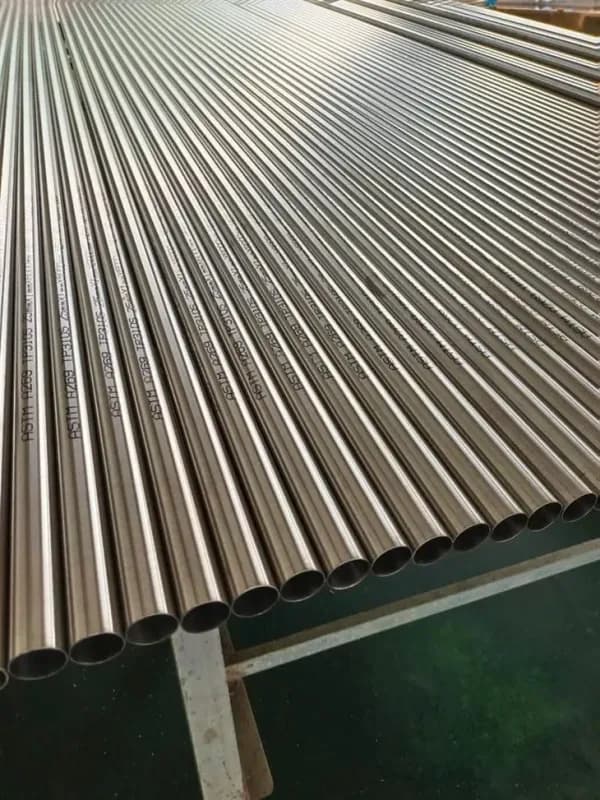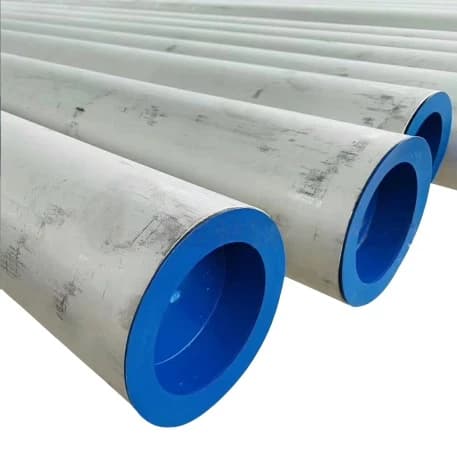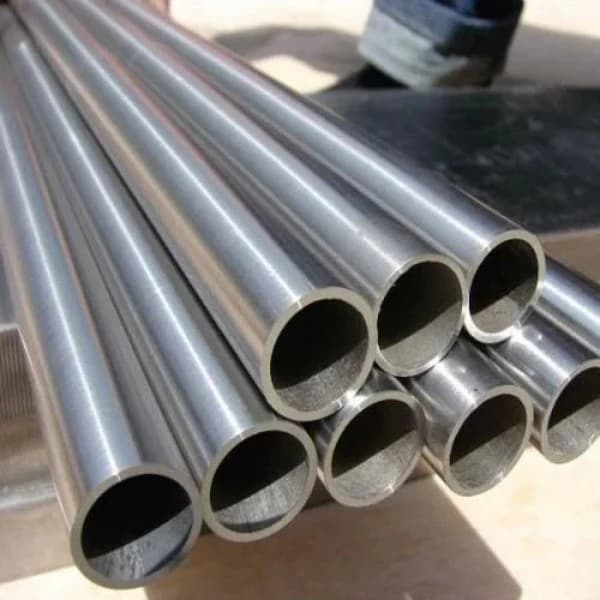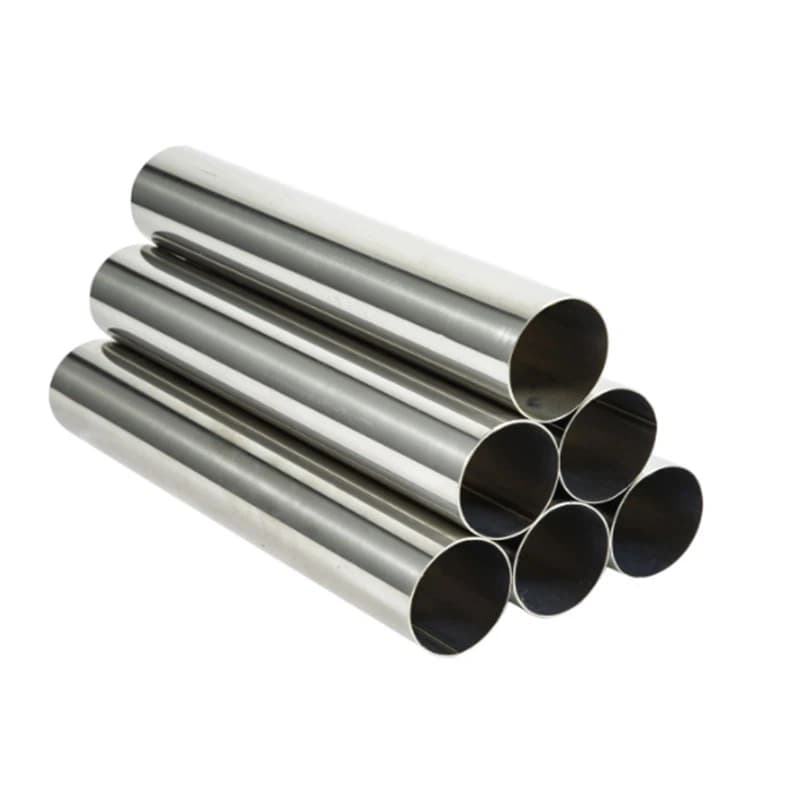
Stainless steel pipe resists corrosion because chromium in the alloy forms a thin, self-healing passive film on the surface; a chromium content of about 10.5% is the usual lower bound for stainless grades. Grade selection follows the service: the media, the chloride content, the temperature, and how the pipe will be welded and formed.
What the Passive Film Does, and Where It Fails
The film is thin and needs oxygen to repair itself. That is why stainless performs well in oxidising media and why it can fail in stagnant, low-oxygen crevices where the film cannot reform. Chlorides attack it locally, producing pitting and, under tensile stress and temperature, stress corrosion cracking. Heat tint from welding and embedded iron from carbon steel tools both leave sites that rust, so surface condition after fabrication matters as much as the grade.
Seamless or Welded
| Factor | Seamless | Welded |
|---|---|---|
| How it is made | Pierced and drawn from a solid billet | Rolled from plate or strip and welded |
| Wall uniformity | Uniform around the circumference | Good; the weld zone may vary |
| Sizes | Strong in small and medium bore | Wider diameter range, including thin wall |
| Pressure and cyclic duty | Preferred where no weld seam is wanted | Widely used where the code allows the weld factor |
| Cost and lead time | Higher price, longer lead | Lower price, shorter lead |
Both forms are standard; the choice is usually driven by size, wall and the code weld factor rather than by corrosion performance. Stainless wall thicknesses follow the ASME B36.19M schedules, so NPS 2 Schedule 40S is 60.3 mm outside diameter with a 3.91 mm wall. See stainless steel seamless and welded pipe for the sizes we hold.
Grades to Start From
| Grade | Why it is chosen | Typical service |
|---|---|---|
| 304 and 304L | General corrosion resistance; the low-carbon variant resists sensitisation after welding | Food and beverage, architectural, general chemical |
| 316L | Molybdenum improves resistance to chlorides and pitting | Marine, pharmaceutical, coastal and process lines |
| 321 | Titanium stabilised for service in the sensitising range | Heat exchangers and elevated-temperature duty |
| Duplex 2205 | Higher strength plus better resistance to chloride stress corrosion cracking | Offshore, desalination, aggressive process media |
Two starting points cover most enquiries: 304 stainless steel seamless pipe for general duty and 316L stainless steel pipe where chlorides or hygienic service drive the decision.
Where Stainless Pipe Is Specified
Chemical and petrochemical process lines
Food, beverage and dairy plant where cleanability is specified
Pharmaceutical and bioprocess piping with documented surface finish
Marine, offshore and desalination service exposed to chlorides
Water treatment and pumping installations
Architectural and structural work where appearance and weathering matter
Heat exchangers and condenser tubing
Limits to Check Before You Specify
Chloride pitting and stress corrosion cracking: 316L is more resistant than 304 but not immune, and temperature raises the risk.
Sensitisation in the heat-affected zone of welds on grades that are not low carbon or stabilised.
A magnet is not a grade test: cold work induces magnetism in austenitic grades, and ferritic and duplex grades are magnetic by structure.
Surface finish and cleanliness requirements for hygienic service, including post-weld cleaning.
Galling on threaded and flanged joints in austenitic grades.
Galvanic corrosion where stainless connects directly to carbon steel without isolation.
What to Confirm with Your Inquiry
Grade and standard, for example ASTM A312 TP304L or TP316L
Seamless or welded, size and schedule
Media, chloride content and operating temperature
Surface finish and any post-weld treatment
Certificate type and testing requirements
Send the service conditions with your inquiry and we will confirm the grade and form that fit.