
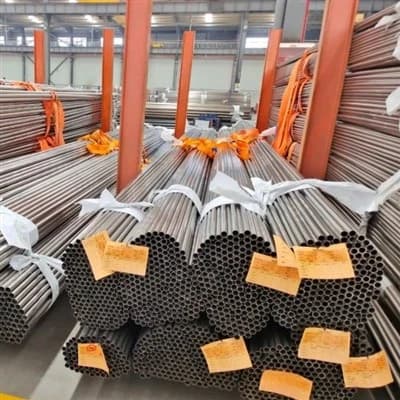
A reliable stainless steel mill is one whose paperwork matches its product, shipment after shipment. Prices are easy to compare; certificate scope, heat traceability and testing capability are not, and those are the three things that determine whether the material will pass your own incoming inspection.
Start with the Document Package
Ask for the package before you ask for a price. A mill that cannot produce these documents quickly usually cannot produce them at all:
- ISO 9001 certificate with the certified scope and expiry date
- Material test report (MTR) samples for the exact grade and product form you intend to buy
- The standards the mill works to, with editions: ASTM, ASME, EN or JIS as applicable
- Calibration certificates for the testing equipment used for acceptance
- Export references for your market, if you need them for your own qualification
Read the scope section, not only the cover page. A certificate for trading activity does not cover manufacturing, and a certificate for plate does not cover pipe.
Verify the Material Test Report
The MTR is where a claim becomes checkable. Open the sample and confirm that every field below is present and consistent:
| Field on the MTR | What it should tell you | Why it matters |
|---|---|---|
| Heat number | A unique melt identity that is also marked on the product | Without it, traceability to the melt is impossible |
| Standard and grade | The specification, edition and grade, for example ASTM A240 304 | Confirms which limits the results were judged against |
| Chemical analysis | Element values within the specified range for that grade | Grade substitution is the most common failure mode |
| Mechanical results | Tensile, yield, elongation and hardness, with the test method | Confirms the condition, not just the chemistry |
| Dimensions and quantity | Thickness or wall, width or diameter, length and piece count | Confirms the certificate covers what is being shipped |
| Certificate type | EN 10204 3.1 or 3.2, and the signatory | Determines whether the results are independently verified |
Mechanical testing definitions are standardised, for example in ASTM A370, and harmonised grade compositions in ASTM A959. Use those to check that the numbers on the report belong to the grade being offered.
Check the Grade and Form You Actually Need
"Stainless steel manufacturer" covers very different plants. A mill that rolls plate is not automatically a source for pipe, and a shop that makes flanges from purchased bar is not a melt source. Match the mill's route to your product form before you compare anything else: 304 stainless steel plate and 304 stainless steel seamless pipe come from different routes, and duplex 2205 flanges are forged components with their own specification.
Testing Capability and Inspection Access
Ask which tests are done in-house and which are subcontracted. In-house tensile, hardness, spectrometer analysis and hydrostatic or NDT capability is a good sign; a mill that subcontracts everything can still be acceptable, but you then need to know who did the testing and under which accreditation.
Then confirm inspection access in writing: can your inspector or a third party witness testing, can they inspect before shipment, and will the mill hold the material until release. Put the hold points in the purchase order.
Certifications: What They Cover and What They Do Not
- ISO 9001 covers the quality management system. It is not a product certificate.
- PED 2014/68/EU applies to pressure equipment placed on the EU market, and the material route it requires must be followed; it is not a general quality mark.
- CE marking applies where a specific EU directive or regulation covers the product. It is not a blanket requirement for every stainless steel product, and it should be requested only where it applies.
- ASTM or ASME compliance means the material meets a material specification. It does not by itself qualify the finished component.
Verify certificates with the issuing body, and check expiry dates. A certificate that cannot be verified is worth nothing in a dispute.
Red Flags
- Reluctance to provide a sample MTR for the exact grade and form
- Vague answers about which standards and editions the mill works to
- Certificates whose scope does not cover the product being offered
- Heat numbers that cannot be traced back to a marked product
- Prices that cannot be explained once testing scope, packing and certificate type are aligned
Comparing Offers
Compare only after the specification is identical on both sides: standard and edition, grade, dimensions and tolerance, condition, testing scope, certificate type, packing and marking, and delivery terms. A lower price that quietly drops intergranular corrosion testing or supplies a 3.1 certificate where a 3.2 was required is not a saving.
What to Confirm with Your Inquiry
- Grade, standard and edition, and the product form with dimensions and quantity
- Manufacturing route and condition or finish
- Required testing and certificate type (EN 10204 3.1 or 3.2)
- Inspection and audit access, including witness testing and pre-shipment inspection
- Marking, packing and export documentation requirements
- Delivery schedule and the Incoterms for the quotation
Send this list with your enquiry so that every quotation you receive covers the same scope and can be compared directly.



