Welding carbon steel pipe is controlled by the applicable code and the qualified procedure, not by a single preheat table. Agree the governing code, the welding procedure specification and its supporting qualification record, the filler classification and the examination scope before the first arc is struck.
What Governs the Weld
A welding procedure specification describing the process, filler, preheat, interpass limits and parameters, supported by a procedure qualification record.
The construction code for the line: ASME B31.3 for process piping, API 1104 for pipelines, or the structural welding code for building work.
Welder qualification for the process, position and material thickness.
Filler storage and handling, including baking and holding where low-hydrogen electrodes are used.
Base Grades You Are Likely Welding
Carbon content and strength set how the steel responds to welding heat, so identify the pipe specification first. The tensile figures below are the minimums required by the pipe specification; they are not weld metal requirements.
| Pipe | Specification | Minimum tensile strength | Typical service |
|---|---|---|---|
| A106 Grade B | ASTM A106 | 415 MPa | High-temperature process piping |
| A53 Grade B | ASTM A53 | 415 MPa | General mechanical and pressure service |
| API 5L Grade B | API 5L | 415 MPa | Line pipe, PSL1 or PSL2 |
| API 5L X52 | API 5L | 460 MPa | Transmission pipelines |
| API 5L X65 | API 5L | 535 MPa | High-pressure transmission lines |
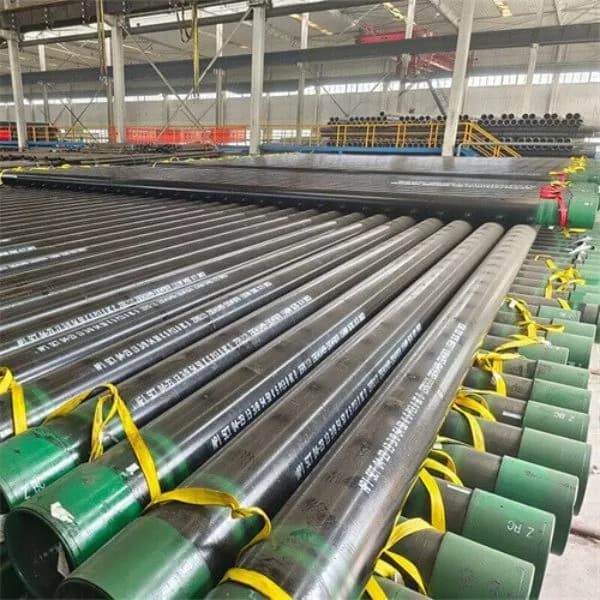
Carbon steel pipe is supplied both seamless and welded, and the two are not interchangeable on a specification. See seamless carbon steel pipe and carbon steel line pipe for the grades and standards we supply.
Preheat and Interpass Temperature
Preheat slows the cooling rate, gives dissolved hydrogen time to diffuse out, and reduces hardness in the heat-affected zone. The minimum required value is set by the code or the qualified procedure from the material group, the carbon equivalent and the thickness, not by a rule of thumb. State the preheat and interpass range on the WPS, measure it before each pass, and record it. Where a procedure does not name a value, ask for one rather than assuming.
Filler Metal Selection
| Base material | Commonly specified filler | Note |
|---|---|---|
| ASTM A106 Grade A or B | E7018 | Low-hydrogen; needs controlled storage |
| ASTM A53 Grade B | E6013 or E7018 | Choose by procedure and position |
| API 5L Grade B to X60 | E7018 or E8018 | Match the strength required by the design |
| API 5L X65 and above | E9018 or E10018 | Confirm against the qualified WPS |
| Root passes with GTAW | Matching bare filler rod | Used where root profile and cleanliness matter |
Treat the table as a starting point. The final filler is the one named on the qualified WPS for the material group, thickness and process you are running.
Joint Preparation
Bevel preparation normally follows ASME B16.25 so the welding end matches the fitting and the flange. Groove form follows wall thickness: light walls take a square or single-V preparation, heavier walls move to a compound or U preparation to keep the weld volume manageable. Whatever the groove, clean the bevel and the adjacent metal, control the root gap and alignment, and keep the fit-up consistent around the circumference.
Defects and What They Point To
Cracking: rapid cooling, high hydrogen, high restraint, or a preheat below the procedure minimum.
Porosity: moisture, contaminated base metal or filler, shielding gas problems, or too long an arc.
Lack of fusion: low heat input, poor fit-up, or an incorrect electrode angle.
Undercut: excessive current or a long arc at the edge of the bead.
Slag inclusions: incomplete cleaning between passes or an unsuitable electrode angle.
Examination and Records
Visual examination after each pass catches most problems while they can still be fixed cheaply. Surface examination by magnetic particle or liquid penetrant and volumetric examination by radiography or ultrasonics follow the extent required by the code and the line class. Keep the WPS, the PQR, the welder qualifications, the heat numbers and the examination reports together: they are what a client or inspector will ask for.
What to Confirm with Your Inquiry
Standard and grade, including the edition year
Size: NPS and schedule, or exact outside diameter and wall thickness
Quantity, length and end finish
Heat treatment, testing and certificate type required
Any third-party inspection scope or hold points
Send these details with your inquiry so the quotation matches what you actually need to buy.