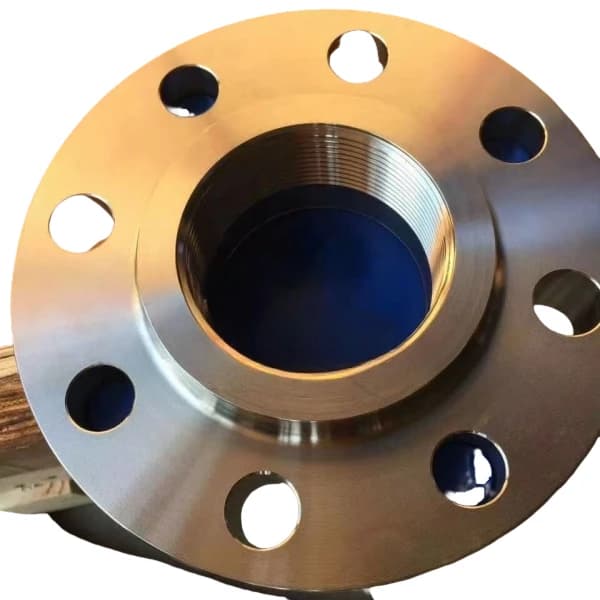
Product Description
ASTM A182 F22 is the forged 2.25Cr-1Mo (2¼ chromium, 1 molybdenum) low-alloy steel grade used for pipe flanges, forged fittings and valve parts in high-temperature pressure service. Flanges ordered under this grade carry UNS K21590 and the European designation W.Nr. 1.7380 (10CrMo9-10); ASME SA-182 F22 is the boiler-and-pressure-vessel-code twin of the same material.
The grade is normally supplied as Class 3, normalized and tempered, which is the default condition for piping and pressure parts. Class 1, annealed, is available on request for lower-hardness or forming applications. Flange dimensions, drillings and pressure ratings are not set by A182 — they come from ASME B16.5, ASME B16.47 or the drawing named on the order.
F22 sits above F11 (1.25Cr-0.5Mo) in creep strength and above carbon steel in resistance to high-temperature hydrogen attack, which is why it is a standard choice for main steam and hot reheat lines in conventional power plants and for hydrotreater, hydrocracker and synthesis-loop flanged joints. It is a low-alloy steel, not a stainless steel, and it is not selected for aqueous corrosion resistance. Confirm the governing specification, class, facing and heat-treatment requirement on the enquiry.
Chemical Composition and Product Form
The table below gives the ASTM A182 / ASME SA-182 heat-analysis limits for grade F22. The same window applies to Class 1 and Class 3, which differ only in heat treatment and in the acceptance values that follow from it.
| Element | ASTM A182 F22 (%) |
|---|---|
| Carbon, C | 0.05 – 0.15 |
| Manganese, Mn | 0.30 – 0.60 |
| Phosphorus, P | 0.040 max |
| Sulfur, S | 0.040 max |
| Silicon, Si | 0.50 max |
| Chromium, Cr | 2.00 – 2.50 |
| Molybdenum, Mo | 0.87 – 1.13 |
| Iron, Fe | Balance |
Two points matter at the enquiry stage. ASTM A336 F22 covers the same alloy for boiler and pressure-vessel forgings but holds phosphorus and sulphur to 0.025% max each and calls for Charpy V-notch testing, so the governing specification should be named rather than assumed. And F22V (2.25Cr-1Mo-0.25V) is a separate grade carrying an intentional vanadium addition for heavy-wall hydroprocessing equipment; it is not interchangeable with plain F22.
Mechanical Properties of F22 Class 1 and Class 3
F22 is supplied in two heat-treated conditions and the class must be stated on the enquiry, because the acceptance values are different. The figures below are the room-temperature requirements of ASTM A182.
| Property | Class 1 (annealed) | Class 3 (normalized and tempered) |
|---|---|---|
| Tensile strength, min | 415 MPa (60 ksi) | 515 MPa (75 ksi) |
| Yield strength, min | 205 MPa (30 ksi) | 310 MPa (45 ksi) |
| Elongation in 50 mm, min | 20% | 20% |
| Reduction of area, min | 35% | 30% |
| Hardness | 170 HBW max | 156 – 207 HBW |
| Typical use | Weld-overlay base metal, forming | Piping and pressure parts (default) |
ASTM A182 lists only Class 1 and Class 3 for F22. Class 2 is published for F11 and F12, not for F22, and an enquiry quoting “F22 Class 2” should be re-stated before the forging is released. Impact testing is not mandatory under A182; where low-temperature toughness matters it is added as a supplementary requirement on the order. For sour service, NACE MR0175 / ISO 15156 caps hardness at 22 HRC for this grade, which has to be built into the heat-treatment cycle rather than checked afterwards.
Above 450 °C the design is governed by creep rather than by room-temperature yield. Allowable stress is taken from ASME BPVC Section II Part D, not from the acceptance table above.
Flange Types, Sizes and Pressure Classes
F22 is forged into the full range of B16.5 flange types. The table summarises what the dimensional standards publish; the flange type, size and class actually required are set by the piping class on the project.
| Item | Coverage |
|---|---|
| Material standard | ASTM A182 / ASME SA182, Grade F22 (UNS K21590) |
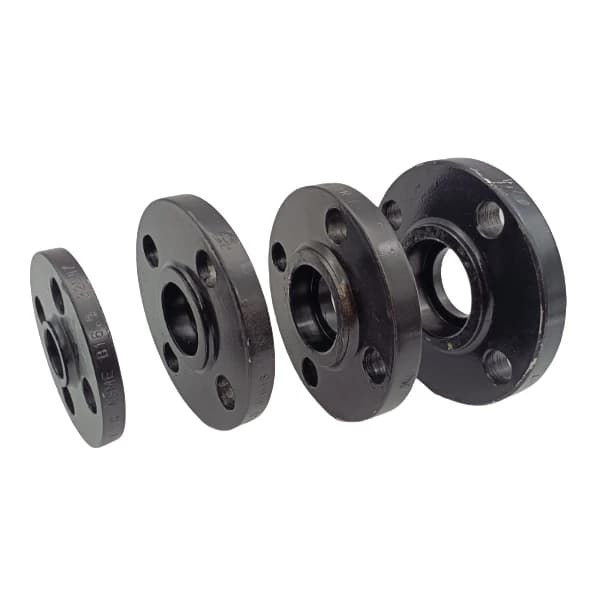
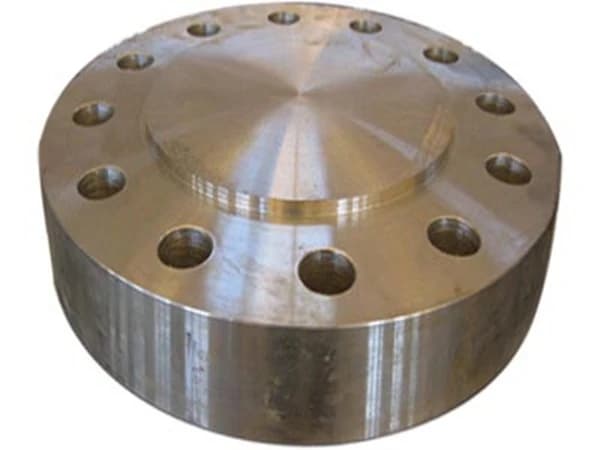
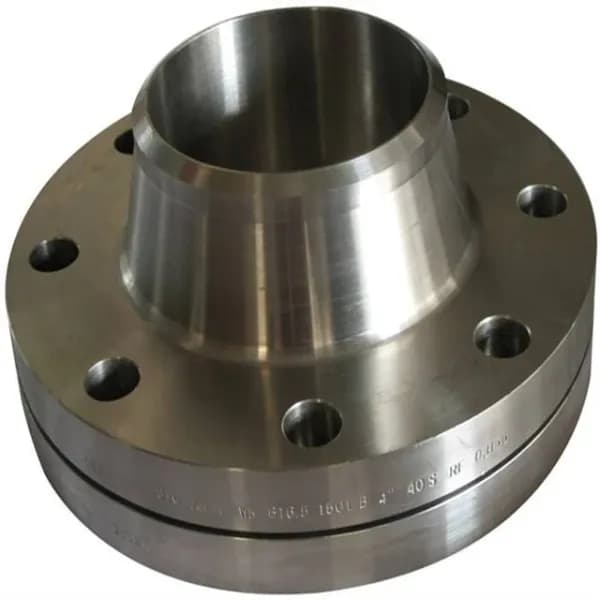
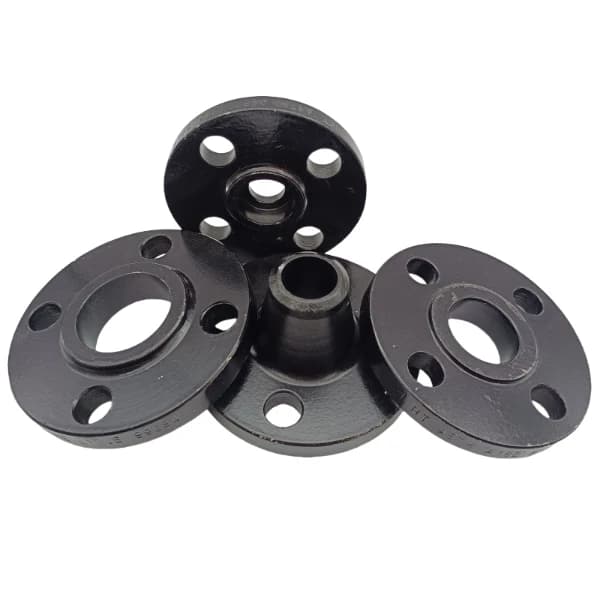
| Flange types | Weld neck, slip-on, blind, socket weld, threaded, lap joint, long weld neck, orifice, reducing, spectacle blind |
| Sizes, ASME B16.5 | NPS 1/2 to NPS 24 (DN 15 to DN 600) |
| Sizes, ASME B16.47 | NPS 26 to NPS 60 (DN 650 to DN 1500), Series A and Series B |
| Pressure classes | ASME B16.5 Class 150, 300, 400, 600, 900, 1500, 2500; ASME B16.47 classes per series |
| Facings | Raised face (RF), ring type joint (RTJ), flat face (FF) |
| Weld end preparation | Butt-welding ends to ASME B16.25; bore matched to the pipe schedule |
| Orifice flanges | ASME B16.36, using B16.5 dimensions |
| Certification | EN 10204 3.1 or 3.2 mill test certificate; PMI and hardness survey on request |
B16.5 and B16.47 are separate dimensional families rather than one catalogue, and Series A and Series B of the same size and class generally will not bolt together — the series has to be stated explicitly. A nominal size match does not prove a mating fit either: outside diameter, bolt circle, number and diameter of holes, thickness, hub, bore and facing all have to agree with the mating component.
What the Pressure Class Actually Means
It is common to see “Class 2500” read as “2500 psi”. The class number is a dimensionless rating index, not a pressure. In ASME B16.5 the maximum allowable non-shock working pressure for a class is read from the pressure–temperature table for the flange’s material group, and it falls as the design temperature rises. F22 forgings are listed in B16.5 material group 1.10, alongside A217 WC9 castings and A387 Grade 22 plate, and the group’s rating tables extend to 1200 °F (650 °C), with Class 150 ending at 1000 °F (538 °C).
Two consequences follow. In ASME B16.5, Class 2500 is published only up to NPS 12 — larger sizes move to ASME B16.47. And the limiting pressure of a joint may be set by the connected pipe, valve, gasket or bolting rather than by the flange itself. Specify the class, not a psi figure, and read the rating for the design and upset temperatures from the current edition of the standard.
How F22 Compares with F11, F91 and F22V
F22 is one rung on the chrome-moly ladder. The table below maps position within the family; it is not a source of allowable stresses, which come from the design code.
| Forging grade | Nominal composition | Where it is used |
|---|---|---|
| F11 | 1.25Cr-0.5Mo | Hot process and steam lines below about 593 °C where F22’s extra creep strength is not needed |
| F22 | 2.25Cr-1Mo | Main steam and hot reheat, hydroprocessing and synthesis loops — the grade on this page |
| F22V | 2.25Cr-1Mo-0.25V | Heavy-wall hydroprocessing reactors and closure forgings |
| F5 | 5Cr-0.5Mo | Higher-chromium refinery service with sulfidic corrosion |
| F9 | 9Cr-1Mo | High-temperature erosive refinery service |
| F91 | 9Cr-1Mo-V-Nb | Supercritical steam; higher creep strength, but stricter welding and heat treatment |
Watch the UNS designations when comparing published tables. Third-party compilations routinely mix the pipe (A335 P-series) and forging (A182 F-series) numbers for the same chemistry, and more than one web table prints a pipe number against a forging grade. If the UNS designation is contractually important, take it from the edition named on the purchase order rather than from a reference page.
High-Temperature Steam, Hydrogen Service and Corrosion Limits
Two service conditions drive the specification of F22, and one misreading of the grade is worth correcting up front.
High-temperature steam. The full percent of molybdenum gives F22 creep strength a clear step above F11. It is a standard material for main steam and hot reheat headers, hot boiler connections and turbine leads in conventional fossil plants, in a selection range up to 550–595 °C, which is a selection practice and not a rating. Above 450 °C, creep rather than yield strength governs the design, so allowable stress is taken from ASME BPVC Section II Part D or the applicable design code, not from the acceptance values on this page.
Resistance to high-temperature hydrogen attack. At elevated temperature and hydrogen partial pressure, carbon in steel can react with hydrogen to form methane, which cannot diffuse out of the metal and leads to internal fissuring and blistering. The 2.25% chromium in F22 ties up the carbon and raises the temperature and hydrogen partial pressure at which this becomes a risk. The permissible combinations are mapped by the Nelson curves in API 941, where 2.25Cr-1Mo sits above both carbon steel and 1.25Cr-0.5Mo. This is why hydrotreater and hydrocracker reactor loops, ammonia and methanol synthesis circuits and hydrogen recycle compressor piping commonly specify F22 flanges together with A335 P22 pipe and A234 WP22 fittings as a matched set.
What F22 is not. With 2.25% chromium, F22 is a low-alloy steel — well below the 10.5% chromium needed to form a passive surface film. It is not a stainless steel and offers no useful resistance to aqueous corrosion: in ambient wet service it rusts much as carbon steel does. Its alloy content is aimed at creep strength and hydrogen resistance at high temperature, not at corrosion. For wet corrosion, specify a 300-series or duplex stainless grade; for hot sulfidic refinery streams, the higher-chromium F5 and F9 grades are the next step.
Heat Treatment, Welding and PWHT
F22 is genuinely air-hardening: the heat-affected zone of a weld quenches itself hard in still air, so fabrication has to be planned rather than improvised. Every F22 forging is heat treated, and the flange is supplied in that condition. Typical fabrication requirements are summarised below.
| Item | Typical requirement |
|---|---|
| Heat treatment of the forging | Normalize and temper, or quench and temper; Class 3 tempering at 675 °C (1250 °F) minimum |
| Preheat before welding | Typically 200–300 °C (392–572 °F) |
| Consumables | Matching 2.25Cr-1Mo: E9018-B3 (SMAW), ER90S-B3 (GTAW / GMAW) |
| Post-weld heat treatment | Mandatory for the 2.25Cr class — typically 690–750 °C (1275–1380 °F) |
| PWHT temperature limit | Must stay below the tempering temperature applied to the parent forging |
| Practice | Low-hydrogen consumables, controlled interpass temperature, full traceability of heat numbers |
Two of these belong on the purchase order from the start. Post-weld heat treatment is required for the 2.25Cr class by ASME B31.1 and B31.3 at essentially all practical thicknesses, so it has to be in the construction schedule rather than added afterwards. And the PWHT temperature must remain below the tempering temperature used on the parent forging: over-tempering at the joint destroys the certified mechanical properties of the flange even though the flange itself was correct when it left the forge.
Where a piping class permits slip-on flanges they cost less and are simpler to fit, but creep-range and cyclic services are frequently restricted to weld neck designs, whose full-penetration butt weld can be radiographed and which resist thermal fatigue better than fillet welds.
For heavy-wall or long-life high-temperature service the order may also carry temper-embrittlement controls — a J-factor limit and a Bruscato X-bar limit for weld metal — with step-cooling and Charpy testing. These are supplementary requirements: they are not part of base A182 and must be stated on the enquiry.
Applications of ASTM A182 F22 Flanges
Typical applications include:
- Main steam and hot reheat headers, hot boiler connections and turbine leads in conventional and HRSG power plants.
- Hydrotreater, hydrocracker and reformer reactor loops and hydrogen recycle compressor piping, where the flanged joint has to sit inside the API 941 Nelson curves.
- Ammonia and methanol synthesis circuits, and high-pressure separator and hot flash drum nozzle connections.
- High-temperature process piping in refineries and petrochemical plants, generally as part of a matched 2.25Cr-1Mo system with A335 P22 pipe and A234 WP22 fittings.
Design temperature, hydrogen partial pressure and any sour-service requirement are the three inputs that decide whether plain F22 is adequate or whether F22V or a 9Cr grade is needed. Confirm them before fixing the grade and heat treatment.
Ordering Information
To quote an ASTM A182 F22 flange, the following information is needed:
- Grade and class — ASTM A182 F22 Class 1 or Class 3. Class 3 is the default; there is no Class 2 for F22.
- Flange type and facing — weld neck, slip-on, blind, socket weld, threaded, lap joint, long weld neck or orifice; RF, RTJ or FF.
- Size and pressure class — nominal size together with the dimensional standard: ASME B16.5, ASME B16.47 Series A or Series B, ASME B16.36, or a drawing.
- Bore or pipe schedule — required for weld neck and long weld neck types so the bore matches the mating pipe.
- Heat treatment and PWHT notes, plus any hardness or NACE MR0175 / ISO 15156 requirement.
- Quantity, marking, destination and documentation — EN 10204 3.1 or 3.2 mill test certificate, PMI, hardness survey and third-party inspection as applicable.
State the required delivery date on the enquiry so that the schedule can be confirmed with the quotation. Flanges are marked with grade, size, class and heat number for traceability.
Related pages: the full flange range for other material grades and flange types, the alloy steel pipe range for the matching A335 P22 line, and the ASTM A182 F347 flange page for another forged A182 grade.
Common Questions About ASTM A182 F22 Flanges
Is F22 the same as 2.25Cr-1Mo and UNS K21590?
Yes. ASTM A182 F22, 2.25Cr-1Mo (2¼Cr-1Mo), UNS K21590 and W.Nr. 1.7380 / 10CrMo9-10 all refer to the same forged low-alloy steel, and ASME SA-182 F22 is the code twin of the ASTM designation. The pipe and fittings specified alongside it are A335 P22 and A234 WP22 — same chemistry in a different product form.
What is the difference between F22 Class 1 and Class 3?
Heat treatment and the strength that follows from it. Class 1 is annealed and is held to 415 MPa (60 ksi) minimum tensile and 205 MPa (30 ksi) minimum yield, with hardness capped at 170 HBW. Class 3 is normalized and tempered and is held to 515 MPa (75 ksi) minimum tensile and 310 MPa (45 ksi) minimum yield, with a 156–207 HBW band that certifies the heat treatment. Class 3 is the default for piping and pressure parts; Class 1 suits lower-hardness or forming applications such as weld-overlay base metal.
Does F22 have a Class 2?
No. ASTM A182 publishes only Class 1 and Class 3 for F22; Class 2 exists for F11 and F12. Buyers often carry the habit across from F11. If an enquiry quotes “F22 Class 2”, the class should be re-stated before the forging is released.
Is Class 2500 the same as 2500 psi?
No. The class number is a dimensionless rating index. The maximum allowable working pressure of a Class 2500 flange depends on its material group and on the design temperature, and is read from the ASME B16.5 pressure–temperature tables; F22 forgings sit in material group 1.10. In B16.5, Class 2500 is published only up to NPS 12. Specify the class rather than a psi figure, and take the rating from the current edition of the standard.
Is ASTM A182 F22 a stainless steel, and does it resist corrosion?
No. With 2.25% chromium, F22 is a low-alloy steel, well below the 10.5% chromium needed to form a passive surface film. It rusts in ambient wet service much as carbon steel does and should not be specified for aqueous corrosion resistance. Its alloying is aimed at creep strength and resistance to high-temperature hydrogen attack. For wet corrosion, choose a 300-series or duplex stainless grade.
Does F22 require post-weld heat treatment?
Yes. F22 is air-hardening, so the heat-affected zone of a weld quenches itself hard, and ASME B31.1 and B31.3 require post-weld heat treatment for the 2.25Cr class at essentially all practical thicknesses — typically 690–750 °C (1275–1380 °F). The PWHT temperature must remain below the tempering temperature applied to the parent forging. Plan preheat, matching 2.25Cr-1Mo consumables and PWHT into the fabrication schedule together.
What information is needed for a quotation?
Grade and class; flange type and facing; size and pressure class together with the dimensional standard; bore or pipe schedule for weld neck types; heat treatment and PWHT notes; quantity and destination; and the certification required — EN 10204 3.1 or 3.2, PMI, hardness survey or third-party inspection.