
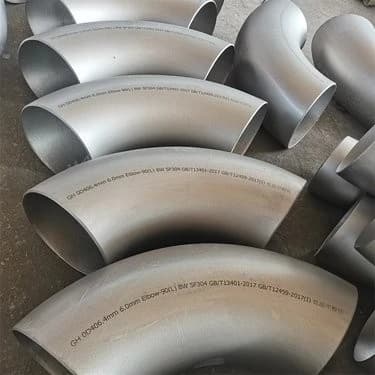
A stainless pipe fitting is specified by material grade, product form, end connection and governing standard. Type 304 and Type 316 are not interchangeable grades, and a press or grooved joint is not the same product as a butt-weld fitting. Corrosion performance still depends on the service, the finish and the standard named on the order.
Lock the grade and the standard first
304 and 304L are the common general-purpose austenitic grades. 316 and 316L add molybdenum and are the grades normally named when chloride exposure or a more aggressive corrosion service is expected. The L grades are the low-carbon versions used where welding and corrosion resistance both matter. The piping class has to say which one applies.
Do not carry carbon-steel or low-alloy pipe grades such as 20G, 16Mn or 12Cr1MoV into a stainless fitting specification. Those are different material families. A duplex, super-austenitic or nickel-alloy fitting is also a different inquiry, with its own grade and standard.
The fitting standard does not replace the material standard. A butt-weld fitting can be a wrought fitting whose dimensions follow ASME B16.9 while its grade follows a material standard such as ASTM A403. Threaded and socket-weld forged fittings are a different family. Confirm the current edition rather than assuming a clause from a catalogue.
Match the end connection to the joint you actually need
Butt-weld ends are prepared for a full-penetration weld and must match the pipe outside diameter and the specified wall. Socket-weld ends take the pipe into a socket and use a fillet weld. Threaded ends need a named thread form. These three are not optional descriptions of one fitting.
Press-connect fittings are a mechanical joint made with a press tool and a seal. Grooved fittings are another mechanical system, used with a coupling and an elastomer gasket. A supplier claim about installation speed, a pressure test on one joint, or a gasket temperature range belongs to that manufacturer's listed system. It is not a property of stainless steel, and it does not convert the fitting into an ASME B16.9 butt-weld fitting.
Flanged ends are a third decision. The flange type, class and facing follow the flange standard, while the fitting body still needs its own grade. See the site's ASME B16.5 stainless steel flanges when the joint is flanged rather than welded.
A grade name does not prove hygiene, fire rating or life
Potable-water use needs the hygiene approval named by the destination market. Fire-protection use needs the listing or standard the project specifies. Neither follows automatically from the words 304 or 316.
Published life figures, failure percentages and cost savings are not material properties. A three-year exposure anecdote and a tensile number without the product form, test method and standard are not acceptance values. Check the mill test certificate for the heat, the grade, the chemical analysis and the mechanical results the material standard requires.
Market certifications are also order requirements, not decoration. Ask which of CE, UPC, WaterMark, a drinking-water approval or another named approval the project actually requires. REACH duties apply to products placed on the EU market, but a fitting page cannot claim that every substance list has been cleared unless the seller provides that declaration.
Fields that make the fitting quotation comparable
- Grade, such as 304, 304L, 316 or 316L, and the material standard.
- Fitting form: elbow, tee, reducer, cap or other named form.
- End type, nominal size, schedule or wall, and quantity.
- Governing dimensional standard and edition.
- Required certificate, third-party inspection and any listed approval.
Related published pages are 2 inch stainless steel pipe fittings, stainless steel butt-weld fittings and 316L stainless steel butt-weld elbows. Use those pages for the product identity and this page for the grade and end-connection checks.



