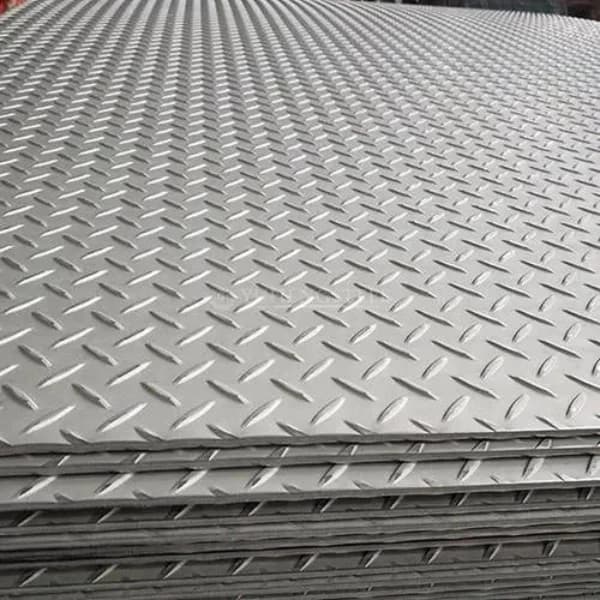
Product Description
Carbon steel tread plate is a hot-rolled carbon steel plate with a raised lug pattern rolled into one surface, giving dependable grip underfoot in areas where slipping is a risk. The same product is widely known as carbon steel diamond plate, checker plate or floor plate, depending on the pattern style and regional usage. This product family is typically supplied in Q235/Q235B and Q345/Q345B structural carbon steels; the governing standard and exact grade for each order are confirmed before production, and comparable carbon steel floor plate in international markets is commonly referenced to ASTM A786.
The raised pattern provides slip resistance through its mechanical profile rather than any applied coating, so actual anti-slip performance in service depends on the pattern type, plate thickness, load and installation conditions. Because the base material is structural carbon steel, the plate is weldable and cold-formable, which keeps fabrication straightforward for floors, stair treads, ramps and enclosures. For wet or outdoor service, a protective finish such as galvanizing or painting is normally specified and confirmed per order.
Specifications
Product family reference values — final grade, pattern and dimensions for each order are confirmed at quotation:
| Item | Reference |
|---|---|
| Material | Q235 / Q235B / Q345 / Q345B structural carbon steel; equivalent standards to be confirmed per order |
| Product form | Hot-rolled carbon steel floor plate with raised pattern (tread plate) |
| Pattern | Diamond or checker raised lug pattern; available pattern tooling confirmed per order |
| Thickness | 0.45-100 mm. Sizes outside this range are made to the ordered dimensions. |
| Width | Standard widths 1000 mm and 1219 mm; other widths up to 1500 mm. Sizes outside this range are made to the ordered dimensions. |
| Length | Standard lengths 3 m and 6 m; other lengths up to 12 m. Sizes outside this range are made to the ordered dimensions. |
| Surface | As-rolled mill finish; galvanized or painted finish subject to order confirmation |
| Reference standard | ASTM A786 referenced for comparable carbon steel floor plate; applicable standard confirmed per order |
Reference mechanical values for a comparable commercial-quality carbon steel floor plate item: yield strength about 33,000 psi (≈230 MPa) and tensile strength about 60,000 psi (≈415 MPa). These values come from a single stocked item and vary with the actual grade and governing standard, so they are not a guarantee for all sizes — request the mill test certificate or the applicable standard values with your enquiry.
Material Characteristics
The tread pattern is formed during hot rolling, so the anti-slip profile is integral to the surface and cannot peel or wear away the way an applied coating can. The Q235/Q345 family of structural carbon steels offers good weldability and cold-forming behaviour, supporting load-bearing floors, stair treads and vehicle decks with conventional cutting, welding and fabrication practice. Because carbon steel corrodes in humid or outdoor environments, specify hot-dip galvanizing or an industrial paint system where long-term weather exposure is expected; the suitable coating system for the application is confirmed at order stage.
Applications
Carbon steel tread plate is used wherever secure footing and a durable wearing surface are needed: industrial flooring and workshop floors, stair treads, ramps and loading areas, walkways and platforms, truck and trailer beds, running boards, trench covers, and general structural or industrial fabrications. It is an economical choice where corrosion protection can be handled by coating rather than by the base alloy. For flat structural and machinery plate applications without a tread requirement, see carbon steel plate and Q235 carbon steel plate.
Ordering Information
To receive an accurate quotation, please provide: the pattern required (diamond, checker, or a drawing reference), the grade or an equivalent standard (for example Q235/Q235B or Q345/Q345B), plate thickness, width and length, total quantity, and the surface treatment required. Include any documentation requirement — such as a mill test certificate — together with the service environment, so the most suitable grade and finish can be proposed. Where a dimension sits at the limit of standard rolling practice, it will be confirmed with the mill before order acceptance.